

If you’re wondering about ADHD sex drive, here’s the short answer: attention-deficit/hyperactivity disorder (ADHD) can be associated with differences in sexual function, but it does not predict whether your desire will be high, low, or somewhere in between. Some studies find more sexual difficulties or distress among adults with ADHD. Others find differences in sexual behaviors without a difference in sexual dysfunction. Your health, medications, mood, relationships, and reproductive life stage also deserve attention.[1] [2] [3] [4]
Looking for one explanation and finding several possibilities can be frustrating. Wanting sex but losing focus is different from having less interest in the first place. A partner’s concern about frequency might not match your own. And when something has changed, you may simply want to understand why you don’t feel like yourself.
I want to help you separate those experiences rather than put all of them under “low libido.” We’ll look at what researchers have measured, where hormones and medication fit, and how to describe the change so you can get useful support.
Your sex drive is not a test of how much you love someone, how well you manage ADHD, or whether your body is working correctly.
You're in ✦
Check your inbox. Day one is on its way.
Your ADHD Hormone & Brain Sync Guide is heading to your inbox now — look for it from Dr. Brighten in the next few minutes.
New Book · Out October 6, 2026
The full system behind the guide
These five days are the doorway. ADHD and Women is the whole map — the ADHD-Hormone Profile and what to do across every hormonal transition.
Pre-Order ADHD and WomenADHD Sex Drive: What Does the Research Show?
Researchers have measured several different experiences: interest in sex, physical arousal, orgasm, pain, satisfaction, and distress about sexual difficulties. A score that combines these is not simply a measure of how much someone wants sex. That distinction explains some of the apparently conflicting ADHD findings.[5] [6] [7]
Two clinic studies suggest that sexual concerns deserve attention during ADHD care. In one, researchers compared 63 adults with ADHD and 66 controls, including 31 women in each group; the women with ADHD scored worse across the measured sexual-function domains. A second screened 136 adults at a Dutch ADHD clinic for sexual difficulties. These clinical samples cannot establish causation or tell us how common the concerns are among everyone with ADHD.[8] [9]
A 2024 community study adds an important piece: distress. Among 943 people, including 106 classified with presumptive ADHD, ADHD symptoms were associated with worse sexual function, orgasm difficulties, and greater sexual distress. The ADHD classification was based on study measures, not a full clinical evaluation. As a snapshot in time, the study shows an association rather than what caused the difficulties.[10]
Then there’s the finding that doesn’t fit a simple low-desire story: a 2022 online survey found more hypersexual behaviors in its ADHD group, but no group difference in sexual dysfunction or risky sexual behaviors. The full-text methods describe 139 participants with ADHD and 67 without. Recruitment and self-report limit how broadly we can apply the findings.[11]
“Hypersexual behaviors” needs some explanation here. That survey used the Hypersexual Behavior Inventory, which asks about attempts to control sexual thoughts and behaviors, using sex to cope with unwanted emotions or stress, and unwanted consequences of sexual behaviors. It does not just count how often someone wants sex. Higher questionnaire scores therefore should not be translated into “people with ADHD naturally have a higher libido.”[12]
Here’s what those studies can—and cannot—tell you:
| Research finding | Useful interpretation | What it does not mean |
|---|---|---|
| Lower sexual-function scores in some ADHD samples | Ask about desire, arousal, orgasm, comfort, and satisfaction separately. | Everyone with ADHD has low libido. |
| Greater sexual distress in a community sample | The experience and its emotional impact both deserve care. | An ADHD questionnaire explains the cause of a sexual concern. |
| More hypersexual behaviors in an online survey | Sexual experiences within ADHD populations vary. | High desire and hypersexual behaviors are interchangeable. |
| Different findings across studies | Sample, measurement, and context influence the answer. | Your experience is invalid if it differs from a study average. |
The practical message is not to decide which study describes you best. It’s to recognize that ADHD belongs in a sexual-health conversation without becoming the automatic explanation for everything in it.
For you, the useful question is whether anything feels unwanted, difficult to control, painful, or upsetting—not whether your desire resembles a group average. If you enjoy a high level of sexual interest and it fits your life, a research label is not a reason to regard yourself as unwell. If behavior is interfering with responsibilities or feels outside your control, that concern deserves a conversation even when your level of desire itself is comfortable.
For broader background on the condition, see ADHD in women. Here, I’m keeping the focus on what changed in your sexual experience and what may help you understand it.
What Does Sex Drive Mean?
Sex drive, or libido, usually means interest in or motivation for sexual activity. It isn’t a single on/off switch that controls everything that happens during sex. Desire, physical arousal, orgasm, and comfort are related but distinct parts of sexual experience. Researchers measure them separately for a reason.[13] [14]
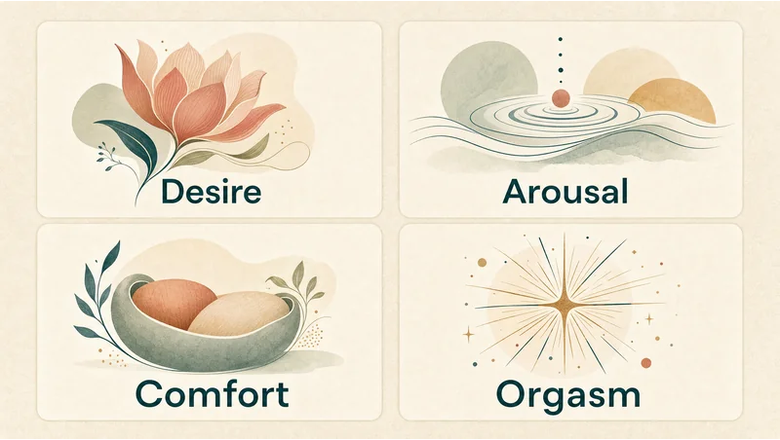
For example, you might want intimacy but find that touch hurts. You might feel physically aroused without wanting sexual activity. Or you might enjoy being close to a partner but struggle to reach orgasm. Calling each of those “low sex drive” can make it harder to describe the support you need.
Desire can also emerge in different ways. Some people experience interest before any sexual interaction. For others, interest sometimes develops in response to an enjoyable, wanted context. Neither pattern describes everyone, and an individual can experience both.
An experimental study of 100 women in relationships with men found that the connection between genital arousal and partner-specific desire varied with sexual-interest/arousal symptoms and relationship satisfaction. It was not an ADHD study. It helps illustrate why arousal and desire shouldn’t be treated as identical, not why someone with ADHD has a particular libido.[15]
Physical arousal is not consent, and responsive desire is not a reason to push yourself through unwanted sex. You can be curious about what feels good without promising that you will want more. You can also stop, even if you initially wanted sexual activity.
When I suggest getting more specific about the concern, I mean asking: Is the change in interest, attention, sensation, comfort, orgasm, or how you feel about the experience afterward? That’s a more useful starting point than deciding your libido is “wrong.”
What Else Could Be Affecting Desire?
ADHD may be one part of the picture. Relationship difficulties, stress, anxiety, depression, certain medicines, pregnancy and postpartum changes, menopause, and physical health conditions can also contribute to low desire. You do not have to choose between considering ADHD and checking for something else.[16]
Attention, emotional strain, and the experience of sex
The 2024 community study links ADHD symptoms with sexual-function difficulties and distress. Its authors discuss inattention, distractibility, and emotional regulation as possible contributors. That is different from proving that distraction causes low desire or that improving focus will resolve a sexual concern.[17]
If attention is what bothers you, describe that directly. “I want to be here, but my mind keeps jumping to tomorrow” tells a clinician or therapist something different from “I don’t want sex.” Notice whether the problem is present across situations or mostly when you’re exhausted, worried, uncomfortable, or feeling pressured.
Anxiety can be part of this discussion, too, but it should not become a catch-all explanation. You deserve to have pain, medication effects, and other health concerns considered rather than dismissed because you also have a mental health diagnosis.
Medication changes
A change after starting a medicine or changing a dose is worth bringing to the prescriber. Include all your medicines, not just ADHD treatment: antidepressants and some other medicines can affect desire or sexual function.[18]
Some ADHD medicines have documented sexual side effects. A pooled analysis of placebo-controlled atomoxetine trials found more sexual and urinary side effects among adult men taking atomoxetine. Among female participants, reported side effects were generally similar in the medication and placebo groups. The authors cautioned that these problems were likely underreported, so this is not evidence that women cannot experience them. Atomoxetine findings also do not predict the effects of stimulants or other ADHD medicines.[19]
I would not recommend skipping doses, stopping medication, or changing the schedule on your own to test your sex drive. Instead, bring a timeline: what you take, what changed, and when you noticed it. Your prescriber can help weigh a possible side effect against treatment benefits and other explanations.
Useful questions include: “Is this a known effect of this particular medicine?” “Could another prescription or health issue be contributing?” and “How will we follow up if the concern continues?” You don’t have to decide in advance that the medication is responsible. Reporting a possible side effect is part of asking for care, not a commitment to abandon treatment that otherwise helps you.
Menstrual-cycle changes and PMDD
If you menstruate, cycle patterns may be worth noting. A small study tracked hormones and ADHD symptoms for 35 days in 32 regularly cycling young women. It found associations between reproductive steroids and next-day ADHD symptoms. It did not measure libido or sexual function.[20]
A 2025 online survey of 715 people assigned female at birth, ages 18–34, found more provisional premenstrual dysphoric disorder, or PMDD, among groups with self-reported or questionnaire-defined ADHD. “Provisional” matters: a screening questionnaire does not establish the diagnosis. That study did not examine sexual desire either.[21]
These are studies of ADHD symptoms and provisional PMDD, not sexual desire. A pattern you notice is still worth discussing: tell your clinician which symptoms recur, when they begin, and whether they settle after your period. My guides to ADHD and hormones and the ADHD–PMDD connection cover that broader context.
Hormones are part of the story, not a single explanation
General desire research also resists a simple “more estrogen equals more desire” formula. In an older prospective study of 168 women, sexual interest varied across cycle phases but did not correlate with measured urinary estrogen or pregnanediol. A randomized trial of 126 healthy young adults found that a short-term estradiol increase had little effect on desire and no effect on orgasm frequency.[22] [23]
Neither was an ADHD study, and the estradiol trial was not a test of menopause treatment or clinical low desire. These studies don’t show that hormones never matter. They show why one hormone cannot explain everyone’s experience. For a fuller discussion, see how desire and arousal change with the menstrual cycle.
Sensory preferences, comfort, and life stage
A study of 45 adults, including 23 with ADHD, found differences in self-reported sensory profiles. It did not study sex or test whether sensory differences caused sexual difficulties.[24]
Notice whether a sound, texture, light, or type of touch feels distracting or uncomfortable, and describe that preference plainly. “The music distracts me” is useful information about what you enjoy. Pain, burning, or dryness calls for a different conversation: don’t assume physical symptoms are simply a sensory preference.
Pregnancy, breastfeeding, and menopause can be associated with changes in sexual desire or vaginal dryness. Mention these transitions if they coincide with your concern.[25] [26]
For changes in attention or other ADHD symptoms in midlife, see ADHD during menopause. For changes in sexual comfort or intimacy during that transition, start with perimenopause and intimacy.
How to Describe the Change
You don’t need a perfect symptom diary to ask for help. A few notes on your phone or a short list on paper can be enough to start. If tracking adds stress or becomes another task you feel you’re failing, simplify it.

I suggest starting with these questions:
- When did it begin? Was the change sudden, gradual, or something you’ve noticed for years? Was there a new medicine, illness, pregnancy, relationship change, or stressful period around that time?
- What feels different? Is it desire, physical arousal, staying engaged, reaching orgasm, comfort, satisfaction, or distress? More than one answer is fine.
- When does it happen? Across situations or only in some? If relevant, does it coincide with a cycle phase, postpartum changes, poor sleep, or menopause symptoms?
- Whose concern is it? Is the change unwanted for you, or are you mainly worried because a partner wants something different? Both can prompt a conversation, but they are not the same problem.
- What would useful support look like? Less pain? Feeling more present? Understanding medication effects? Talking without blame? You get to name the goal.
A description might sound like: “I still want intimacy, but I started having pain a few months ago. Now I feel worried beforehand.” Or: “My interest changed after a prescription change, and I’d like to review whether they could be connected.” Start with the words that fit your experience; medical terminology can come later.
You can also tell the clinician what has stayed the same. Wanting closeness but not penetration, having desire in some situations but not others, or feeling comfortable with a lower frequency all add context. There is no need to make the story fit a single category before your appointment.
If you’re worried about being brushed off, bring your main question in one sentence and ask for time to discuss it. You can request a separate visit if a routine medication check doesn’t leave enough room. It’s reasonable to ask what the next step will be if the first explanation or treatment doesn’t fit.
This is preparation for a conversation, not a way to diagnose ADHD, PMDD, a hormone imbalance, or a sexual disorder. There isn’t a number of times per week that can do that work for you.
What Support May Help?
The best starting point depends on what you’ve identified. A sexual concern may call for medical care, a medication review, therapeutic support, or more than one of these. General low-libido guidance also recommends matching care to the underlying issue rather than choosing the same treatment for everyone.[27]
Ask for care when something hurts or has changed
If desire has changed persistently or the change worries you, make an appointment. Describe pain, dryness, unusual discharge, or bleeding rather than treating those as side notes. Vaginal dryness that affects daily life, persists despite self-care, or comes with unusual discharge or bleeding should be assessed.[28]
For dryness, water-based lubricants and vaginal moisturizers may help, but they aren’t a substitute for evaluating persistent symptoms. Products intended for vaginal use are different from ordinary skin lotions.[29] My article on why sex hurts explains why pain deserves its own conversation rather than a recommendation to “just relax.”
Tell the clinician about relevant health conditions and other symptoms. They can decide whether an examination, medication review, or targeted testing makes sense. Having ADHD does not automatically mean you need a hormone panel or a supplement protocol for libido.
Before trying something marketed as a libido supplement, I’d ask what problem it is meant to address and what evidence supports it for someone in your situation. The studies discussed here do not establish a supplement treatment for ADHD-related desire changes. A product described as “hormone balancing” is not an explanation for pain, distress, or a change after a prescription adjustment.
Discuss distress and relationship communication
If the difficult part is worry, shame, pressure, or talking about different preferences, an appropriately qualified therapist or sex therapist may be a useful place to discuss it. The goal isn’t to train yourself to meet someone else’s preferred frequency. It’s to understand what you want, what feels comfortable, and where communication has become difficult.
When it feels safe to talk with a partner, be specific: “I want closeness, and I don’t want us to assume that means intercourse every time.” You can discuss affection, touch, and boundaries without promising a particular outcome. If you feel afraid, coerced, or unable to say no safely, seek confidential individual support rather than treating that as a libido problem to solve together.
You can also choose what not to share. A symptom timeline for your clinician does not have to become a report you give a partner, and you don’t have to justify a boundary with a medical explanation. If you seek therapeutic support, ask about the professional’s training in sexual health and experience discussing ADHD. Clarify whether you want individual support, a conversation about differing desires, or help with a specific sexual concern.
Try low-pressure adjustments, not a performance plan
You might choose a quieter setting, ask for a different kind of touch, or leave room for closeness without a deadline. These are personal comfort experiments, not established treatments for ADHD-related libido concerns; the sensory study did not test them.[30]
Make the experiment small enough to be useful. If background noise bothers you, try a quieter room rather than changing everything about the encounter. Agree that either person can pause or stop. Afterward, “I felt less distracted” is enough of an observation—you don’t need to turn it into a score for arousal or a target for next time. If nothing changes, that information belongs in the conversation, too.
You can notice what helps without keeping score. An experiment is allowed to end with “not for me.” If you want broader ideas beyond the ADHD-specific question, see ways to support sexual desire, keeping your own preferences and medical needs at the center.
Final Thoughts
You don’t need to squeeze your experience into a “high” or “low” ADHD sex-drive category to deserve support. Start with what changed, how you feel about it, and what you would like help with. I encourage you to bring that short description to a healthcare professional when a change is persistent, distressing, painful, or accompanied by other symptoms. The goal is care that fits you—not a number to perform toward.