

You’ve asked your partner to handle the same thing so many times that you could recite the conversation in your sleep. Except lately, you aren’t sleeping. You’re waking up hot, worrying about everything you need to do tomorrow, and wondering why a request that once felt manageable now makes you want to cry. Or scream.
If you’re searching for menopause and divorce, you may be asking whether your hormones are changing your marriage. Here’s what I want you to know: research has not established that menopause causes divorce. But the changes happening in your body can arrive at the same time as changes in your family, your workload, and your tolerance for an unequal relationship.
Your children may need you differently now, or they may have left home. Meanwhile, you’re still keeping track of appointments, meals, birthdays, and everything your partner says they’ll do “later.” If you also have attention-deficit/hyperactivity disorder (ADHD), the effort it takes to keep up may have been invisible to everyone else, including you.
None of this means your marriage is over. It also doesn’t mean you have to go back to carrying everything once you feel better. Let’s separate the questions about your health from the questions about your relationship, so you can get support for both.
If you’re afraid of your partner, experiencing coercion, or worried about retaliation, skip to the safety section. Couples counseling is not recommended with an abusive partner.[1]
Where can you start today? Choose the concern that needs your attention first. If sleep, anxiety, or another symptom is affecting your life, make a healthcare appointment and write down when the change began. If the household load is the immediate problem and it feels safe to talk, name one responsibility you want your partner to take over, including the planning, not just the final task. You don’t have to solve both problems in one day.
You're in ✦
Check your inbox. Day one is on its way.
Your ADHD Hormone & Brain Sync Guide is heading to your inbox now — look for it from Dr. Brighten in the next few minutes.
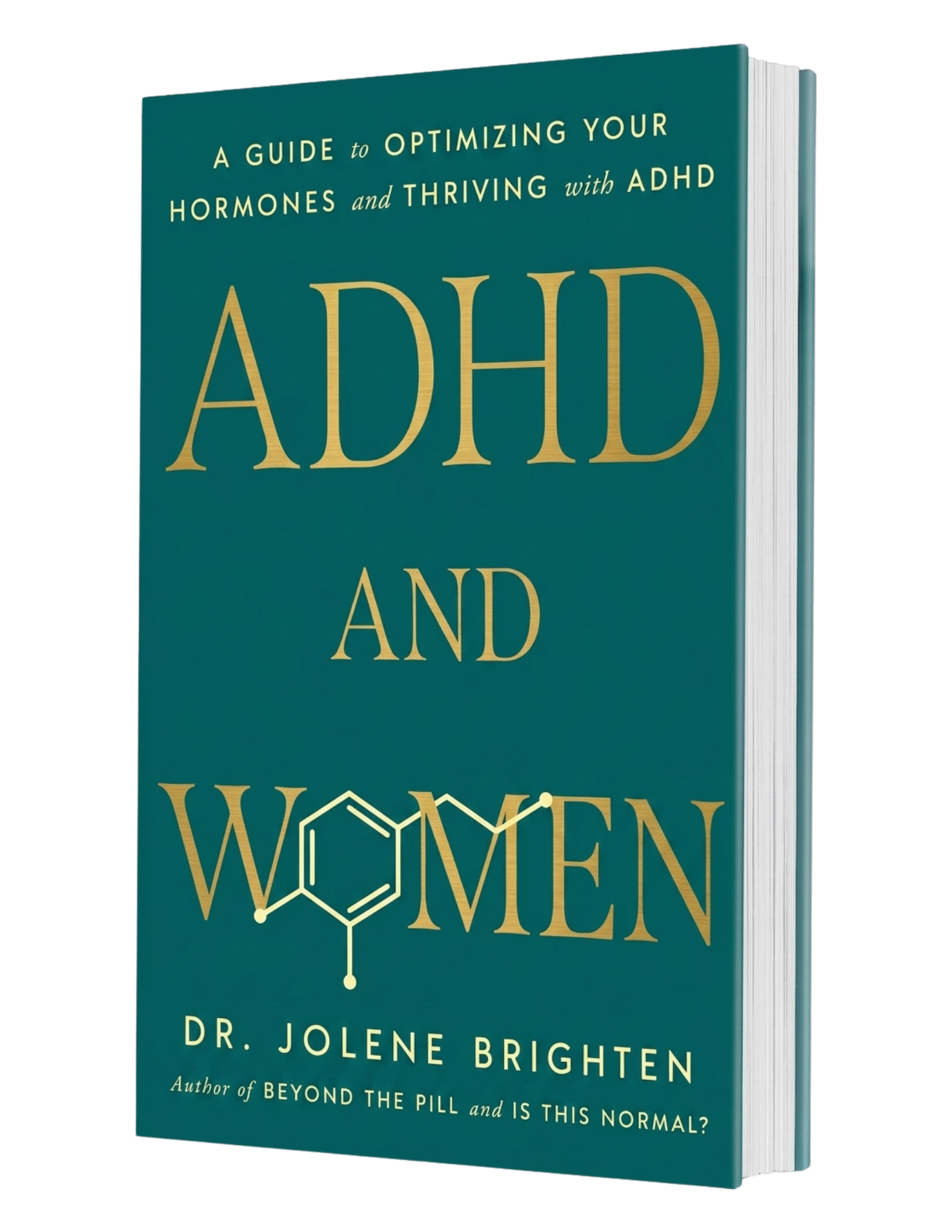
New Book · Out October 6, 2026
The full system behind the guide
These five days are the doorway. ADHD and Women is the whole map — the ADHD-Hormone Profile and what to do across every hormonal transition.
Pre-Order ADHD and WomenWhat Perimenopause Can Do to Mood, Sleep, and Mental Health
Perimenopause is the transition leading up to menopause, when hormone levels fluctuate and menstrual cycles often change. Menopause itself is generally recognized after 12 consecutive months without a menstrual period, provided there isn’t another explanation. The transition can last years, and symptoms vary. Some women notice very little; others experience changes that affect sleep, work, relationships, and how they feel in their own bodies.[2]
It’s easy to hear “hormones” and think the problem is a single number on a lab test. But estrogen and other hormones change over time, while sleep, health, stress, and life circumstances change too. You can read more about when perimenopause starts and how long it lasts. For now, let’s look at what those changes can mean for your day-to-day capacity.
Depression and anxiety deserve attention, not dismissal
In a Harvard study, researchers followed 460 women who were premenopausal and had no lifetime diagnosis of major depression at enrollment. Those who entered perimenopause were about twice as likely to develop significant depressive symptoms as those who remained premenopausal. That finding matters if you’ve never struggled with depression before and are wondering why you feel so unlike yourself. Significant symptoms on a questionnaire are not automatically the same thing as a diagnosis, and the study does not prove one hormone caused them.[3]
A later review of prospective studies found higher odds of depressive symptoms or diagnoses during perimenopause compared with premenopause. The studies used different measures and definitions, and the review did not find a statistically significant increase in the postmenopausal group compared with the premenopausal group. Risk is not destiny: many women will not experience depression.[4]
Anxiety belongs in the conversation too. A review of U.S. observational studies found that more frequent or severe hot flashes and night sweats were associated with more anxiety and depressive symptoms. If you’re experiencing both, bring both to your appointment. The studies don’t establish that hot flashes caused the anxiety, or that every anxious feeling in midlife is hormonal.[5]
If you’re feeling persistently low, unusually anxious, or unable to enjoy things you usually care about, please tell a healthcare professional. You do not have to wait until your relationship is in crisis. If you feel at immediate risk of harming yourself, call emergency services or go to an emergency department. In the U.S., you can call or text 988 for the Suicide & Crisis Lifeline.
When sleep disappears, patience can feel harder to find
Night sweats can wake you. So can anxiety, an urgent need to urinate, or an unrelated sleep problem. Sleep difficulties are common during the menopause transition, but they have more than one possible cause. A clinician can help you consider symptoms, medications, sleep apnea, mood, and other health concerns rather than assuming every sleepless night is menopause.[6]
Think about what happens after several nights of broken sleep. The unanswered email, the dinner question, and the appointment nobody else remembered are all still there. You may have less energy to absorb them. The work is still real, and not every frustrated response is a hormone symptom. It means your health deserves care while you look at what is being asked of you.
The Invisible Load You’ve Been Carrying
“Just ask me what to do.”
If you’ve heard that from a partner, you may already know why it doesn’t feel like the help it promises. Asking means noticing the empty refrigerator, working out what everyone will eat, making the list, and remembering which evening there’s time to shop. Someone else may pick up the groceries. You are still managing the job.
Sociologist Allison Daminger describes this less visible work as the cognitive dimension of household labor: anticipating needs, identifying options, making decisions, and monitoring what gets done. It’s different from the physical task of carrying the bags inside. In interviews with couples, she found that this work was not necessarily shared equally even when partners described themselves as sharing the household.[7]

The mental list can include arranging a parent’s appointment, knowing which child needs a ride, keeping track of bills, remembering a birthday, or being the person who notices the relationship has become distant. Not every couple divides these responsibilities the same way. The point is to make the planning visible enough to ask whether the division works for both of you.
One study asked 322 mothers of young children about planning and performing 30 household tasks. On average, the mothers reported doing a larger share of both, with the planning share especially unequal. A greater share of cognitive labor was associated with more reported stress, burnout, and depressive symptoms, as well as lower relationship quality. The study asked mothers of young children, not specifically menopausal women, and measured these associations at one point in time. It cannot prove that planning work caused their distress or tell us what happens in every midlife household.[8]
Still, if you recognize the pattern, you don’t need a study to give you permission to name it. Perhaps you’ve carried the calendar for years because you were good at it. Perhaps the work accumulated slowly, or your partner’s work hours made one arrangement seem practical at the time. An arrangement that once worked can stop working. And one that never felt fair can become harder to live with when your sleep and energy change.
Being less willing to absorb an unfair load is not the same thing as becoming unreasonable.
The feeling underneath may be bigger than the dishes. If you’ve asked for help repeatedly, you may be asking yourself: “Why do I have to explain this again? Why does it matter only when I’m too exhausted to do it?” Those are relationship questions. They deserve more than an instruction to be patient or an assumption that the answer is to leave.
Menopause and Divorce: What’s Colliding in Midlife?
Imagine your capacity as a bucket you draw from throughout the day. Sleep, health, rest, and support can affect what you have available. Work, caregiving, finances, and unresolved conflict draw from it. This isn’t a medical measurement, and it won’t tell you what decision to make. It can help explain why a load you’ve carried for years may feel different now.
Your partner may see the moment you finally say, “I can’t do this anymore.” They may not see the years of reminders behind it, or the night sweats and anxiety that made another night of managing everyone else feel impossible. Both parts deserve attention.
Better sleep or relief from symptoms may help you feel more like yourself. But feeling better doesn’t make an unequal arrangement fair. If you’ve been asking your partner to take responsibility for something, the relationship question remains: Are they willing to listen and follow through without making you manage them? Your treatment plan belongs to you; their response to a reasonable request belongs to them.
Research on divorce gives us context, not a way to predict your future. A study of dual-earner marriages found that perceived unfairness in housework was associated with lower marital happiness for both husbands and wives and with higher odds of divorce among wives. This was an association; it did not study menopause or prove that one partner’s chores caused a divorce.[9]
Researchers also use gray divorce to describe divorce among adults age 50 and older. That is an age category, not a menopause diagnosis. A historical U.S. analysis found that the rate doubled between 1990 and 2010; trends then differed by age group, and a later study found a decline between 2019 and 2021. Neither tells us which marriages ended because of menopause.[10] [11]
Your marriage isn’t a population trend. You can ask whether there is an unequal load, whether your health has changed, and whether you feel heard without turning your answer into a statistic.
When the House Gets Quieter: Empty Nest and Role Shifts
For some couples, raising children creates a shared schedule and a shared purpose. School pickups, meals, sports, and the question of who will be home by six leave little room to ask what the relationship feels like without those responsibilities. When children grow more independent or leave home, the calendar changes. You may see the relationship differently, too.
That can be a relief. It can also feel lonely. You might discover you enjoy each other’s company again, or realize you have been coordinating a household more than talking as partners. You might feel proud of your child and grieve the daily closeness at the same time. Adult children may still need practical or financial support, and many women don’t have children or never experience an empty nest. There is no single midlife timetable.
One study followed women over 18 years and found that marital satisfaction increased in midlife. The move to an empty nest was linked with greater marital satisfaction through increased enjoyment of time with a partner. That’s a useful counterpoint to the idea that children leaving automatically damages a marriage. It was one study, not a promise about every couple.[12]
Another analysis of older couples found no association between the onset of an empty nest and gray divorce. Marital quality, duration, and economic resources were among the factors associated with divorce in that analysis. It did not assess menopause.[13]
So I wouldn’t treat an empty home as a warning sign. I would treat a change in roles as an invitation to ask new questions: What do we want our days to look like now? What responsibilities are still mine? What do I want to keep doing, and what do I want to stop?
ADHD and Perimenopause: When Your Usual Strategies Stop Working
If you have ADHD, you may have spent years building systems to compensate for difficulties with attention, planning, or remembering. Maybe you set three reminders for an appointment, prepare everything the night before, or work late to recover the time you lost when your focus disappeared. From the outside, it can look as if everything is under control. From the inside, it can feel like a second job.
Then your sleep changes. Your periods become unpredictable. The system that used to get you through the day starts taking more effort than you have. You may wonder whether your ADHD has changed, whether this is perimenopause, or whether you’ve somehow stopped trying hard enough.
Start with what’s different for you. Tell your clinician, “I used to manage with reminders, but lately I’m missing appointments even with them,” or describe another change you’ve noticed. Bring your sleep and cycle patterns, your mood, and your medications into the same discussion. You don’t have to identify the cause before asking for help.
In a population-based study, researchers compared 535 women who reported an ADHD diagnosis with 4,857 women without one. On a menopause-symptom questionnaire, 54.2% of the ADHD group and 30.1% of the comparison group met the study’s threshold for severe symptoms. The ADHD group also reported higher psychological, physical, and urogenital symptom scores.[14]
That is an important reason to take these concerns seriously. It is not a prediction for you. ADHD diagnoses were self-reported, and symptoms were assessed with questionnaires; the study does not establish that a hormone change caused worsening ADHD, identify the onset of menopause in each participant, or measure divorce. Some symptoms can overlap across ADHD, sleep problems, depression, anxiety, and the menopause transition.
In a separate study, 19 women with ADHD in Ireland described emotional, cognitive, physical, and sexual changes during perimenopause. They also described difficulty finding care that considered both ADHD and menopause. Their interviews can help clinicians understand individual experiences, though they cannot tell us how common those experiences are.[15]
What about masking?
You may use the word masking for the effort of hiding difficulties, rehearsing what to say, or making yourself appear organized when you feel overwhelmed. Some researchers use the term camouflaging. In an online study of 329 Polish women with self-reported ADHD, higher scores on questions about social camouflaging were associated with more depressive symptoms and lower life satisfaction. Because the study captured one point in time, it cannot tell us which came first or whether masking caused the symptoms.[16]
Researchers also disagree about how well the concept applies to ADHD and how to measure it. An editorial has called for ADHD-specific validation rather than assuming measures developed in another context fit. That debate doesn’t make your effort unreal. It means we need better research before saying that menopause causes a universal “masking collapse.”[17]
The overlap can be confusing, especially if you’ve never been evaluated for ADHD. An expert review notes that ADHD medication research specific to women during the menopause transition remains limited, with no randomized trials specific to that group. Don’t change ADHD medication on your own; bring the changes you’ve noticed to your prescriber.[18]
My guides to ADHD and menopause, ADHD in women, and ADHD and hormones explore those questions in more detail.
Pulling Back Isn’t Giving Up
You might want an hour alone after work instead of smoothing over another disagreement. Or you may be done reminding another adult to make their own appointment. Stepping back can be a boundary, a response to exhaustion, or a way to protect time for yourself. It isn’t automatically a declaration that you no longer love your partner.
Consider what pulling back feels like for you. Are you choosing rest and finding some relief? Or are you feeling numb, persistently hopeless, or unable to enjoy anything? A boundary can support your wellbeing; depression deserves assessment and treatment. You don’t need to figure out the answer alone.
Changes in intimacy can add another layer. If sex hurts, if you’re exhausted, or if you feel like the person responsible for everyone else’s needs, desire may be difficult to discuss. You never owe someone sex to prove the relationship is intact. Pain and dryness deserve healthcare, and trust, resentment, and boundaries deserve their own conversation. My guide to perimenopause and intimacy offers more on sexual comfort.
Asking whether a relationship meets your needs is a legitimate question. In one longitudinal study, changes in life satisfaction after divorce differed by prior marital quality and gender; some women in the lowest-quality marriages reported improved satisfaction after divorce. That does not predict what will happen to you, and it is not a recommendation to stay or leave. Preserving a marriage is not the only possible measure of wellbeing.[19]
What Actually Helps?
You don’t have to solve your health, your household, and your marriage in one conversation. Start with the part that needs attention now. If safety is a concern, go to the safety section first.
1. Get support for the physical and mental load
Make a visit about your symptoms, not just their effect on your relationship. Bring a short list: what changed, when it began, how you’re sleeping, what happens with your periods if you still menstruate, and which medicines you take. Mention hot flashes, anxiety, low mood, pain, bleeding, or anything else affecting your life.

Depending on your symptoms, history, and preferences, a clinician may discuss menopause hormone therapy, nonhormonal options, or other care. Anxiety and depression may need their own assessment and treatment; hormone therapy is not a substitute for evaluating significant mood symptoms. The right choice is individual, and not every treatment is appropriate for everyone.[20]
Ask: “Which symptom is this treatment intended to help? What are the risks for me? When should we follow up?” My perimenopause symptoms and treatment guide can help you prepare. Treating your symptoms is worthwhile because your health matters, not because you owe anyone a more accommodating version of yourself.
2. Make the invisible work visible
If it is safe to have this conversation, pick a calm time and choose one area rather than opening with every disappointment from the last decade. Write down what it takes to get the job done, including noticing, planning, and following through.
Take meals as an example. The work may include checking the calendar, planning around dietary needs, shopping, cooking, and cleaning up. Compare what each person thinks the job includes.
Then decide who owns which pieces from start to finish. Agree on what “done” means and when you’ll check in. The aim isn’t a perfect 50/50 spreadsheet; it’s to stop making one person responsible for noticing everything.
Try a specific request: “I need you to take responsibility for the grocery planning and shopping each week, including checking what we already have.” If your partner agrees, discuss what support or information they need to start and what you will no longer manage for them. Shared ownership can take practice; repeated refusal to engage is information about the relationship, not a failure of your wording.
If you have paid help, a disability, unpredictable work hours, or children and parents with different needs, a fair plan may not look identical to another household’s. Ask whether it feels sustainable and whether both people can raise concerns without punishment. A practical experiment can start this week; it cannot by itself resolve a longstanding breach of trust.
3. Choose the kind of relationship support you want
Individual therapy can give you private space to sort through exhaustion, anger, grief, or decisions you aren’t ready to discuss with a partner. A qualified couples therapist may help when both partners want to participate and can do so safely. You can ask a potential therapist how they approach unequal labor, menopause, ADHD, and autonomy. Ask whether their goal is understanding your needs rather than keeping a couple together at any cost.
You don’t need to be certain about the future before asking for support. You also don’t need a therapist’s permission to have a boundary. If a partner mocks your concerns, controls your access to care, threatens you, or makes you afraid to speak, don’t treat that as a communication exercise to solve together. Seek confidential individual safety support.
4. Ask for ADHD-aware care when it fits
If you have ADHD, tell your clinician which strategies used to help and what has changed. If you suspect ADHD but were never assessed, ask about an evaluation rather than assuming midlife brain fog confirms the diagnosis. Sleep disruption, mood symptoms, medication effects, and other medical concerns can also affect concentration.
It may help for the professionals involved in your care to coordinate, with your permission. A menopause-informed clinician and an ADHD prescriber can consider symptoms and treatment together. There is no single protocol proven to restore everyone’s focus or capacity, and you should not have to choose between taking ADHD seriously and taking menopause seriously.[21]
If there is abuse or coercion, prioritize safety
Abuse is not a menopause symptom, and treating your symptoms will not stop someone else’s abusive behavior. The National Domestic Violence Hotline does not recommend couples counseling with an abusive partner: information shared in therapy can be used against the person experiencing abuse, and joint counseling does not remove the imbalance of power.
In the United States, contact the National Domestic Violence Hotline at 800-799-SAFE (7233) or text START to 88788. If you’re in immediate danger, contact local emergency services if you can do so safely. Outside the U.S., seek a local domestic-abuse service. If your internet use or device may be monitored, consider a safer device. You do not need to confront a partner or announce plans before seeking confidential support.
Final Thoughts
Your symptoms are real, and so is the work you’ve been carrying. Wanting something to change does not make you selfish. Your health and your relationship both deserve attention; neither has to wait for you to prove which one is responsible for how you feel.
Ask one question first: What is taking the most from me right now, and what kind of help would make it lighter? Bring the health question to a clinician, name the household work if it is safe to do so, and give yourself room to decide what you want next. You deserve support for your body and a life that doesn’t depend on you having unlimited energy.