

Perimenopause doesn’t announce itself the way most women expect. There’s no official start date, no clear signal—just a slow unraveling of things that used to feel easy. Your brain misfires mid-sentence. Your body sends strange, almost unbelievable signals. And somewhere along the way, you’re told, “Your labs are normal.”
Except they’re not. They’re just not being interpreted through the right lens.
In fact, many women start searching things like “itchy ears perimenopause,” “burning tongue menopause,” “perimenopause weird symptoms,” or “why do I feel electric shocks in my body in my 40s” because the symptoms don’t seem connected to hormones at all.
Except they are.
And for many women, these strange symptoms of perimenopause begin years before a missed period, making them some of the most overlooked early perimenopause symptoms.
They’re just not the ones anyone warned you about.
In this episode, we unpack the most overlooked and misunderstood symptoms of perimenopause (the ones that leave women questioning their sanity) and more importantly, what’s actually driving them beneath the surface. Because once you understand the “why,” you can finally do something about it. And I’ll guide you on when symptoms may be more serious and when it is time to see a doctor.
Send this to the friend who keeps saying “something feels off” but can’t explain it.
Then go listen together because this is the stuff no one taught us about perimenopause.
Perimenopause Weird Symptoms: What You’ll Learn in This Episode
Perimenopause is more than hot flashes and missed periods—it’s a full-body neurological, metabolic, and hormonal shift. And often, the perimenopause weird symptoms show up long before the “classic” signs.
Here’s what you’ll uncover:
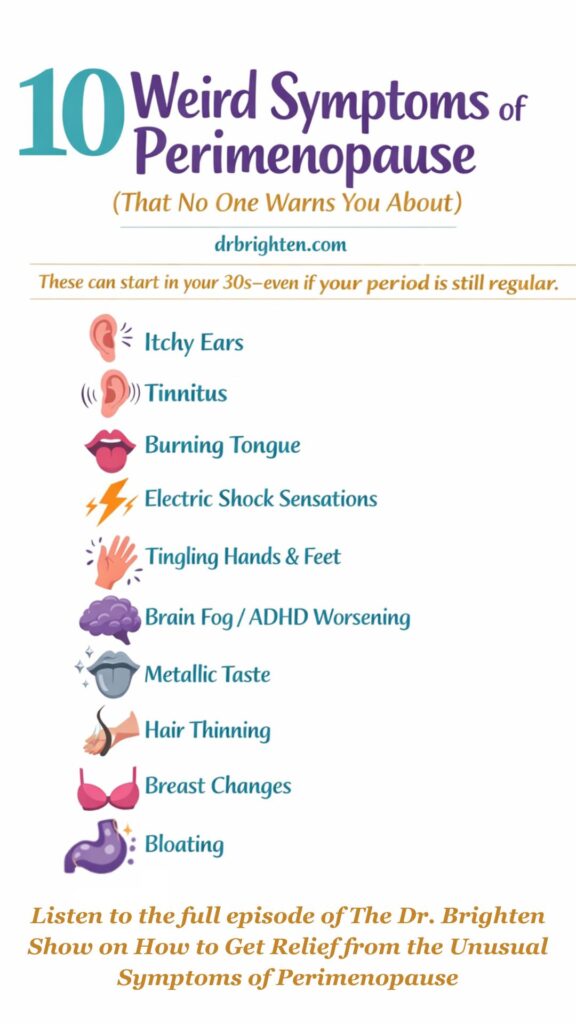
- Why itchy ears in perimenopause may be one of the earliest signs of estrogen decline
- The surprising connection between tinnitus and menopause hormone fluctuations
- What a burning tongue in menopause (burning mouth syndrome) has to do with your oral microbiome
- Why some women experience electric shock sensations in perimenopause
- The hidden drivers behind tingling hands and feet menopause symptoms—and when to worry
- How estrogen loss impacts dopamine, focus, and executive function in perimenopause
- Why your brain suddenly feels like it’s “offline” mid-task during hormonal shifts
- The reason behind a metallic taste in mouth menopause symptom (and why it’s not random)
- What’s really happening when your hair thinning in perimenopause starts
- Why breasts lose fullness—and what’s actually within your control
- The truth about perimenopause bloating and digestive changes (hint: it’s not just fiber)
- The biggest mistake women make that makes every symptom worse
Strange Symptoms of Perimenopause Explained: What’s Really Happening in Your Body
What makes perimenopause so disruptive isn’t just the symptoms, it’s how disconnected they seem. An itchy ear. A foggy brain. A sudden intolerance to foods. These don’t feel related. But they are.
And this is exactly why so many women dismiss early signs because the early perimenopause symptoms don’t match what we’ve been told to expect.
For example, if you’ve ever Googled “itchy ears perimenopause”, you’re not alone. This is one of those perimenopause weird symptoms that stems from estrogen’s role in maintaining moisture and tissue integrity in mucous membranes, including the ear canal. As estrogen declines, tissues dry out, nerve endings become more sensitive, and the brain interprets that irritation as itch.
At the center of it all is estrogen, and not just as a reproductive hormone.
Estrogen is a master regulator. It influences collagen production, nerve signaling, blood flow, microbiome diversity, and neurotransmitters like dopamine and serotonin. So when estrogen begins to fluctuate—often years before your cycle changes—you don’t just feel it in your ovaries. You feel it everywhere.
This is why symptoms like burning mouth menopause (also called burning tongue syndrome) can emerge. As estrogen declines, saliva production drops, oral tissues become more sensitive, and nerve signaling shifts—creating that persistent “burnt tongue” sensation. Many women worry this is something serious or unrelated to hormones, but it’s one of the more classic strange symptoms of perimenopause once you understand the physiology.
Take neurological symptoms, for example. Many women describe brain fog, forgetfulness, and a drop in executive function in perimenopause. This isn’t imagined. Estrogen directly supports dopamine signaling, which governs focus, motivation, and task completion.
So when estrogen fluctuates:
- Dopamine signaling becomes less efficient
- Brain energy metabolism declines
- Cognitive fatigue increases
This is why what feels like “just stress” is often actually hormone-driven neurochemical change.
Similarly, symptoms like electric shock sensations in perimenopause or unexplained tingling often stem from disrupted nerve signaling. Estrogen helps regulate neuronal firing, and when that balance shifts, the nervous system can misfire—leading to sensations described as zaps, jolts, or tingling.
Layer in:
- Sleep disruption from declining progesterone
- Rising cortisol levels
- Blood sugar instability
- Increased inflammation
And now your brain is operating in a low-energy, high-noise state—which explains why so many women report feeling like they’ve suddenly lost their mental edge.
The same systemic shift explains sensory changes. Tinnitus menopause symptoms (ringing in the ears) are linked to changes in blood flow and neurotransmitter signaling in the auditory system. When estrogen fluctuates, the brain may amplify internal noise, making ringing more noticeable and persistent.
Then there’s the gut.
Estrogen doesn’t just influence digestion—it shapes your gut microbiome, immune signaling, and intestinal permeability. As it declines:
- Gut motility slows
- Gas and bloating increase
- Food sensitivities become more common
- Microbial diversity shifts
This is why so many women experience perimenopause bloating and digestive changes even when their diet hasn’t changed.
And that brings us to the nervous system.
Perimenopause is a nervous system sensitization phase, where stress feels amplified and recovery takes longer. This contributes to symptoms like:
- Tingling hands and feet menopause symptoms
- Anxiety and overwhelm
- Sleep disruption
- Digestive dysfunction
- Even metallic taste in mouth menopause symptoms
When you zoom out, what looks like a collection of unrelated issues is actually a coordinated systemic shift driven by hormonal change.
And the truth about perimenopause symptoms is that you can’t fix a multi-system problem with a single solution.
You can’t out-supplement poor sleep.
You can’t out-hormone chronic stress.
And you can’t ignore inflammation and expect your brain to function normally.
The women who navigate this phase best aren’t waiting for symptoms to become unbearable. They recognize that these strange symptoms of perimenopause are signals, not just inconveniences you have to live with.
This episode is brought to you by:
Dr. Brighten Essentials
Want science-backed supplements formulated by a doctor who actually understands women’s health? 🌿 At Dr. Brighten Essentials, every product is crafted to support your hormones, boost your energy, and help you feel your best—inside and out. From targeted nutrients for glowing skin to essentials that fuel your daily vitality, you’ll get the highest-quality ingredients in forms your body can truly use.
Exclusive for podcast listeners: Use code POD15 at checkout for 15% off your order.
HigherDOSE – Red Light Showerhead Filter
Your shower water could be impacting your skin more than you think. The HigherDOSE Red Light Showerhead Filter features a 10-stage filtration system designed to reduce chlorine, VOCs, and other contaminants that can contribute to dryness and irritation. It also includes built-in red light therapy to support cellular energy and overall skin appearance—turning your daily shower into a more restorative ritual.
Save 15% at higherdose.com/drbrighten and use code DRBRIGHTEN15 for 15% off
Pique – Pu’er Tea Duo
Gut health isn’t just about probiotics—it’s also about nourishing your microbiome. Pique’s Pu’er Tea Duo delivers polyphenol-rich support to help promote microbial diversity, gut lining health, and balanced digestion. Featuring Green Pu’er for antioxidant support and Black Pu’er for digestion and reduced bloating, it’s an easy daily ritual for whole-gut wellness.
Get 20% off at https://piquelife.com/drbrighten to learn more.
Links & Resources Mentioned in This Episode
- Dr. Brighten hormone resources: https://drbrighten.com
- ADHD + Hormone Sync Guide: https://drbrighten.com/sync
- Dr. Lisa Mosconi’s book The Menopause Brain
- Radiant Mind (cognitive support supplement with saffron, bacopa, and choline)
Related Episodes
- 5 Science-Backed Steps to Stop Female Hair Loss and Regrow Your Hair
- Sjogrens Syndrome and Treatment: What Women Need to Know | Dr. Kara Wada
- The Truth About Insulin Resistance Treatment, Foods, and Labs in Perimenopause
- Weight Gain in Perimenopause Over 35: Why Your Body Is Changing and What Actually Works
- Testosterone Hormone Therapy in Perimenopause: How to Match Symptoms, Labs, and Treatment Correctly
- Hormone Replacement Therapy for Menopause: What the FDA’s Black Box Removal Really Means for Women
- Thyroid Problems in Women Skyrocket During Perimenopause + What to Do About It | Dr. Christine Maren
- ADHD and Perimenopause: Why Perimenopause Is Worse for Women With ADHD | Dr. Jolene Brighten
- ADHD in Women: How Your Periods, Progesterone, PMS, and PMDD Can Change Your Brain Every Month
- How Hormones and Menopause Affect ADHD: What No One’s Telling You | Dr. Jolene Brighten
- ADHD, Sleep & Hormones: Why Your Brain Won’t Shut Off at Night
Related Articles:
- This Is How Your ADHD Can Affect You During Menopause
- Best Natural ADHD Supplements for Focus and Attention (Science-Backed Guide)
- Extreme Fatigue in Perimenopause: What’s Really Going On—And What Helps?
- When Does Perimenopause Start and How Long Does It Last?
- Best Saffron Supplement for Mood, Anxiety, ADHD & PMS
Early Perimenopause Symptoms Most Women Miss (FAQ)
Perimenopause weird symptoms include itchy ears, burning mouth, brain fog, tingling sensations, tinnitus, and even metallic taste. These occur because estrogen affects multiple systems beyond reproduction, including the nervous system and microbiome.
Early perimenopause symptoms often include sleep disruption, mood changes, brain fog, and unusual sensory symptoms like itching or tingling. These can begin in your 30s or early 40s, well before cycle changes.
Yes. “Itchy ears perimenopause” is a commonly searched symptom tied to declining estrogen. As estrogen drops, the ear canal becomes drier and more sensitive, leading to persistent itching.
Burning tongue or burning mouth syndrome in menopause is linked to reduced saliva production, nerve sensitivity, and changes in the oral microbiome due to low estrogen.
Yes. Tinnitus menopause symptoms are associated with hormone-related changes in blood flow and neurotransmitter signaling in the auditory system.
These symptoms are not random—they are the result of estrogen influencing the brain, gut, immune system, and nervous system. When estrogen fluctuates, multiple systems shift at once.
Some of the weirdest symptoms of perimenopause include itchy ears, burning mouth, electric shock sensations, metallic taste, and tinnitus. These may seem unrelated, but they are driven by estrogen’s role in nerve signaling, tissue hydration, and brain function.
Yes. Perimenopause can cause neurological symptoms because estrogen directly affects neurotransmitters like dopamine and GABA. This can lead to brain fog, tingling, memory issues, and even sensations like electrical zaps or heightened sensitivity in the nervous system.
Brain fog in your 30s or 40s is often one of the earliest perimenopause symptoms. As estrogen fluctuates, it disrupts dopamine signaling and brain energy metabolism, making focus, memory, and executive function more difficult.
Yes. Low estrogen can contribute to tinnitus and burning mouth syndrome. Estrogen supports blood flow, nerve stability, and tissue health, so when it declines, sensory pathways in the ears and mouth can become dysregulated.
Perimenopause symptoms can begin as early as your mid-30s, though they are more common in the late 30s to early 40s. Many early perimenopause symptoms—like sleep changes, mood shifts, and brain fog—occur before menstrual irregularities.
Natural support for perimenopause symptoms includes stabilizing blood sugar, prioritizing protein and fiber intake, managing stress, improving sleep quality, exercising regularly, and supporting the gut microbiome. These foundational habits help regulate the brain, hormones, and nervous system.
Perimenopause isn’t a decline—it’s a transition. But if no one teaches you how to navigate it, it can feel like everything is falling apart.
And those perimenopause weird symptoms? Turns out, they’re not so weird because many of us have them. Once you understand them, you stop fearing them and start working with your body instead of against it.