



If you feel like “protein” has become a competitive sport on your social media feed, you are not alone. Between the “What I Eat In A Day” videos and the pressure to carry hard-boiled eggs in your purse, the message is clear: more is better. But for the woman in perimenopause, “more” is not a strategy: it is a recipe for burnout. You do not need to eat like a bodybuilder to save your muscle. You need to eat like a woman who understands her changing hormones and the daily protein intake for women that actually works.
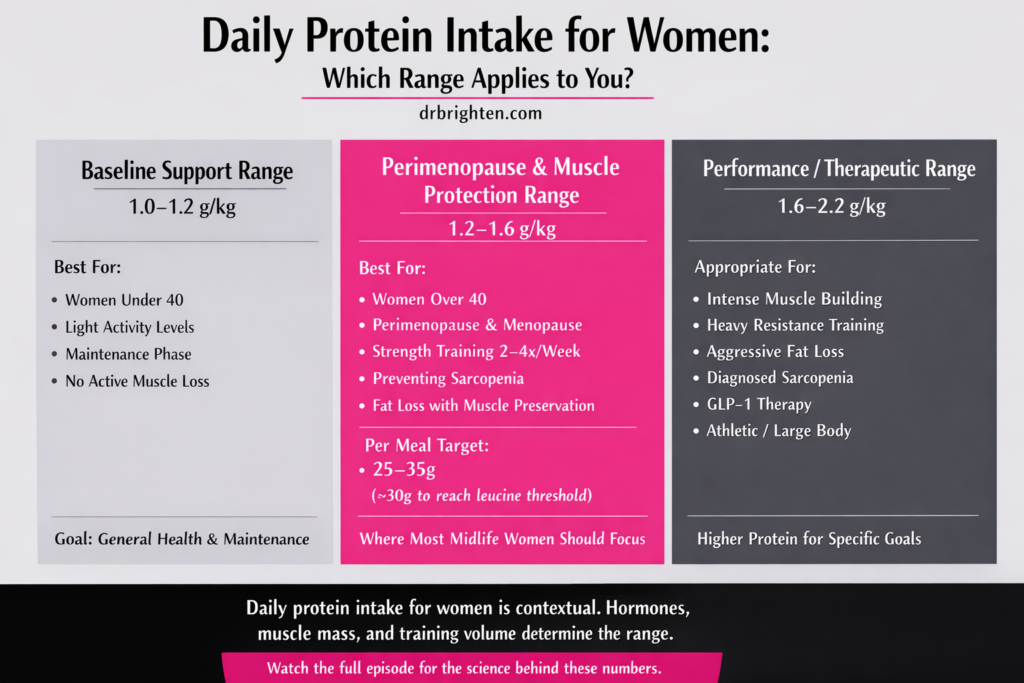
In this episode of The Dr. Brighten Show, I examine the science behind daily protein intake for women and explain how declining estrogen, shifts in insulin sensitivity, and age-related anabolic resistance change your protein requirements. We discuss whether 1.2 to 1.6 grams per kilogram is sufficient, when higher protein targets may be appropriate, how protein distribution across meals impacts muscle protein synthesis, and why extreme recommendations can crowd out fiber and negatively affect gut and thyroid health.
If you are trying to determine the right daily protein intake for women in perimenopause — whether you should aim for 90 grams, 120 grams, or more — this episode provides a research-informed, nuanced framework rather than a one-size-fits-all number.
Confused about how much protein you actually need? Watch the full episode to find your range and stop guessing.
The Protein Cheat Sheet
- The Target: Aim for 1.2 to 1.6 grams of protein per kilogram of your ideal body weight.
- The 30g Rule: Hit 30g of protein at breakfast to trigger muscle protein synthesis (the “leucine threshold”).
- The Myth: You do NOT need 200g of protein unless you are an elite athlete in a heavy cutting phase.
- The Goal: Prevent sarcopenia (muscle loss) and stabilize blood sugar during metabolic shifts.
What You’ll Learn in This Episode: How Much Protein Do Women Need
- The “Estrogen Trap”: Why your 20-year-old self could get away with low protein, but your 40-year-old self cannot.
- The Leucine Threshold: The biological “on-switch” for muscle building that most women miss at breakfast.
- The RDA Scam: Why the government's protein recommendation is the bare minimum to prevent disease, not the target for health.
- Protein as a Personality: How to spot the difference between science-based nutrition and influencer-driven “protein chaos.”
- The 30-Gram Anchor: Why hitting 30 grams of protein in your first meal of the day changes your metabolic rate.
- Sarcopenia Prevention: The real reason you feel like your muscle is “evaporating” in real-time during perimenopause.
- The GLP-1 Insurance Policy: Why protein is the non-negotiable requirement for anyone using medications like Ozempic or Wegovy.
- Plant-Based Precision: The specific strategy vegans must use to hit amino acid targets without over-consuming calories.
- The Ideal Weight Formula: Why you should calculate your protein needs based on your goal weight, not your current weight.
- Anabolic Resistance: How declining estrogen makes your muscles “deaf” to protein signals and how to fix it.
- The Fiber Trade-Off: Why eating 200 grams of protein can actually damage your gut health and hormone balance.
- The Thermic Effect: How protein acts as a metabolic tool to burn more energy during digestion and stabilize blood sugar.
Why Protein Needs Change in Perimenopause
Protein becomes more important in perimenopause for three key reasons discussed in the episode:
1. Estrogen Declines
As estrogen fluctuates and eventually declines:
- Insulin sensitivity shifts
- Muscle becomes less efficient
- Anabolic signaling weakens
2. Increased Risk of Sarcopenia
Sarcopenia is age-related muscle loss combined with fat infiltration into muscle tissue.
This isn’t about aesthetics. It’s about:
- Bone density
- Metabolic rate
- Insulin resistance
- Long-term independence
3. Muscle Protein Synthesis Becomes Less Efficient
In your 20s, you could “get away with” lower protein intake.
After 40? You need to be more intentional.
But intentional does not mean extreme.
The 150–200 Gram Myth: Who Actually Needs That Much?
One of the biggest frustrations I address in the episode is influencers telling menopausal women to eat 150–200 grams of protein daily — without context.
Let’s be clear:
Very high protein intake can make sense for:
- Women resistance training 4–5+ days per week
- Women in aggressive fat-loss phases
- Women trying to maintain significant lean mass
- Larger-bodied athletes
But for the average perimenopausal woman currently eating 60–80 grams per day?
Doubling intake overnight is not realistic. And it may create other problems.
Before you double your protein intake, watch this. I break down exactly when 1.2 g/kg is enough and when 2.0+ actually makes sense.
Ideal Body Weight vs. Current Weight
Another critical clarification from the episode: Protein calculations should generally be based on ideal or goal body weight, not current weight if actively losing.
Example: If you weigh 200 pounds but your goal weight is 160, calculating protein off 200 pounds can overshoot your needs.
However, and this is key, in the episode I also call out confusion between:
- 0.8 grams per kilogram
- 0.8 grams per pound
Those are very different numbers. And it creates confusion when people use kilograms and pounds interchangeably.
Misunderstanding units is one of the biggest drivers of protein panic online.
When Higher Protein Makes Sense
There are situations where protein intake may increase toward the higher end (1.6–1.7 g/kg):
- Aggressive caloric restriction
- Preserving lean mass during weight loss
- Heavy strength training
- Larger body size
- Significant muscle mass to maintain
Protein improves:
- Satiety
- Lean mass preservation
- Appetite regulation
But more is not always better. Muscle protein synthesis plateaus per meal. Excessive protein does not equal excessive muscle.
If you’re over 40 and worried your muscle is disappearing, this episode is for you. Learn how to protect lean mass without sacrificing fiber, hormones, or sanity.
Calculating Your Needs: How Many Grams of Protein Per Day?
When determining how many grams of protein per day targets require, we must look at “ideal body weight” rather than current weight. If a woman is currently 220 pounds but her healthy, functional goal weight is 150 pounds, calculating protein based on 220 pounds may lead to excessive caloric intake. By using the goal weight as the baseline, we ensure the body has enough amino acids to protect lean muscle without overtaxing the digestive system.
The perimenopause factor is the most overlooked variable in this calculation. As estrogen levels begin to fluctuate and eventually decline, women experience something called anabolic resistance.
This means your muscles become less sensitive to the signals that tell them to grow or maintain themselves. In your 20s, a casual approach to protein was often enough. In your 40s, you must be more intentional because your biological “work order” for muscle maintenance has changed.
Protein is also the most thermic of all macronutrients. This means your body burns more energy digesting protein than it does digesting fats or carbohydrates. This “metabolic advantage” is crucial for managing the “perimenopause middle” or stubborn midsection weight gain. By prioritizing protein, you are not just feeding your muscles: you are using nutrition as a tool to keep your metabolic rate from slowing down.
Vegan and Vegetarian Protein: Can You Get Enough?
A common claim circulating online is that it is impossible to meet adequate protein requirements on a vegan or vegetarian diet. This assertion is not supported by evidence. Women can achieve an appropriate daily protein intake on a plant-based diet, including during perimenopause, but doing so requires intentional planning and an understanding of amino acid composition.
Protein adequacy on a vegan diet is not automatic.
While many whole plant foods contain protein, the leucine density and total essential amino acid profile differ from most animal-based sources. For women over 40, when anabolic resistance increases and muscle protein synthesis becomes less efficient, attention to protein quality and distribution becomes even more important.
During the episode, I explain how plant-based eaters can strategically structure their daily protein intake for women to support muscle maintenance, metabolic health, and hormone balance. This includes focusing on leucine-rich plant sources and combining complementary proteins to ensure a complete amino acid profile.
Daily protein intake for women isn’t one number. Watch the episode to calculate yours based on hormones, training, and goals.
Key Considerations for Plant-Based Protein Intake
1. Leucine Density Matters
Leucine is the amino acid responsible for triggering muscle protein synthesis. Soy-based foods such as tofu and tempeh are among the most leucine-dense plant options. Other supportive sources include lentils, seitan, pea and rice protein blends, nutritional yeast, and hemp seeds.
2. Soy Is Often Misunderstood
Soy continues to be unfairly criticized in some online discussions. Moderate intake of minimally processed soy foods, such as tofu and tempeh, is well-supported in the literature and can be part of a hormonally supportive dietary pattern. Concerns generally arise when intake is excessive or heavily reliant on ultra-processed soy derivatives rather than whole or traditionally prepared foods.
3. Whole-Food vs. Ultra-Processed Vegan Diets
It is possible to meet protein targets using ultra-processed vegan products, but doing so may displace fiber, phytonutrients, and micronutrients that are essential for gut and hormonal health. A whole-food-forward approach — incorporating legumes, intact grains, seeds, and minimally processed soy — provides both protein and metabolic support.
4. Reading Labels Is Essential
Protein content varies widely across plant-based products. Serving sizes can change, formulations shift, and marketing claims are not always transparent. Women aiming to optimize their daily protein intake should verify protein per serving and total leucine content when possible, particularly if relying on powders or convenience products.
Strategic Protein Planning for Sustainability
Rather than prescribing a rigid meal plan, the episode emphasizes building flexible frameworks. Sustainable dietary change depends on adherence, cultural preferences, accessibility, and individual metabolism. A well-structured vegan or vegetarian approach can absolutely meet protein needs in perimenopause — but it requires intention rather than assumption.
For women navigating hormonal transitions, the goal is not perfection. The goal is adequacy, consistency, and long-term metabolic resilience.
High Protein Foods for Muscle Building and the Leucine Threshold
To understand high protein foods for muscle building, we have to talk about the “leucine threshold.” Leucine is an essential amino acid that acts as the “on-switch” for muscle protein synthesis. You can eat protein all day long, but if you never hit the specific concentration of leucine required to trigger this switch, your body will not effectively repair or build muscle tissue.
For most women, this threshold is approximately 2.5 grams of leucine per meal. This typically equates to about 30 grams of high-quality protein. This is why the “30-gram anchor” at breakfast is so transformative. If you start your day with only 10 grams of protein, you remain in a catabolic state (breaking down tissue). By hitting 30 grams, you flip the switch to an anabolic state (building and repairing tissue).
Think of muscle as your “metabolic spanx.” It keeps your insulin sensitivity high and your bones strong. As we age, muscle is the primary organ of longevity. If you are walking around with nonstop brain fog and feeling exhausted by mid-afternoon, it is often because your protein distribution is skewed. You might be eating 60 grams at dinner but only 5 grams at breakfast. Redistributing that protein to hit the 30-gram mark earlier in the day can stabilize your energy and stop the “pantry raids” later in the evening.
Foods High in Leucine: Your Muscle-Building Grocery List
When looking for foods high in leucine, animal sources are the most efficient delivery systems. Whey protein, Greek yogurt, chicken breast, and lean beef contain high concentrations of leucine in relatively small caloric packages. For example, a single scoop of high-quality whey protein or 4-5 ounces of chicken will
This Episode Is Brought to You By
Dr. Brighten Essentials
Want science-backed supplements formulated by a doctor who actually understands women’s health? 🌿 At Dr. Brighten Essentials, every product is crafted to support your hormones, boost your energy, and help you feel your best—inside and out. From targeted nutrients for glowing skin to essentials that fuel your daily vitality, you’ll get the highest-quality ingredients in forms your body can truly use.
Exclusive for podcast listeners: Use code POD15 at checkout for 15% off your order.
LMNT Electrolytes —Want a clean, science-backed way to stay hydrated and energized? At LMNT, electrolytes are formulated with a precise balance of sodium, potassium, and magnesium — with no sugar, no artificial ingredients, and no unnecessary fillers. Designed to support hydration, muscle function, and daily energy, LMNT helps you feel your best through workouts, busy days, and everyday life.
Exclusive for podcast listeners: Visit DrinkLMNT.com/Brighten to receive a free sample pack with any purchase.
Links Mentioned in This Episode
- 30 grams of protein per meal recipe guide: A practical meal guide showing how to structure breakfast, lunch, and dinner to consistently hit 30 grams of protein per meal for muscle support and metabolic health.
- How Much Protein Should Women Have: An evidence-based breakdown of daily protein intake for women, including how age, activity level, and hormonal changes influence your ideal target.
- Breakfast with 30 grams of Protein for Hormone Balance: High-protein breakfast ideas designed to reach the leucine threshold and support blood sugar stability, muscle maintenance, and hormone balance.
- Snacks With the Most Protein: What to Eat for a High-Protein Snack: A curated list of high-protein snack options that maximize satiety and muscle support without sacrificing fiber or nutrient density.
- High Protein Diets, Creatine for Women, and What You Need to Lose Weight in Perimenopause | Liz Plosser: A conversation exploring high-protein strategies, creatine use for women, and practical nutrition tools to support fat loss and muscle preservation during perimenopause.
- How to Lose Weight With PCOS
- How to Lose Weight During Perimenopause
Creators Featured
Matt Hyams, Perimenopause Protein Skit
Lauren Hubert MS, RD Dietitian, Influencer 200 Grams of Protein Rant
The Lisa Fit Life, 30 Grams of Protein
Mayaim Bialk, Vegan’s Don’t Get Enough Protein
Rachel Jo, Vegan Protein Meal Plan
FAQ: Protein and Perimenopause
Most women over 40 benefit from 1.2–1.6 g/kg of body weight daily. If you are losing muscle mass or looking to put it on, your nutrition provider may recommend 1.6-2.2 g/kg. But this should be increased over time.
For many active perimenopausal women, 100 grams is appropriate and in some instances, you may need more.
Yes, due to anabolic resistance and increased sarcopenia risk.
Yes, with intentional food combinations and attention to leucine density.
No. Gradual increases improve sustainability and prevent dietary imbalances