



f you’ve been wondering whether Ozempic, semaglutide, tirzepatide, or other GLP-1 medications could help with endometriosis symptoms, chronic pelvic pain, adhesions, fatigue, or endo belly, you are not alone. More and more women with endometriosis are reporting that GLP-1 medications may be helping with symptoms that go far beyond weight loss, from lower inflammation and less pain to improved energy and better blood sugar stability.
But what does the science actually say?
In this episode of The Dr. Brighten Show, Dr. Jolene Brighten breaks down the emerging research and real-world clinical observations around GLP-1 receptor agonists and endometriosis, including what is currently known, what remains theoretical, and why this conversation may be one of the most important developments in women’s health right now.
You’ll learn how GLP-1 medications like Ozempic (semaglutide), Wegovy, Mounjaro (tirzepatide), liraglutide, and exenatide may influence inflammatory signaling, fibrosis, metabolic dysfunction, and long-term cardiovascular risk in women living with endometriosis.
GLP-1, Ozempic, and Endometriosis Symptoms: What You’ll Learn in This Episode
In this episode, we explore whether GLP-1 medications may help manage endometriosis symptoms and endometriosis pain through mechanisms that extend far beyond weight loss.
Here’s what you’ll learn:
- Why endometriosis is not just painful periods, but a full-body inflammatory disease
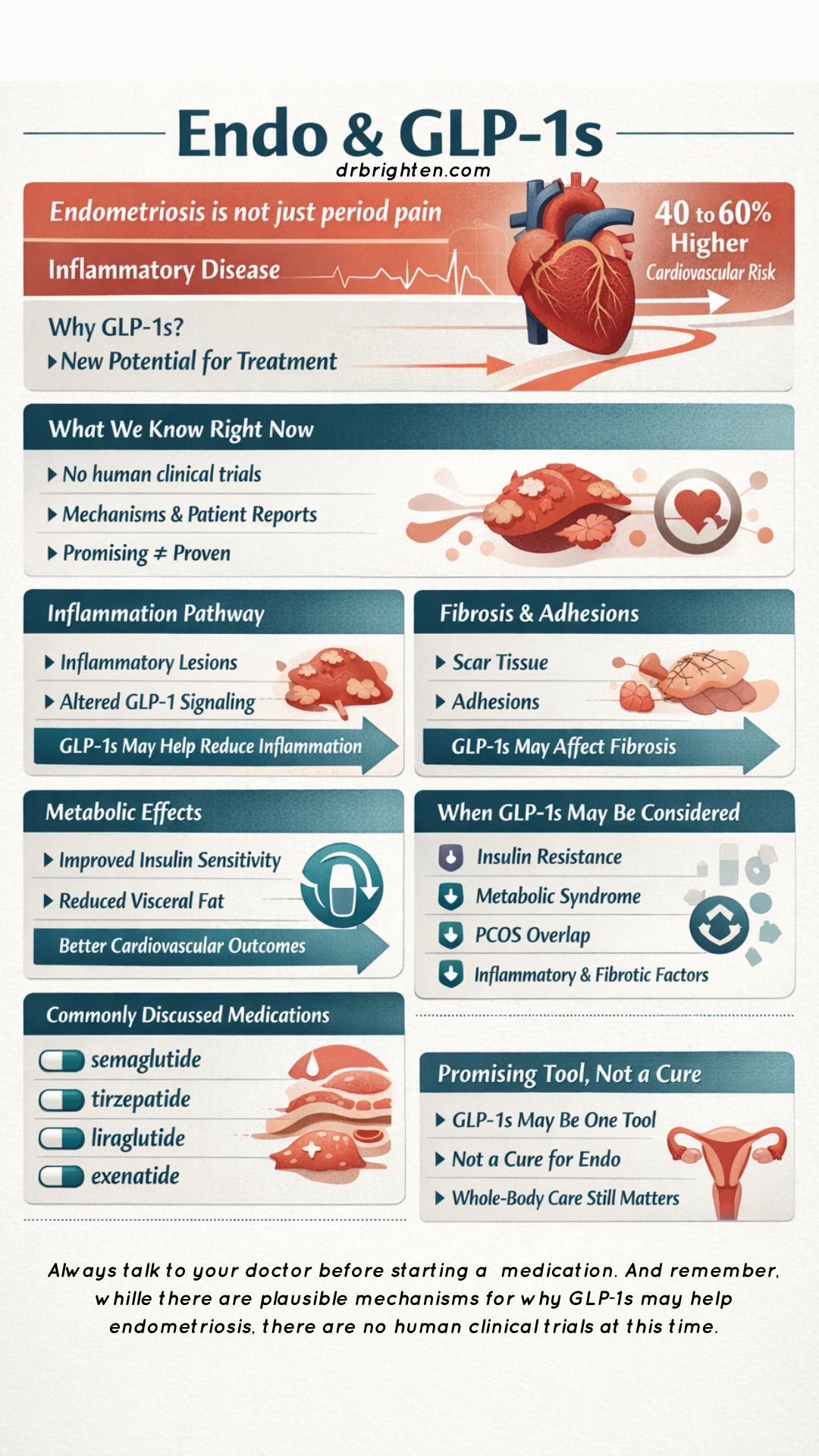
- The shocking statistic that women with endometriosis may have a 40–60% higher risk of cardiovascular disease
- How Ozempic and other GLP-1 medications may help reduce inflammatory signaling
- Why GLP-1 levels may already be altered in women with endometriosis
- The connection between endometriosis pain, cytokines, prostaglandins, mast cells, and immune dysfunction
- How adhesions, fibrosis, and scar tissue may contribute to worsening pelvic pain
- Why some women report less endometriosis pain after starting semaglutide or tirzepatide
- How GLP-1s may support blood sugar stability, insulin sensitivity, and reduced visceral fat
- Why 80% of women with endometriosis report fatigue as a major symptom
- The possible connection between mitochondrial dysfunction, brain fog, and endo fatigue
- Which GLP-1 medications are most commonly discussed: Ozempic, semaglutide, tirzepatide, liraglutide, and exenatide
- Why GLP-1s are not a cure for endometriosis, but may be one tool in a broader strategy
- What to discuss with your doctor if you have endometriosis symptoms plus insulin resistance, PCOS, or metabolic syndrome
- Why endo belly, blood sugar crashes, and inflammation may all be connected
- How nutrition, sleep, omega-3s, NAC, and pelvic floor physical therapy fit into the bigger picture
How Ozempic and GLP-1 Medications May Affect Endometriosis Pain and Symptoms
One of the most important takeaways from this episode is that GLP-1 medications may influence multiple pathways involved in endometriosis symptoms and pain.
Endometriosis is not simply tissue growing outside the uterus.
As discussed in the episode, endometriosis lesions are biologically active inflammatory tissue. They recruit immune cells, produce inflammatory cytokines, create local estrogen signaling, and contribute to scar tissue formation and adhesions.
This means symptoms like:
- chronic pelvic pain
- painful ovulation
- painful bowel movements
- fatigue
- endo belly
- pulling or tugging pain
- worsening symptoms after surgery
may all be driven by more than one mechanism.
GLP-1 and Inflammation in Endometriosis
One of the most compelling reasons GLP-1 medications are being discussed in endometriosis is their effect on systemic inflammation and immune signaling.
GLP-1 receptor agonists may help modulate:
- macrophage activity
- inflammatory cytokines
- oxidative stress
- blood sugar instability
- visceral adiposity
These are all factors that can amplify endometriosis pain and symptoms.
According to the episode, a human study found that women with endometriosis had lower GLP-1 levels in peritoneal fluid, suggesting that GLP-1 signaling may already be altered in the inflammatory environment surrounding lesions.
GLP-1 and Adhesions, Fibrosis, and Scar Tissue
Another major focus of this episode is how GLP-1 medications may influence fibrosis and scar tissue signaling.
This is especially important for women experiencing:
- adhesions after excision surgery
- worsening ovulation pain
- organ tethering
- pulling pelvic pain
- bowel symptoms
- pain with movement
As discussed in the transcript, animal studies suggest that GLP-1 medications may reduce collagen deposition and fibrosis pathways, which could potentially influence adhesion formation.
For many women, this is where endometriosis becomes life-altering.
Endometriosis Fatigue, Brain Fog, and GLP-1s
Fatigue is one of the most overlooked endometriosis symptoms.
In the episode, Dr. Brighten notes that approximately 80% of women with endometriosis experience fatigue as a major symptom.
This may be connected to:
- immune activation
- reactive oxygen species
- mitochondrial dysfunction
- chronic inflammation
- pain-related nervous system stress
GLP-1 medications may help by reducing oxidative stress and improving metabolic function, which may translate into improved energy for some women.
Ozempic vs Tirzepatide vs Other GLP-1 Medications
One of the most frequently asked questions is:
Which GLP-1 is best for endometriosis?
The honest answer shared in this episode is that there is currently no one best GLP-1 specifically for endometriosis, because there are no direct human clinical trials comparing them for this condition.
The most commonly discussed options include:
- Ozempic / semaglutide
- Wegovy / semaglutide
- Mounjaro / tirzepatide
- liraglutide
- exenatide
Tirzepatide may be discussed differently because it acts on both GLP-1 and GIP receptors, making it mechanistically distinct.
However, the right medication depends on:
- symptom goals
- insulin resistance
- metabolic health
- GI tolerance
- fertility plans
- access and cost
- physician experience
Natural Strategies Discussed Alongside GLP-1s
This episode also emphasizes that medications are never the whole story.
Additional strategies discussed include:
- blood sugar stabilization
- anti-inflammatory nutrition
- omega-3 fatty acids
- NAC (N-acetylcysteine)
- polyphenol-rich foods
- sleep optimization
- visceral fat reduction
- pelvic floor physical therapy
- nervous system rehabilitation
- gut healing and microbiome support
This Episode Is Brought to You By
This episode is brought to you by The Endometriosis Reset, my step-by-step program designed to help women address the full-body drivers of endometriosis symptoms, including inflammation, blood sugar instability, endo belly, fatigue, scar tissue support, and nervous system dysregulation.
Inside the program, I walk you through clear protocols for nutrition, supplement timing and dosing, lifestyle support, and the conversations to have with your doctor so you can stop piecing together conflicting advice online.
Learn more at drbrighten.com/endocourse
EndoGlobal Group
At EndoGlobal Group, a network of world-class endometriosis specialists comes together to provide comprehensive, multidisciplinary care for patients with complex endometriosis—offering advanced diagnostic mapping, complete excision surgery, and holistic support.
Click here to learn more and schedule a free consultation.
Links Mentioned in This Episode
- Endometriosis Reset Course: drbrighten.com/endocourse
- Dr. Brighten Essentials N-Acetyl Cysteine (NAC)
- Saffron for Endometriosis: How It Can Help With Pain, Mood, and Inflammation
- Endometriosis and Painful Ovulation: Why Ovulation Hurts, Where It’s Felt, and What Helps
- Best Supplements for Endometriosis (Evidence-Based Guide)
- Does Endometriosis Go Away After Menopause? Here’s the Truth
Related Episodes:
- Natural Ways to Manage Endometriosis Beyond Surgery
- Endometriosis Relief of Pain: Experts Explain Laparoscopy, Chronic Pelvic Pain, and Why So Many Women Are Still Suffering
- The Hidden Connection Between Estrogen and Histamine: Why Your Hormones Cause Inflammation
- Endometriosis Surgery: What Most Doctors Won’t Tell You
- Birth Control for Endometriosis? Hormones, Progesterone Resistance, and What Doctors Aren’t Telling You
- Endometriosis Symptoms vs Normal Period Pain with Dr. Patrick Yeung
- What Is Endometriosis? 4 Surgeons Explain the Symptoms, Misdiagnosis, and Whole-Body Impact
- 3 Period Problems Women Should Never Ignore (Heavy Bleeding, PMS, and Period Pain)
- Can Ozempic and Mounjaro Fix Thyroid Issues? The Anti-Inflammatory Power of GLP-1 Agonists! | McCall McPherson
- GLP-1 Weight Loss in Menopause: How HRT Amplifies Results
Frequently Asked Questions About Ozempic, GLP-1s, and Endometriosis
GLP-1 medications like Ozempic may help manage some drivers of endometriosis pain, including inflammation, blood sugar instability, and metabolic dysfunction, but they are not currently proven treatments for endometriosis lesions.
Some women report improvement in symptoms such as pain, fatigue, inflammation, and endo belly, but clinical trials specifically studying semaglutide for endometriosis are still lacking.
No. As discussed in the episode, GLP-1 medications are not a cure for endometriosis and should be considered one potential tool within a broader strategy.
Because GLP-1s may improve inflammation, gut-related symptoms, and insulin resistance, they may help some women with bloating and endo belly symptoms.
References:
Mu, F., Rich-Edwards, J., Rimm, E. B., Spiegelman, D., & Missmer, S. A. (2016). Endometriosis and Risk of Coronary Heart Disease. Circulation. Cardiovascular quality and outcomes, 9(3), 257–264. https://doi.org/10.1161/CIRCOUTCOMES.115.002224
Cavadias I, Maitrot-Mantelet L, Perol S, et al. Risk of cardiovascular disease and mortality among women with endometriosis: A systematic review and meta-analysis. Acta Obstet Gynecol Scand. 2026; https://pubmed.ncbi.nlm.nih.gov/41310987/
Pabon, M. A., Wang, X., & Rexrode, K. M. (2024). Beyond reproductive health: the cardiovascular risks of endometriosis. European heart journal, 45(44), 4744–4746. https://doi.org/10.1093/eurheartj/ehae674
Szpila, G., Szczotka, J., Suchodolski, A., & Szulik, M. (2025). Endometriosis and Cardiovascular Disease: Exploring Pathophysiological Interconnections and Risk Mechanisms. Diagnostics (Basel, Switzerland), 15(12), 1458. https://doi.org/10.3390/diagnostics15121458
MDPI
Desai, S. N., Reed, C. C., Mendez, Y., Yang, Q., & Guan, X. (2026). The Hidden Link Between Endometriosis and Obesity: A State-of-the-Art Review. Cureus, 18(2), e102896. https://doi.org/10.7759/cureus.102896
Bendotti, G., Montefusco, L., Lunati, M. E., Usuelli, V., Pastore, I., Lazzaroni, E., Assi, E., Seelam, A. J., El Essawy, B., Jang, J., Loretelli, C., D'Addio, F., Berra, C., Ben Nasr, M., Zuccotti, G., & Fiorina, P. (2022). The anti-inflammatory and immunological properties of GLP-1 Receptor Agonists. Pharmacological research, 182, 106320. https://doi.org/10.1016/j.phrs.2022.106320
Yang, F., Luo, X., Li, J., Lei, Y., Zeng, F., Huang, X., Lan, Y., & Liu, R. (2022). Application of glucagon-like peptide-1 receptor antagonists in fibrotic diseases. Biomedicine & pharmacotherapy = Biomedecine & pharmacotherapie, 152, 113236. https://doi.org/10.1016/j.biopha.2022.113236
Liu, C., Zhang, Q., Zhou, H., Jin, L., Liu, C., Yang, M., Zhao, X., Ding, W., Xie, W., & Kong, H. (2024). GLP-1R activation attenuates the progression of pulmonary fibrosis via disrupting NLRP3 inflammasome/PFKFB3-driven glycolysis interaction and histone lactylation. Journal of translational medicine, 22(1), 954. https://doi.org/10.1186/s12967-024-05753-z
Fandiño, J., Toba, L., González-Matías, L. C., Diz-Chaves, Y., & Mallo, F. (2020). GLP-1 receptor agonist ameliorates experimental lung fibrosis. Scientific reports, 10(1), 18091. https://doi.org/10.1038/s41598-020-74912-1
Anastasi, E., Scaramuzzino, S., Viscardi, M. F., Viggiani, V., Piccioni, M. G., Cacciamani, L., Merlino, L., Angeloni, A., Muzii, L., & Porpora, M. G. (2023). Efficacy of N-Acetylcysteine on Endometriosis-Related Pain, Size Reduction of Ovarian Endometriomas, and Fertility Outcomes. International journal of environmental research and public health, 20(6), 4686. https://doi.org/10.3390/ijerph20064686
Karakoç, E., Halaçlı, S.O., Hanelçi, R.H. et al. N-acetylcysteine stimulates organelle malfunction in endometriotic cells via IFN-gamma signaling. Sci Rep 15, 15120 (2025). https://doi.org/10.1038/s41598-025-00195-z
Guo, C., Huang, T., Chen, A., Chen, X., Wang, L., Shen, F., & Gu, X. (2016). Glucagon-like peptide 1 improves insulin resistance in vitro through anti-inflammation of macrophages. Brazilian journal of medical and biological research = Revista brasileira de pesquisas medicas e biologicas, 49(12), e5826. https://doi.org/10.1590/1414-431X20165826
Mehdi, S. F., Pusapati, S., Anwar, M. S., Lohana, D., Kumar, P., Nandula, S. A., Nawaz, F. K., Tracey, K., Yang, H., LeRoith, D., Brownstein, M. J., & Roth, J. (2023). Glucagon-like peptide-1: a multi-faceted anti-inflammatory agent. Frontiers in immunology, 14, 1148209. https://doi.org/10.3389/fimmu.2023.1148209
Shiraishi, D., Fujiwara, Y., Komohara, Y., Mizuta, H., & Takeya, M. (2012). Glucagon-like peptide-1 (GLP-1) induces M2 polarization of human macrophages via STAT3 activation. Biochemical and biophysical research communications, 425(2), 304–308. https://doi.org/10.1016/j.bbrc.2012.07.086
The Hidden Link Between Endometriosis and Obesity: A State-of-the-Art Review https://www.cureus.com/articles/424899-the-hidden-link-between-endometriosis-and-obesity-a-state-of-the-art-review#!
GLP-1R activation attenuates the progression of pulmonary fibrosis via disrupting NLRP3 inflammasome/PFKFB3-driven glycolysis interaction and histone lactylation https://link.springer.com/article/10.1186/s12967-024-05753-z
Journal of Translational Medicine – Pulmonary fibrosis is a serious interstitial lung disease with no viable treatment except for lung transplantation. Glucagon-like peptide-1 receptor (GLP-1R) https://doi.org/10.1186/s12967-024-05753-z
Mahony L, Saunders P, Whitaker L et al. The overlooked symptom in endometriosis: brain fog The Lancet Obstetrics, Gynaecology, & Women’s Health, 2025; https://www.thelancet.com/journals/lanogw/article/PIIS3050-5038(25)00111-6/abstract
Transcript
[00:00:00]
Dr. Brighten: GLP one Medications may be doing something far bigger than helping people lose weight. And if you have endometriosis, what I'm about to share might completely change how you think about inflammation, fibrosis and adhesions pain, and even the long-term chronic disease risk that comes with having this disease.
Because here is the shocking truth, women with endometriosis have a slightly higher risk of cardiovascular disease. Some research suggests 40 to 60% higher, so I want you to let that sink in for a minute because this fact alone makes it super clear that this is not just a period problem, not just a painful period, and not just pelvic pain.
This is a full body inflammatory disease that leads to further chronic disease. So today we're breaking down whether GLP One medications actually help support women with endometriosis, what the science says [00:01:00] and what it absolutely does not yet prove. . And stay with me until the end, because I'm going to break down which GLP ones are typically used in this scenario. And I want you to understand as we dive into this that the answer is not as simple as TikTok wants you to believe. I now, if you're new here. Hi, I'm Dr. Jolene Brighton. I'm board certified in naturopathic endocrinology.
I'm a nutrition scientist. I'm the author of several books and I have endometriosis and adenomyosis. And if you can take a quick second subscribe, share, comment. This helps this podcast, get out to the people who need it. It helps the show thrive. So thank you so much, and let's not hold this up. Let's get into it.
So first, let's get one thing straight. No, we do not currently have human clinical trials showing GLP one. Medications treat endometriosis and this matters. We need to be clear about what the science we do have and don't have at this current [00:02:00] moment. Now what we do have is research showing possible mechanisms that make this one of the most fascinating areas of women's health right now, and a promising treatment in helping manage endometriosis.
So no, we don't have treatment guidelines for endometriosis. We don't have clinical trials for endometriosis. Uh, but what we do have is a whole lot of women. Using GLP ones and saying, this has helped my endometriosis symptoms, and that's important to listen to. When we listened to early on, the patients who said, GLP one's helped my autoimmunity, we then got research to follow up and say, how, what's going on?
Let's understand this more. And I think that's important because then we actually got research around it. So that's where we're at with endometriosis. Now if you understand endometriosis, then you know there is immune dysfunction dysregulation. There's chronic inflammation, there's histamine issues, there's fibrosis and adhesions. There is abnormal tissue [00:03:00] surviving and thriving because it makes its own local estrogen. It produces inflammatory cytokines, chemical messengers of the immune system.
There's altered pain signaling, there's metabolic disruption, and so this is a reason why GLP ones have become a very interesting part of the conversation. And before I tell you the first way that they might help, I need you to understand something that most people are never told, and that is.
Endometriosis lesions behave in a way that are far more biologically active than most people realize. They are recruiting immune cells. They create their own inflammatory environment. In fact, as Dr. Anna Sierra just shared with a live Q and a today, the inflammation environment is usually three centimeters or more outside of the lesion.
They also drive scar tissue formation, and that I think is really important to understand as we go into the first mechanism.
[00:04:00] Now something we have come to understand. The research that was kind of shocking was that a human study showed people with endometriosis have lower GLP one levels in their, in their peritoneal fluid. That means right in the environment surrounding where most lesions are found. Where most inflammation is happening and more immune activity is upregulated GLP one signaling may already be altered In endometriosis patients, this is huge because GLP ones are not just about blood sugar and weight loss.
GLP one has a profound effect on inflammatory pathways. Now I wanna give you a tip on reducing inflammatory signaling. But let's talk about why GLP one's inflammation matters in the context of endometriosis.
Endometriosis isn't simply just some rogue tissue growing outside of the uterus and causing you to have period pain. it Is immune amplified inflammatory tissue, and what that means is macrophages, [00:05:00] cytokines, prostaglandins, mast cells, immune messengers, they keep the disease process active, highly inflammatory tissue, and.
GLP one receptor agonists have been shown in other research to reduce inflammatory signaling and modulate immune pathways. So what does that mean in plain English for you? GLP ones may help calm down the inflammatory fire.
Now what if you don't want a GLP one? And what if you wanna go about this a naturally? I want you to understand that the GLP one pathway on inflammation, those same pathways are influenced by blood sugar stability in itself. Managing your blood sugar has a tremendous impact on your endometriosis inflammation, as does getting good sleep.
Reducing visceral fat. I have episodes I will link at drbrighten.com in the show notes all about how to reduce visceral fat and why you should care about it. Increasing your Omega-3 fatty acids, dietarily maybe with supplements. [00:06:00] Polyphenols and polyphenols and highly affect gut health, but gut health overall can help influence and modulate inflammation.
Which is why we go so much deeper on this inside the endometriosis reset because medications are never the whole story, and we have to recognize that GLP ones for endometriosis aren't likely going to be covered by insurance and that they're pricey. These are expensive drugs
all right. Let's talk about another mechanism by which GLP ones may be helping endometriosis. And this one honestly made me stop and reread the literature because it is, um, frankly, life changing if it, if it works for all endo patients now. GLP ones may influence fibrosis and scar tissue signaling, and if you have endometriosis, you already know this is where things can get life altering because.
When it comes to adhesions, even the best yet excision surgery, you can form adhesions and then you can have more pain. This disease is not just inflammation, even though I just spent a whole lot of time talking [00:07:00] to you about that. It's also adhesions, organ tethering, scar tissue, thickened tissue, uh, pain that gets worse over time because of how things are pulling on the structures.
I mean, just ovulation alone can become really painful because of adhesions on the ovaries Now. In animal studies, GLP one medications reduce fibrosis and collagen deposition. That means less scar tissue signaling and potentially less adhesion formation. There may be therapeutic application to use GLP ones around surgery.
Now, here's the clinically important implication, right? If you have endometriosis plus symptoms that suggest fibrosis, things like increasing pain with movement, bowel symptoms, um, pain that feels like pulling or tugging symptoms that are returning after surgery. This is the conversation worth having with your physician.
Not because we can say GLP ones treat endometriosis. We cannot [00:08:00] say that at this time, but because fibrosis and inflammatory burden. Maybe part of a broader clinical picture your doctor has been missing or hasn't even considered yet, and GLP ones may aid in this. Now, I wanna give you throughout this episode, like practical tips to help you.
So I will say the scar tissue pathway is heavily influenced by ongoing inflammation, metabolic stress, which means that like the basics of of good health, they matter more than people realize. So. Again, going back to stabilizing blood sugar, lowering inflammatory fluids that flare you is important. Often we see alcohol being the biggest culprit.
Gluten and dairy may be implicated as well. N acetylcysteine or NAC. It helps with glutathione. It helps with inflammatory pathways as do polyphenols. So polyphenols like eating blueberry olive oil, and then. Movement that [00:09:00] improves your mobility without overloading your nervous system. So regular exercise that can help modulate your immune system.
And I think working with a good physical therapist because if you have adhesions, you can still get some mobility in the pelvis and a good pelvic floor physical therapist can help with that.
So endometriosis always needs a whole body strategy, including if we're talking about scar tissue and, you know, if you're considering GLP ones, they, they may be helpful in this. And this is something that within the Endometriosis Reset course I talk about, like dosing and how to talk to your doctor about it.
Um, if you wanna fit GLP ones into that bigger picture, and I have this theory because we see this so often when it comes to any kind of hormone resistance, and I think that insulin resistance is really the archetype of this. Anytime cells are inflamed, it is harder to dock receptors.
It's harder to put hormones on the receptor, and so that's what happens with insulin [00:10:00] resistance. We also see with PMDD, which is a extreme, extreme form of PMS, and even saying that is not doing its service in how bad it is, there's GABA alpha receptor dysfunction, and so allopregnanolone doesn't dock appropriately in the brain with endometriosis.
There is progesterone resistance. I have a theory. That the hyper inflammatory environment created by these lesions makes them more resistant to progesterone. They would also become resistant to estrogen. However, they up regulate estrogen receptors because they need estrogen to survive. So my theory is if we drop inflammation.
Whether you're doing that nutritionally with an anti-inflammatory diet, lifestyle wise, getting good sleep, saying nice things to yourself, like all the things we do naturally, or you're leveraging a GLP one. And you're dropping inflammation that may help progesterone dock on the receptor. And now we've got progesterone [00:11:00] stimulating the lesions, which we know opposes estrogen's, proliferative growth effects.
And so in that way, we may be able to use GLP ones to alter the lesions, actual hormone receptors, because if they're not resistant, they're not gonna upregulate estrogen receptors as much. And if we start altering. Estrogen levels, then these lesions can't proliferate. Now these are theories and I'm putting 'em out there.
If you are a scientist listening to this, please study it.
But I think this is, this is something that I'm like, this may be the mechanism by which women do anti-inflammatory protocols. And their lesions don't grow and the, in some cases, maybe GLP ones are also working on this mechanism.
Now, because GLP ones also help with inflammation. Something that we see is that they help modulate the immune system. So the macrophages, which are like the PAC band of the immune system, they can be really inflammatory in [00:12:00] endometriosis. And so they're trying to gobble up lesion, uh, debris and, and just, you know, they're trying to clean up
or clean house, so to speak. And so. We, maybe GLP ones actually help them act, right. But something that's really promising about GLP ones is reducing reactive oxygen species. So I'm actually working on a book right now where I'm writing all about how, uh, reactive oxygen species impact mitochondrial health and how that leads to.
More brain fog and um, more issues in terms of our energetic production in our brain. So like maybe we stall out mid-sentence. We don't have the brain energy to follow through on things. And so with that saying, GLP ones, they may help lower reactive oxygen species as we lower reactive oxygen species. I think that's gonna help with a lot of things in terms of our cellular function.
But the phenomenon of endo brainin, of the changing of our brain, the central sensitization that can occur, but also [00:13:00] the potential, it's potential, higher risk of dementia, and then the brain fog and the executive dysfunction that we see with endometriosis. That may improve well in GLP ones, and that is because as you get these reactive oxygen species, they cause your mitochondria to misbehave.
The mitochondria then increase more reactive oxygen species and every single cell in your body starts to struggle. And that is a big reason why women with endometriosis struggle with endo fatigue. So 80% of us. Roughly present with fatigue as a major symptom. And that can be related to reactive oxygen species, mitochondrial dysfunction, and immune chaos that's going on.
And so GLP ones, if it can calm that chaos and you continue to eat while you're on them, 'cause you need calories, you may actually see improvement in energy. So I think that's another aspect of this disease that's really, um. Interesting and promising that GLP ones may [00:14:00] help with. But again, we don't have a human clinical trial on GLP ones and endometriosis.
And I just wanna be clear about that because we, this is experiment. This is an experiment right now. And in a lot of ways, I mean, let me be really clear. 'cause people are always like, Hmm, you can't use GLP ones off-label. I don't know why GLP ones and testosterone being used in women off label are like the only medications that people are like, you can't do that.
That's off label. Like, hello? Spironolactone all day every day, pumping it out in clinics to women with PCOS, not approved off-label usage like that was a blood pressure medication that helps lower androgens. We use a lot of medications off-label. We beg the FDA to like get approvals and we beg scientists to study things more.
And we do like, I just wanna be clear, even though we're using GLP ones, experimentally in endometriosis patients, and really the way it's been used is that someone is overweight insulin resistance, like GLP one is indicated [00:15:00] it's used. Oh. They also have endometriosis. Things get better. Hmm. Okay. That's interesting.
Now we're starting to see women elect to get on GLP ones. And do what's called microdosing or you know, low dose. And they're saying, I'm having benefits. 'cause their goal isn't weight loss. They're, they're like, I don't wanna lose weight. I don't want any of the nausea. I just wanna see if it lowers my inflammation.
We are seeing positive effects, so, okay. That's interesting. As a clinicians who are listening right now, we need to be judicious in how we use this. We need to make sure that there's no risk factors. We need to monitor patients closely. We don't wanna risk sarcopenic obesity in their future because they lose muscle mass just to try to manage endometriosis.
Remember, she is always more than endometriosis. That patient who sits across from you, it's always more than endometriosis. She's a complex biological system that is navigating a very stressful environment, and we have to account for all of those things. And as a clinician, I always say. I have to be predictive of what is gonna try to take you out early, [00:16:00] which is like, what is gonna try to make you past tense before your time?
And then that's where I need to operate. And if I think like, oh, this is like cardiovascular disease, then then we need to be focusing there, not waiting until things change. And we're like, yes, we do have cardiovascular disease, now we now we need to start a medication. We need to employ things early on.
Now the other thing that I would say is if you're a clinician. And you are seeing these results, please drop a comment on YouTube. Let's start building this mass. You would be surprised how many politicians, how many researchers actually look at my comment section and it starts to peak interest. It gets people to say, there's something to this.
We need to do more about this. So I think there's a lot of promise in GLP ones, but with that being said, they have to be used in the right person and in the right way. . Another interesting part that maybe isn't directly about endometriosis, but is a consequence of endometriosis that GLP [00:17:00] ones may help with. So, as I said, women with endometriosis, they might be 40 to 60% more likely to develop cardiovascular disease.
Cardiovascular disease is the number one killer of women, so this is something we need to pay attention to. And this is why endometriosis is a full body disease. And I keep saying that and I'll keep saying that. So if you do nothing else, starting with blood sugar stability is a really important move for endometriosis because unstable blood sugar, we talked about, it increases inflammation.
It also worsens cortisol dysregulation that could lead to hypertension as well. So high blood pressure. You know, when you have a poor blood sugar control, it also amplifies pain sensitivity. But bottom line, in this context, it contributes to cardiometabolic disease, and that means every single meal that you eat needs to be anchored around protein, fiber, and healthy fats.
This is something, I know I talk about this all the time. I know you hear [00:18:00] this from other people all the time. But in endometriosis, women, we are at high risk for cardiometabolic disease. We are at higher risk for having insulin resistance. Even when our labs look normal, we can still have issues with our blood sugar.
And balancing your blood sugar helps calm multiple pathways at once. Now, why GLP Ones become part of this conversation is because these medications have strong evidence for improving insulin sensitivity. Reducing visceral fat. The deep fat that packs around the organs metabolically active also causes inflammation.
They, and then GLP ones, remember I said they lower systemic inflammatory burden? That's important because cardiometabolic issues usually are rooted in inflammation.
And we have studies that GLP ones can help improve cardiovascular outcomes in the right population. So that's another reason to consider it this kind of like adjacent to endometriosis, but it is like how endometriosis drives cardiovascular disease [00:19:00] and GLP ones may help with that.
So if someone has endometriosis plus insulin resistance, metabolic syndrome, central adiposity, maybe they have A-P-C-O-S overlap. This is a good reason your doctor should be talking to you about GLP ones. You would be a good candidate for this, not just the endometriosis alone, but because of the insulin and the inflammation, the cardiometabolic risk.
And I do have to just like underline that like this is not about losing weight because everybody always really reduces GLP ones to like, you just wanna like cheat the system and try to lose weight. And so if you're using it like you're a lazy person. That's not what this conversation is about. And I think that, I mean, I think you probably get it, but there's gonna be someone who comes across this that's gonna be like, she's just talking about GLP ones.
It's a gimmicky weight loss, and I'm not, I'm talking about GLP ones because they show real promise in endometriosis management. And when enough people are telling you. This helps [00:20:00] me, and I've seen it on patients. I've seen their CRP drop, so that's a marker of inflammation. I have had patients whose inflammatory markers objectively get better when they're on a GLP one.
So it's not just about weight loss to the haters out there, it's not just about weight loss.
Okay, let's get to the last question everyone keeps asking me, and that is, which GLP one. Is best and the honest answer is there is no one best specifically for endometriosis because we haven't studied it. We haven't done any trials. Looking at GLP ones and endometriosis and understanding which one is absolutely best for you and anyone telling you otherwise is making claims beyond the scientific evidence we currently have. But it may be rooted in their clinical experience and what, what they have seen. So typically, the ones most commonly discussed, that includes semaglutide, tirzepatide.
Liraglutide, [00:21:00] exenatide, ide, semaglutide and tirzepatide tend to be the one that people ask about most. Right now. Tirzepatide does have promise in autoimmune conditions. Tirzepatide also acts on GIP receptors, which makes it mechanistically different. But the right medication also depends on your metabolic goals.
Um, especially with the dose, if you're trying to lose weight or you're not, how well you tolerate it. If you're having GI side effects, if you're having fertility goals, because we don't wanna be using these medications while you're actively trying to conceive or once you are pregnant. Because we just don't have safety data on it.
And then also there's like access issues. Some countries only have like semaglutide. There's also clinician preference and experience, and uh, they what they are comfortable working with and there's comorbid insulin resistance that also has to be considered in this conversation.
Now, this is not something that I would say go DIY. [00:22:00] Okay, so if there's anything to take away from this episode is that GLP ones may be one tool, one tool in the broader treatment scope of endometriosis because of their potential on inflammation. Metabolic health fibrosis, cardiovascular risk, but they're not gonna be the whole strategy.
They're not going to be a cure for endometriosis. And that I think is important because you've certainly seen well-meaning individuals out there being like, this cured my endometriosis. It didn't cure your endometriosis, but it did make your pain more manageable. I believe you about that. But there's nothing to show right now that using GLP ones will actually make your lesions disappear.
I want so badly there to be something out there though that we can use other than surgery to do that. So keep in mind there's no one supplement, no one diet, no one surgery, no one medication that is going to completely treat endometriosis because endometriosis is affecting the immune system, the gut [00:23:00] blood sugar regulation, uh, pain signaling and hormones and, um, your nervous system like and all at the same time.
And I think. It's important to understand that you have to address all of those things, but you don't have to do it all at once. If you are looking for a guide, you guys ask for it. So I built it. It's the endometriosis Reset course, and I walk you through step by step the protocols, like specifically like supplement, dosage and timing.
Uh, and supplements are, by the way, an extra, you don't have to use them in the course, but I do give specific protocols to make it easier. We also go through like nutrition protocols, blood sugar, stabilization protocols, gut healing and microbiome support to get rid of endo belly, but help modulate the immune system.
We also talk a lot about HPA access dysregulation. We talk about nervous system and how to rehab the nervous system that's learned how to be in pain all the time. We wanna [00:24:00] walk it back from that.
But also in the course, we're going deeper on conversations like, um, if you need to consider hormone replacement therapy, how to talk to your doctor about that, like what you should be considering and what never to do. We also talk about, um, GLP one dosing, how to talk to your doctor about it and, um, ha and, and not, and not avoid, you know, the traps of going too high and then getting sicker from it.
So essentially what I did is instead of you piecing it together from my podcast, social media clips, um, or the conflicting advice online, I gave you a clear roadmap. And what I'm teaching in that course is what I teach clinicians and I train clinicians. On how to do more for their, their endometriosis patients beyond just surgery.
So I teach surgeons how to use these nutrition and supplement protocols as well, and they're really receptive to that integrative approach. And what I try to help you answer in the course is what is driving your endometriosis symptoms right now, since you know the most effective way to intervene, [00:25:00] that's what we're solving inside the course,
and we're helping you figure out how to best manage your endometriosis because none of us have the same experience with endometriosis. We'll have the same factors involved, but the way we experience it can be very different.
The endometrial reset could be found at dr brighton.com/endo course. That's D-R-B-R-I-G-H-T-E n.com/endo course. And listen, if it's right for you, I can't wait to see you in there. And if it's not, no worries. I'm still gonna be here supporting you, making sure that you get access to the information you need and supporting you on your journey, because I think.
That is seriously the minimum of what a woman with endometriosis needs. It's just to know she's not alone. That this is hard for all of us and that there is hope and there are many things that you can do to support your health, and it was always, I really appreciate you being here, supporting the show, supporting my efforts to change women's medicine for the better.
I can't do it alone. I need [00:26:00] your support. I need you out there sharing this podcast, sharing what you learned from this podcast, rallying behind the movement and asking your doctors for better, and literally those little acts. They add up to big change in women's health. If you think about, you know, there are hundreds of thousands of women who listen to this podcast, and if every single one of them goes to their doctor and says.
Hey, endometriosis isn't just period pain, and I don't just want the birth control pill. What I want is a referral to get imaging, to see an excision specialist, to have a broader conversation about what is going on in my system. I also want a PT referral, and I want a nutritionist referral. And then when you get all of those things and you come back and you're feeling better, that's gonna change their mind because they're gonna see the evidence of what is possible.
And it doesn't just happen with endometriosis care, it's happening with perimenopause. It is happening with so many aspects of women's health has been neglected. So thank you so much for being part of the [00:27:00] change we need in this world for supporting my efforts to get you and every woman this information.
And I will see you next time.