

Many women enter their 40s convinced they’re “losing it.”
“I’ve always had PMS… why does it suddenly feel unbearable?” they ask themselves.
One month they feel like themselves, but the next they’re anxious, exhausted, crying over small things, snapping at loved ones, or struggling with brain fog and insomnia.
If these symptoms sound familiar, you might be asking yourself whether you’re dealing with PMDD or perimenopause.
Premenstrual dysphoric disorder (PMDD) and perimenopause can cause many of the same symptoms, including mood swings, irritability, anxiety, fatigue, sleep problems, and difficulty concentrating. Both involve changes in reproductive hormones, but they aren’t the same condition—and understanding the difference is key to getting the right treatment.
Adding to the confusion, some women experience PMDD in perimenopause. Hormonal fluctuations during the menopausal transition can make existing PMDD symptoms more severe or even unmask hormone sensitivity[1] in women who previously had only mild PMS.
In this article, I’ll explain what PMDD and perimenopause are, how to tell them apart, whether perimenopause can cause PMDD, and the evidence-based treatments that can help you feel like yourself again.
You're in ✦
Check your inbox. Day one is on its way.
Your ADHD Hormone & Brain Sync Guide is heading to your inbox now — look for it from Dr. Brighten in the next few minutes.
New Book · Out October 6, 2026
The full system behind the guide
These five days are the doorway. ADHD and Women is the whole map — the ADHD-Hormone Profile and what to do across every hormonal transition.
Pre-Order ADHD and WomenPMDD vs. Perimenopause: The Quick Answer
PMDD is a severe sensitivity to the normal hormonal changes that occur during the luteal phase of the menstrual cycle. Symptoms appear after ovulation and improve within a few days of someone’s period starting.
Perimenopause is the years leading up to menopause, when estrogen and progesterone fluctuate unpredictably. Symptoms can occur throughout the month and commonly include changes in menstrual cycles, hot flashes, night sweats, sleep disturbances, brain fog, and mood-related issues such as depression[2].
- PMDD is a cyclical, luteal-phase pattern with symptom relief after menstruation.
- Perimenopause is a series of increasing hormonal/cycle variability with symptoms that may occur outside the luteal phase.
- Both can coexist.
PMDD vs. Perimenopause Symptoms: A Comparison
| Clue | More suggestive of PMDD | More suggestive of perimenopause |
|---|---|---|
| Timing | Predictable luteal-phase symptoms | Can happen anytime |
| After period begins | Symptoms become minimal/absent | Symptoms may continue |
| Symptom-free interval | Usually present | Often absent |
| Cycle pattern | Historically predictable cycles | Increasing cycle variability |
| Hot flashes/night sweats | Not defining PMDD features | Strong perimenopause clue |
| Skipped periods | Not caused by PMDD | Common later in transition |
| Mood symptoms | Strongly cyclical | May be erratic/noncyclical |
| Diagnosis | Prospective symptom tracking | Primarily clinical history/menstrual pattern |
PMDD follows the cycle. Perimenopause disrupts the cycle. And some women have both.
What Is PMDD?
Premenstrual dysphoric disorder (PMDD) is more than “severe PMS.”
It’s a hormone-sensitive mood disorder[3] that affects approximately 3% to 8% of menstruating women. Unlike PMS, which can cause uncomfortable but manageable symptoms, PMDD can significantly interfere with work, relationships, parenting, and daily life.
One of the most important things to understand is that women with PMDD don’t necessarily produce more estrogen or progesterone than anyone else. Instead, their brains appear to respond differently to the normal hormonal shifts that occur after ovulation.
PMDD symptoms typically develop during the luteal phase of the menstrual cycle, particularly the one to two weeks before a woman’s period. Then, they usually improve rapidly once menstruation begins.
Common PMDD symptoms include:
- Severe irritability or anger
- Depression or feelings of hopelessness
- Anxiety or panic attacks
- Mood swings
- Feeling overwhelmed
- Crying spells
- Difficulty concentrating
- Fatigue
- Food cravings
- Changes in sleep
- Breast tenderness
- Bloating
- Headaches
A hallmark feature of PMDD is timing.
Women describe feeling like a completely different person for one or two weeks every month, only to feel dramatically better once their period begins.
This predictable pattern helps distinguish PMDD from many other mood disorders and from perimenopause.
What Is Perimenopause?
Perimenopause is the transitional stage leading up to menopause.
On average, perimenopause begins in a woman’s 40s, although some women notice changes in their late 30s. It typically lasts until menopause, which is officially defined as going 12 consecutive months without a menstrual period.
During perimenopause, estrogen and progesterone don’t only decline—they fluctuate.
Some months your ovaries produce plenty of hormones. Other months they produce much less. These unpredictable hormonal shifts can affect just about every part of a woman’s body, including the brain[4].
Common perimenopause symptoms include:
- Irregular periods
- Heavier or lighter menstrual bleeding
- Shorter or longer cycles
- Hot flashes
- Night sweats
- Brain fog
- Trouble sleeping
- Mood swings
- Anxiety
- Depression
- Fatigue
- Vaginal dryness
- Low libido
- Joint aches
Unlike PMDD, perimenopause symptoms aren’t always tied to one specific phase of the menstrual cycle. Symptoms occur unpredictably throughout the month and are less predictable. This reflects the hormonal variability that’s characteristic of perimenopause.
One of the reasons this transition feels so confusing is that hormone fluctuations affect neurotransmitters[5] like serotonin, dopamine, and GABA[6]—the same brain chemicals involved in mood, motivation, sleep, and emotional regulation. That helps explain why 4 out of 10 women in perimenopause[7] deal with mood-related issues such as anxiety and depression.
Emotional symptoms during perimenopause, such as irritability and forgetfulness, are every bit as real as physical ones. These aren’t “just stress” or a personal failing. They’re due to fluctuating hormones influencing the brain.
Related:
The 10 Most Unusual Symptoms of Perimenopause (and What They Really Mean)
When Does Perimenopause Start and How Long Does It Last?
PMDD vs. Perimenopause: How to Tell the Difference
It’s easy to mistake PMDD and perimenopause for the other because the two share many symptoms, such as anxiety, irritability, mood swings, fatigue, poor sleep, and difficulty concentrating.
The biggest clue as to which one is affecting you isn’t necessarily the symptoms themselves but when they occur.
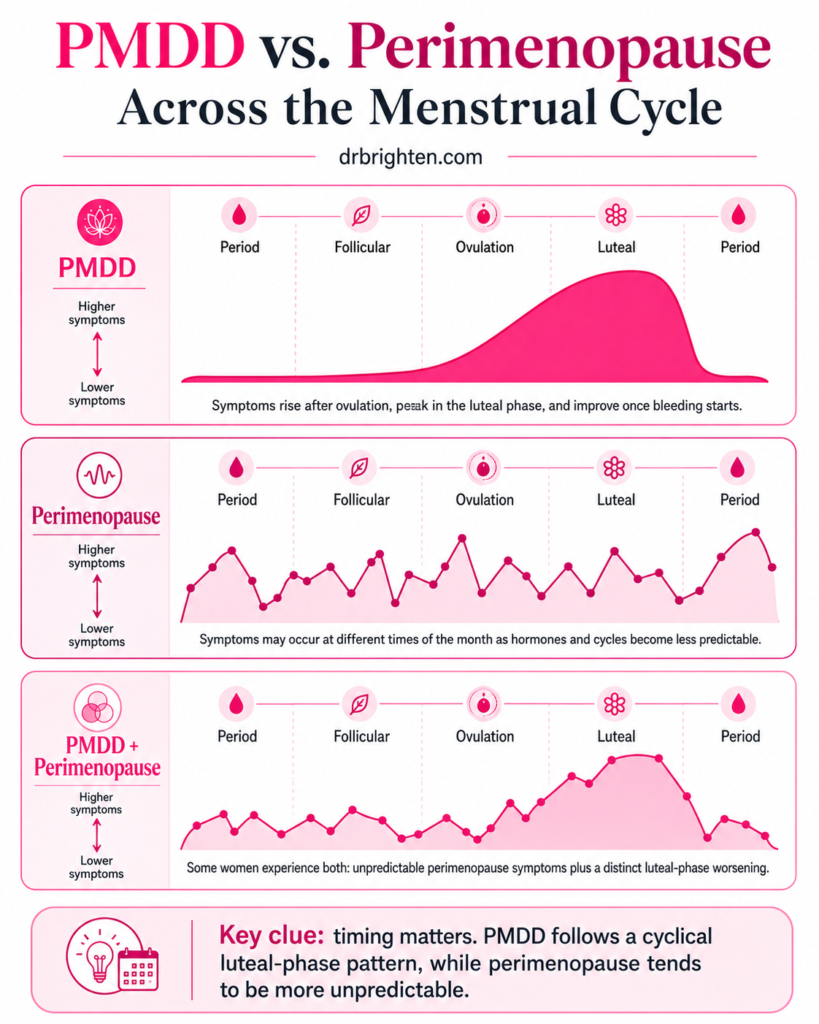
With PMDD, symptoms follow a predictable pattern. They appear after ovulation, worsen during the week or two before your period, and improve shortly after your period begins.
Perimenopause is different because hormone levels fluctuate unpredictably, which means symptoms can occur at any point in your cycle. You may have a difficult week before your period one month, then experience insomnia or anxiety mid-cycle the next.
Over time, you might also notice changes in the timing, length, or heaviness of your periods.
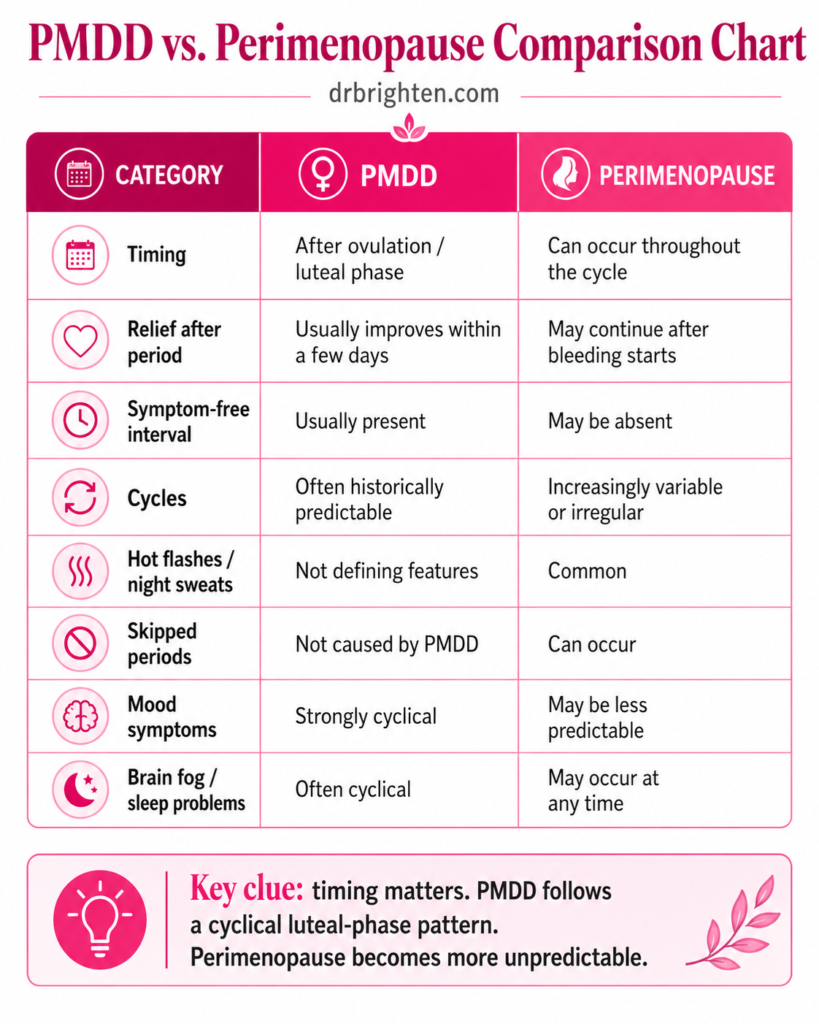
Here’s a simple comparison of PMDD and perimenopause:
PMDD:
- Symptoms occur during the luteal phase (after ovulation).
- Symptoms usually improve within a few days of your period starting.
- Menstrual cycles are typically regular.
- Mood symptoms, such as anxiety, depression, and irritability, are often the most prominent.
- Usually begins during the reproductive years.
Perimenopause:
- Symptoms can occur at any point throughout the month.
- Symptoms may persist even after your period starts.
- Menstrual cycles often become irregular over time.
- Mood symptoms are frequently accompanied by physical symptoms like hot flashes, night sweats, vaginal dryness, and brain fog.
- Usually begins in a woman’s 40s, although it can start earlier.
Of course, real life isn’t always this clear-cut, and some women experience both conditions at the same time.
Related:
Heavy Periods in Perimenopause: Causes, Clots, and How to Stop Heavy Bleeding
PMS Perimenopause Symptoms: Why They Can Feel Worse Than Ever
One of the most common things I hear from women in their late 30s and 40s is, “I’ve always had PMS, but suddenly it’s completely different.“
They’re not imagining it, and there’s a reason why this occurs. During perimenopause, hormonal fluctuations become much more dramatic than they were during earlier reproductive years. Estrogen can surge one week, fall the next, and progesterone production typically becomes less consistent as ovulation becomes more irregular.
Studies suggest that even women who’ve never had significant PMS might notice more of these symptoms during perimenopause[8]:
- More emotional sensitivity
- Increased irritability
- Anxiety before their period
- Worse sleep
- Fatigue
- Brain fog
- More intense breast tenderness or bloating
PMS perimenopause symptoms happen because your brain is adapting to constantly changing hormone levels.
Estrogen influences serotonin, dopamine, and other neurotransmitters involved in mood and emotional regulation.
Progesterone is converted into allopregnanolone, a neurosteroid that interacts with GABA, the brain’s primary calming neurotransmitter. When these hormones go up and down, it’s common to experience changes in how you feel emotionally and mentally.
That doesn’t necessarily mean you have PMDD, either. Women often experience worsening PMS during perimenopause without meeting the diagnostic criteria for PMDD, and the difference is largely about symptom severity.
With PMDD, symptoms become debilitating. They can interfere with normal life and functioning, but then consistently resolve once menstruation begins.
With worsening PMS during perimenopause, symptoms may be uncomfortable but less disruptive, and they often occur alongside other hallmarks of the menopausal transition, such as irregular cycles, hot flashes, or night sweats.
Related:
Why PMDD Treatment Fails: SSRIs for PMDD, Birth Control, and What Your Doctor May Be Missing
Potential Impact of Perimenopause on Sexual Health and Intimacy
PMDD, Perimenopause, or Premenstrual Exacerbation?
PMDD and perimenopause aren’t the only possibilities when your mood, sleep, focus, or anxiety get worse before your period. Another condition called premenstrual exacerbation (PME) can look a lot like PMDD, especially during perimenopause.
With PMDD, symptoms emerge during the luteal phase after ovulation and become minimal or absent after menstruation begins. That symptom-free window during the follicular phase is an important part of the pattern.
With PME, you already have symptoms of another condition throughout the month, but those symptoms become more severe before your period. Depression, anxiety, ADHD, migraines, and other conditions can all show a premenstrual pattern of worsening. PME doesn’t create a separate set of symptoms; it intensifies symptoms that are already present.
Perimenopause can make the distinction harder. As ovulation becomes less predictable and estrogen and progesterone fluctuate more erratically, you may develop anxiety, insomnia, brain fog, irritability, or changes in attention at different points in the month. You can also have a pre-existing condition that gets worse before your period.
A useful way to compare the patterns is:
| Pattern | What You May Notice |
|---|---|
| PMDD | Severe symptoms develop after ovulation, then become minimal or absent within a few days after your period starts. |
| PME | Symptoms are present at other times of the month but become predictably worse during the premenstrual phase. |
| Perimenopause | Symptoms may appear at different points in the cycle and often occur alongside changing cycle length, skipped periods, hot flashes, night sweats, or other signs of the menopausal transition. |
| PMDD + perimenopause | You still have a distinct premenstrual worsening and post-period improvement, but you may also experience perimenopause symptoms at other times of the month. |
This distinction matters because PME and PMDD aren’t interchangeable diagnoses. If you have anxiety throughout the month and it becomes much worse before your period, for example, that pattern may point toward PME of an anxiety disorder rather than PMDD. If you feel substantially better outside the luteal phase and experience severe symptoms only after ovulation, PMDD becomes more likely.
It can be difficult to identify these patterns from memory alone, particularly during perimenopause when cycles become less predictable. Tracking symptoms every day for at least two menstrual cycles can help you and your healthcare provider see whether symptoms disappear after menstruation, remain present but improve, or occur without a consistent relationship to your cycle. Prospective symptom tracking is also an important part of evaluating suspected PMDD and PME.
The goal isn’t simply to decide whether your symptoms are “hormonal.” It’s to identify how your symptoms relate to hormonal changes, because PMDD, PME, and perimenopause can require different treatment strategies.
Can You Have PMDD During Perimenopause?
Yes, you can have PMDD during perimenopause. But current evidence does not establish that perimenopause simply “causes” PMDD. Instead, the increased hormonal variability of the menopausal transition may expose or amplify an existing sensitivity to reproductive hormone changes.
Can Perimenopause Cause PMDD?
Not exactly. Perimenopause doesn’t appear to cause PMDD in the traditional sense.
PMDD is considered a hormone sensitivity disorder in which the brain has an abnormal response to the normal hormonal changes of the menstrual cycle.
However, perimenopause can expose or amplify that hormone sensitivity[9].
Think about it this way: if your brain has always been somewhat sensitive to hormonal shifts, the dramatic fluctuations of perimenopause can make those responses much more noticeable.
Some women who previously experienced mild PMS develop symptoms that resemble PMDD during perimenopause. Others who have lived with PMDD for years find that their symptoms become significantly more intense as they enter the menopausal transition.
Researchers are still working to understand why this happens, but many experts believe the rapidly changing levels of estrogen and progesterone during perimenopause create greater instability in the neurotransmitter systems[10] that regulate mood.
So while we wouldn’t say that perimenopause directly causes PMDD, it can absolutely make hormone-related mood symptoms more severe and more difficult to manage.
Related:
Perimenopause Anxiety Disorder: Can Unbalanced Hormones Like Progesterone Cause Anxiety?
Extreme Fatigue in Perimenopause: What’s Really Going On—And What Helps?
What Happens to PMDD During Perimenopause?
Can you have PMDD during perimenopause? Absolutely. In fact, PMDD in perimenopause is something I see frequently in clinical practice.
Women who have a history of PMDD often report that the years leading up to menopause are some of the most difficult they’ve experienced hormonally. Mood swings can become more intense, anxiety may increase, sleep often worsens, and emotional resilience can feel lower than it did in their 20s or 30s.
The challenge is that perimenopause adds another layer of hormonal unpredictability. For instance, some cycles are ovulatory. Others aren’t. Hormone levels can spike unexpectedly or drop more abruptly than they did in earlier years.
For those whose brains are already highly sensitive to these hormonal changes, that unpredictability can feel overwhelming.
It’s also possible for someone to have PMDD and perimenopause at the same time.
When this happens, you might notice that some symptoms still follow your menstrual cycle—as they do with PMDD—while others, such as hot flashes, night sweats, sleep disruption, or brain fog, occur throughout the month.
Recognizing that these two conditions can overlap is important because it helps guide treatment.
Rather than assuming everything is “just menopause” or “just PMS,” your healthcare provider can develop a plan that addresses both the hormonal transition of perimenopause and the hormone sensitivity associated with PMDD.
Related: The Hidden Causes of Perimenopause Exhaustion: Stress, Hormones, and Your Brain with Mariza Snyder
Does PMDD Get Worse During Perimenopause?
PMDD can become more difficult for some women during perimenopause, although research specifically tracking PMDD severity across the menopausal transition is still limited. Here’s what we know:
- PMDD does not inherently worsen simply because someone is older
- symptoms may change during reproductive transitions
- perimenopause may be a particularly challenging window
- true PMDD should resolve after ovarian cycling ends
While every woman’s experience is different, research and clinical experience suggest that PMDD symptoms often become more difficult to manage during the menopausal transition.
If you’ve lived with PMDD for years and suddenly feel like your symptoms have become more intense in your late 30s or 40s, that’s entirely possible. The hormonal fluctuations of perimenopause can amplify the very brain pathways that are already sensitive in PMDD.
Instead of the relatively predictable rise and fall of estrogen and progesterone that occurs during most reproductive years, perimenopause is characterized by dramatic hormonal swings. And for women with PMDD, these hormonal shifts can contribute to:
- More severe mood swings
- Increased anxiety
- Greater irritability or anger
- Worsening depression
- Poorer sleep
- More intense fatigue
- Increased brain fog
Some also find that their “good” weeks become shorter while the difficult days become longer. If this is happening to you, it’s worth discussing with your healthcare provider rather than assuming it’s something you simply have to endure.
Related: Why Can’t I Sleep? The Real Reasons for Perimenopause Sleep Issues (and What Actually Helps)
Does PMDD Get Worse With Age?
Not necessarily, but it does commonly change.
PMDD doesn’t automatically worsen every year, and many find that their symptoms improve after menopause, when the cyclical hormone fluctuations that trigger PMDD come to an end.
However, the years leading up to menopause can be especially challenging.
That said, if your symptoms have changed significantly, don’t assume it’s simply aging. A thorough evaluation can help determine whether PMDD, perimenopause, thyroid dysfunction, depression, anxiety, iron deficiency, or another condition is contributing to what you’re experiencing.
Related:
Perimenopause Brain Fog: Causes, Symptoms, and Treatment Options
Saffron and PMDD: Natural Relief for Mood Swings, Anxiety & PMS
How Doctors Diagnose PMDD vs. Perimenopause
Diagnosing PMDD
- symptom pattern
- impairment
- prospective daily tracking
- two symptomatic cycles
- DRSP or equivalent tracking tool
- rule out PME/other psychiatric conditions
Diagnosing Perimenopause
- age/context
- menstrual-cycle changes
- symptoms
- hormone testing limitations
- when testing may still be appropriate
Is PMDD a Sign of Perimenopause?
Not by itself. PMDD can develop years before perimenopause and often begins during a woman’s reproductive years.
However, if you’ve always had mild PMS and suddenly develop much more severe mood symptoms in your late 30s or 40s—especially alongside changes in your menstrual cycle—it may be worth considering whether you’re entering perimenopause.
Signs that point more toward perimenopause include shorter or longer menstrual cycles, skipped periods, hot flashes, night sweats, sleep disturbances, and increasing brain fog.
When these symptoms occur alongside severe premenstrual mood changes, it’s possible you’re experiencing both PMDD and perimenopause.
Related: Histamine and PMDD: The Hidden Link Worsening Your Symptoms
PMDD Perimenopause Treatment
Both PMDD and perimenopause are treatable. The key is identifying which condition, or combination of conditions, is driving your most concerning symptoms.
Treating PMDD
Treatment for PMDD often includes:
- Selective serotonin reuptake inhibitors (SSRIs), which are considered a first-line treatment for many women
- Certain hormonal contraceptives designed to suppress ovulation
- Cognitive behavioral therapy (CBT)
- Regular exercise
- Stress management techniques
- Optimizing sleep
- Addressing nutrient deficiencies when present
Treating Perimenopause
Ultimately, perimenopause treatment depends on your symptoms and medical history. Options may include:
- Menopausal hormone therapy (MHT) for appropriate candidates
- Lifestyle strategies that support sleep, stress resilience, and metabolic health
- Resistance training to preserve muscle and bone
- Adequate protein intake
- Targeted supplements when deficiencies are identified
- Medications to address specific symptoms, such as mood changes or hot flashes
What Changes When You Have Both PMDD and Perimenopause?
When PMDD occurs during perimenopause, treatment may need to address both conditions simultaneously.
For example, someone may benefit from therapies that stabilize hormone fluctuations while also supporting serotonin levels[11] and improving sleep quality.
This is why self-diagnosis can be so difficult. Although social media often encourages women to attribute every mood change to hormones, symptoms such as anxiety, depression, insomnia, and brain fog can also result from thyroid disorders, anemia, vitamin B12 deficiency, ADHD, chronic stress, or other medical conditions.
A comprehensive evaluation is the best way to determine what’s driving your symptoms and which treatments are most likely to help.
Related: Guide to Treating PMDD (Premenstrual Dysphoric Disorder)
When Should You See Your Doctor?
It’s common for women to normalize symptoms and tell themselves they’re just stressed, getting older, or not coping as well as everyone else.
But if your symptoms are affecting your quality of life, you don’t have to wait until they’re unbearable before asking for help. I encourage you to schedule an appointment if:
- Your mood symptoms interfere with work, relationships, or parenting
- You dread the week or two before your period every month
- Your menstrual cycles have become noticeably irregular
- You’re experiencing hot flashes or night sweats
- Brain fog or fatigue is making it difficult to function
- You’re struggling with anxiety or depression
- Your symptoms have changed significantly over the past few years
- You’re having thoughts of self-harm or feeling hopeless
If you’re experiencing thoughts of harming yourself or feel that you’re in immediate danger, seek emergency medical care or contact emergency services right away.
The earlier you identify whether you’re dealing with PMDD, perimenopause, or both, the sooner you can begin treatment and start feeling more like yourself again.
The Bottom Line on PMDD vs. Perimenopause
If you’ve been wondering whether you’re dealing with PMDD or perimenopause, know that the overlap between these two conditions is one of the biggest reasons women in their late 30s and 40s feel confused about what’s happening to their bodies.
PMDD and perimenopause can look similar on the surface, but they’re driven by different processes.
PMDD is a heightened sensitivity to the normal hormonal changes that occur after ovulation, while perimenopause is a natural life stage marked by increasingly unpredictable fluctuations in estrogen and progesterone.
For many women, the answer isn’t PMDD or perimenopause—it’s both. The hormonal changes of perimenopause can amplify pre-existing PMDD or make hormone-related mood symptoms much more noticeable than they were in earlier years.
The most important takeaway is this: you don’t have to simply “push through” these symptoms.
Whether you’re experiencing debilitating mood changes before your period, new anxiety in your 40s, brain fog, sleep problems, or hot flashes, there are evidence-based treatments that can help.
A healthcare provider familiar with hormone-related mood disorders can help determine what’s driving your symptoms and develop a treatment plan that’s tailored to your needs. You deserve to feel like yourself—not just for one week each month, but all month long.
FAQs About PMDD Vs. Perimenopause & How to Tell the Difference
The biggest difference is timing. PMDD symptoms consistently occur after ovulation and improve shortly after your period begins. Perimenopause symptoms are usually more unpredictable and may occur throughout the month. Irregular periods, hot flashes, and night sweats are also more suggestive of perimenopause.
Not necessarily. PMDD can develop years before perimenopause and often begins during the reproductive years. However, if severe premenstrual symptoms first appear in your late 30s or 40s—especially alongside changes in your menstrual cycle—it may be worth evaluating whether you’re entering perimenopause.
Current evidence suggests that perimenopause doesn’t directly cause PMDD. However, the dramatic hormonal fluctuations of perimenopause can worsen existing PMDD or reveal an underlying sensitivity to hormonal changes, making symptoms feel much more intense.
Yes. Many women experience PMDD during perimenopause. In fact, the hormonal instability of the menopausal transition can make PMDD symptoms more noticeable or more difficult to manage.
For many women, yes. Although everyone’s experience is different, fluctuating estrogen and progesterone levels during perimenopause can intensify mood swings, anxiety, irritability, and sleep disturbances in women with PMDD.
Not necessarily. PMDD doesn’t automatically worsen as you get older, but many women notice increased symptoms during perimenopause because of changing hormone patterns. After menopause, PMDD symptoms typically resolve because ovulation—and the cyclical hormonal changes that trigger PMDD—has stopped.
Many women experience worsening PMS during perimenopause, including mood swings, irritability, anxiety, bloating, breast tenderness, fatigue, headaches, and sleep disturbances. Unlike PMDD, these symptoms are generally less severe and may occur alongside irregular periods, hot flashes, or night sweats.
The best PMDD perimenopause treatment depends on your symptoms and medical history. Treatment may include SSRIs, cognitive behavioral therapy, hormonal therapies, menopausal hormone therapy for appropriate candidates, lifestyle changes, exercise, sleep optimization, and correcting nutrient deficiencies. Because PMDD and perimenopause often overlap, many women benefit from a personalized treatment plan that addresses both conditions.
Routine hormone testing isn’t usually necessary to diagnose PMDD because the condition is identified based on the timing and pattern of symptoms. During perimenopause, hormone levels fluctuate significantly from day to day, so a single blood test often doesn’t provide a complete picture. Your healthcare provider may recommend testing to rule out other conditions, such as thyroid disease or nutrient deficiencies, depending on your symptoms.
Yes. While lifestyle changes aren’t a replacement for medical treatment when it’s needed, regular exercise, adequate protein intake, blood sugar balance, stress management, good sleep habits, limiting alcohol, and addressing nutrient deficiencies can support hormone health and may help reduce symptoms in both PMDD and perimenopause.