



Low energy. Vanishing libido. Brain fog that makes you feel like you’re pushing through mud. Muscle that refuses to build no matter how hard you train. If you’ve ever been told this is “just stress,” “just aging,” or worse—all in your head—this episode is for you. In this powerful, no-fluff conversation, Dr. Jolene Brighten breaks down how to boost testosterone naturally in women by unpacking the real, research-backed reasons testosterone drops—and exactly what to do about it.
This episode goes far beyond surface-level hormone talk. You’ll learn why low testosterone is far more common in women than most clinicians acknowledge, how modern life quietly sabotages androgen production, and why symptoms like low motivation, poor resilience, loss of orgasms, and difficulty setting boundaries are biochemical—not psychological. Most importantly, you’ll walk away with specific, evidence-based strategies you can start implementing today to support testosterone production, signaling, and receptor function—whether or not hormone therapy is part of your future plan.
How to Boost Testosterone Naturally in Women: What You’ll Learn in This Episode
- Why low testosterone in women is never “normal”, even though it’s incredibly common
- The overlooked connection between chronic stress, cortisol, and suppressed DHEA to testosterone conversion
- How the HPA axis (hypothalamic–pituitary–adrenal axis) quietly controls your androgen output
- Why high-achieving, “undercovered” women are uniquely vulnerable to testosterone depletion
- The surprising reason you can feel exhausted but wired at night when testosterone is low
- How systemic inflammation (including conditions like endometriosis) suppresses adrenal testosterone production
- The exact ways hormonal birth control reduces testosterone production, availability, and receptor signaling
- Why combined oral contraceptives can cause a 40–60% reduction in free testosterone
- How increased sex hormone–binding globulin (SHBG) locks away your active testosterone
- Why some women experience persistent testosterone suppression even after stopping the pill
- The truth about age-related testosterone decline—and why it starts decades earlier than most women are told
- Why ovarian testosterone often drops before estrogen, especially in perimenopause
- How adrenal glands become more stress-sensitive with age, worsening low testosterone symptoms
- The real reason low testosterone shows up as loss of drive, poor boundaries, and mental fatigue, not just low libido
- Evidence-based nutrients and supplements—with clinical dosages—that support androgen synthesis and signaling
- Why endocrine disruptors in plastics and fragrances are a silent threat to testosterone receptors
- Simple, high-impact lifestyle swaps that offer a big hormonal return without overwhelm
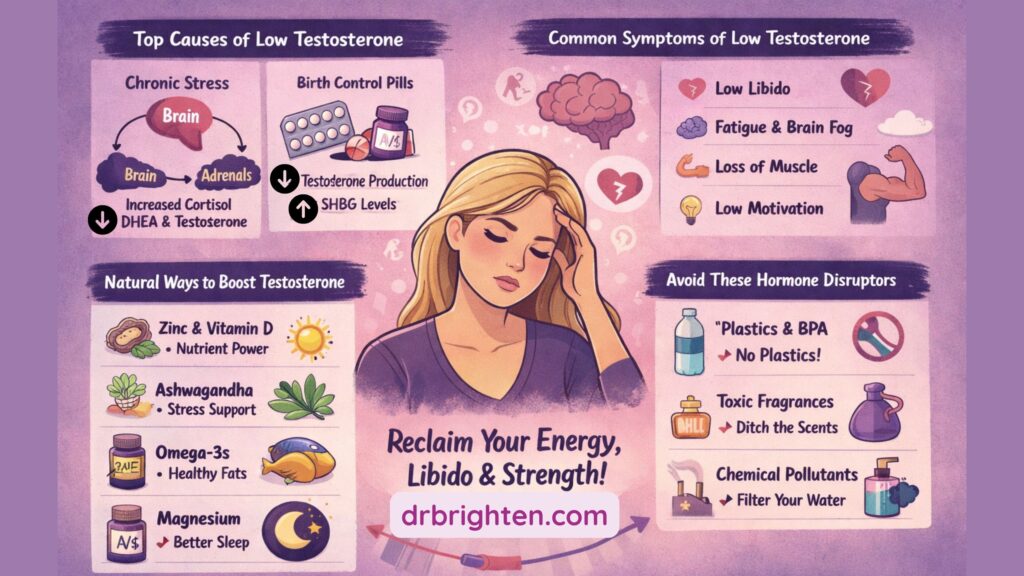
How to Boost Testosterone Naturally in Women: The Science, the Systems, and the Strategy
When people talk about testosterone, the conversation is almost always framed around men. That’s a mistake—and one that has left millions of women underdiagnosed, undertreated, and misunderstood. Testosterone is not a “male hormone.” It is a critical hormone for women’s energy, cognition, muscle integrity, libido, motivation, confidence, and resilience.
In this episode, Dr. Brighten explains that women produce testosterone primarily through two systems: the ovaries and the adrenal glands, with the hormone DHEA acting as a key precursor. Anything that disrupts these systems—stress, inflammation, medications, aging, or environmental toxins—can significantly lower testosterone levels and impair how that testosterone functions at the receptor level.
Chronic Stress and Cortisol: The Hidden Testosterone Blocker
One of the top causes of low testosterone in women is chronic stress, but not in the simplistic “just relax” way it’s often discussed. Chronic stress dysregulates the HPA axis—the communication loop between the brain and adrenal glands. When cortisol remains elevated or erratic over time, DHEA production drops, and testosterone production follows.
This is why women under sustained stress often report:
- Low libido
- Poor strength gains despite consistent training
- Burnout and emotional flatness
- Difficulty initiating or completing tasks
- Feeling tired but unable to sleep
Importantly, stress isn’t always psychological. Chronic inflammation, infections, autoimmune conditions, and diseases like endometriosis all place a continuous demand on the stress response system, further impairing adrenal androgen output.
Hormonal Birth Control and Testosterone Suppression
Another major—and frequently ignored—cause of low testosterone in women is combined oral contraceptive use. The science here is robust and well-documented, yet rarely explained to patients.
Combined oral contraceptives:
- Suppress ovarian testosterone production
- Increase SHBG, which binds free testosterone and reduces bioavailability
- Introduce anti-androgenic progestins that block testosterone receptors
- Can increase inflammation, further impairing adrenal androgen synthesis
The result? Many women experience a profound drop in free testosterone, often accompanied by loss of libido, muted orgasms, reduced genital sensitivity, mood changes, and difficulty building muscle. These effects are biochemical and documented in prescribing literature, not imagined or emotional.
Even more concerning: testosterone levels may remain suppressed after discontinuation, especially following long-term use.
Age-Related Testosterone Decline and Perimenopause
Testosterone peaks in early adulthood and begins declining as early as the late 20s. By the late 30s and 40s—particularly during perimenopause—many women start to feel the effects. Ovarian testosterone production often declines earlier than estrogen, placing greater reliance on adrenal output at a time when adrenal glands are becoming more stress-sensitive.
Low testosterone in perimenopause often shows up as:
- Reduced resilience and stress tolerance
- Worsening brain fog
- Loss of motivation and follow-through
- Decreased confidence and boundary-setting
- Global reduction in “drive,” not just sex drive
Dr. Brighten emphasizes that while testosterone therapy may be appropriate for some women (and is addressed in a future episode), foundational support for natural testosterone production and signaling is essential for everyone.
Evidence-Based Nutrients That Support Testosterone Naturally
This episode provides specific, clinically relevant strategies for supporting testosterone without jumping straight to prescriptions.
Vitamin D3 for Testosterone Support
In clinical practice, supplementation is often considered when levels fall below 50 ng/mL, with common doses ranging from 2,000–4,000 IU daily, adjusted based on labs and individual response.
For those looking for a clinically dosed option, Dr. Brighten Essentials offers a Vitamin D3/K2 supplement designed to support optimal hormone signaling, but any high-quality vitamin D supplement that is third-party tested can be appropriate.
Ashwagandha for Testosterone Support
Because chronic stress suppresses DHEA production and disrupts HPA-axis signaling, prolonged cortisol dysregulation is strongly associated with lower downstream testosterone production in women.
In clinical practice, adaptogenic herbs such as ashwagandha are often used to support cortisol modulation and restore more balanced adrenal signaling. Human clinical trials suggest doses around 200 mg once or twice daily, with timing adjusted based on stress load and sleep patterns.
For those seeking a clinician-formulated option, Dr. Brighten Essentials Adrenal Support includes ashwagandha alongside complementary nutrients designed to support adrenal resilience and hormone signaling. However, any high-quality ashwagandha extract that is standardized and third-party tested may be appropriate.
Magnesium Glycinate for Testosterone Support
Magnesium plays a critical role in hormone availability by influencing sex hormone–binding globulin (SHBG), insulin sensitivity, and sleep quality—three factors that directly impact free testosterone levels in women.
In clinical practice, magnesium supplementation is commonly considered when symptoms such as poor sleep, stress intolerance, or low energy are present, even if serum levels appear within range. Typical dosing is around 300 mg daily, often taken in the evening to support relaxation and sleep architecture.
For those looking for a well-tolerated option, Dr. Brighten Essentials Magnesium Plus is formulated to support nervous system regulation and hormone balance. That said, any magnesium supplement using a bioavailable form—such as magnesium glycinate—that is third-party tested can be an appropriate choice.
Omega-3 Fatty Acids for Testosterone Support
Omega-3 fatty acids play an important role in reducing inflammation, supporting metabolic signaling, and maintaining healthy androgen receptor function, all of which influence how effectively testosterone can exert its effects in the body.
In clinical practice, omega-3 supplementation is often recommended to support hormonal signaling, particularly in individuals with inflammatory drivers, metabolic stress, or perimenopausal hormone shifts. Common dosing ranges from 1–2 grams daily of combined EPA and DHA, adjusted based on dietary intake and individual needs.
For those seeking a concentrated source, Dr. Brighten Essentials Omega Plus provides EPA and DHA in a form designed to support both hormone and brain health. As always, any high-quality fish oil that is third-party tested for purity and potency may be suitable.
- Zinc: Required for androgen synthesis. Deficiency is linked to lower testosterone. Typical dosing ranges from 15–30 mg daily, balanced with copper.
- Vitamin D: Acts as a steroid hormone. Low vitamin D correlates with lower free testosterone. Common dosing ranges from 2,000–4,000 IU daily, adjusted by labs.
- Magnesium (glycinate): Supports free testosterone by influencing SHBG, improves sleep, and enhances insulin sensitivity. Typical dose: ~300 mg nightly.
- Ashwagandha: Shown in human clinical trials to indirectly raise testosterone by modulating cortisol and HPA axis signaling. Typical dose: 200 mg once or twice daily.
- Omega-3 fatty acids (EPA + DHA): Improve inflammation, metabolic signaling, and androgen receptor function. Typical dose: 1–2 grams daily.
These interventions don’t replace hormone therapy when it’s needed—but they optimize the terrain so hormones can work more effectively and with fewer side effects.
Endocrine Disruptors: The Receptor-Level Problem
Even when testosterone production is adequate, environmental chemicals can disrupt how hormones function. Compounds like BPA, phthalates, and flame retardants can:
- Increase SHBG
- Impair androgen receptor signaling
- Worsen hormonal chaos during perimenopause
The episode outlines simple, high-impact swaps:
- Replace plastic with glass or stainless steel, especially for food and water
- Never heat food in plastic
- Filter drinking water when possible
- Reduce fragrance exposure from candles, plugins, and personal care products
These changes require minimal effort but can significantly improve hormonal signaling.
This episode is brought to you by:
Dr. Brighten Essentials Radiant Mind—a science-backed formula created to support women’s brain health through every stage of life. If you’ve ever felt the brain fog of perimenopause or noticed how ADHD can amplify challenges with focus, memory, mood, or sleep, you’re not alone. Radiant Mind combines clinically studied saffron extract, Bacognize® Bacopa, Cognizin® Citicoline, and zinc to help nourish your brain chemistry and support clarity, calm, and resilience. And for a limited time, when you order Radiant Mind, you’ll also receive a free bottle of our best-selling Magnesium Plus—the perfect partner for restorative sleep and steady mood. Learn more at drbrighten.com/radiant.
LMNT Electrolytes —Want a clean, science-backed way to stay hydrated and energized? At LMNT, electrolytes are formulated with a precise balance of sodium, potassium, and magnesium — with no sugar, no artificial ingredients, and no unnecessary fillers. Designed to support hydration, muscle function, and daily energy, LMNT helps you feel your best through workouts, busy days, and everyday life.
Exclusive for podcast listeners: Visit DrinkLMNT.com/Brighten to receive a free sample pack with any purchase.
Fygg — a dentist-developed oral care brand on a mission to “Feed Your Good Guys.” Fygg makes science-backed, microbiome-friendly oral care products — like fluoride-free toothpaste and remineralizing varnish — that support a balanced oral microbiome without harsh chemicals, foam, or unnecessary ingredients. Developed by dentists and grounded in research, Fygg helps strengthen enamel, maintain oral health, and promote a healthier mouth for the whole family.
Use code DRBRIGHTEN for 15% off of their products (both one-time and subscription)
Links mentioned in this episode:
- Dr. Brighten’s hormone optimization plan: https://drbrighten.com/plan
- Resources on cortisol support, perimenopause, and post–birth control recovery (available through The Dr. Brighten Show)
- Nutrients and combination products referenced in the episode (linked in show notes and video description)
- Upcoming episode on testosterone hormone therapy for women
Frequently Asked Questions About How to Increase Testosterone Naturally in Women
No. While it’s common, low testosterone is not considered normal and is associated with measurable changes in energy, libido, muscle mass, cognition, and motivation.
Low libido, reduced orgasm intensity, loss of muscle, fatigue, brain fog, poor motivation, difficulty setting boundaries, and diminished resilience.
Yes. Chronic stress dysregulates the HPA axis, suppresses DHEA production, and reduces downstream testosterone synthesis.
Combined oral contraceptives are strongly associated with reduced testosterone production, increased SHBG, and impaired androgen receptor signaling.
Sometimes, but suppression can persist—especially after long-term use—making targeted support essential.
Decline can begin in the late 20s, with more noticeable effects in the late 30s and 40s, particularly during perimenopause.
Certain nutrients—when used at evidence-based doses—can support androgen synthesis, availability, and receptor function.
No. Many women benefit from foundational lifestyle and nutritional strategies first, though therapy may be appropriate in some cases.
Yes. Endocrine disruptors can impair hormone signaling even when levels appear normal on labs.
No. Low libido is frequently biochemical and hormone-driven, particularly in cases of low testosterone.
If you’ve been searching for real answers on how to boost testosterone naturally in women, this episode delivers clarity, science, and actionable strategies—without minimizing your experience or oversimplifying your physiology.
Supplements do not “force” testosterone production, but certain nutrients—such as vitamin D, magnesium, omega-3 fatty acids, and adaptogenic herbs—can support the systems involved in androgen production and signaling when deficiencies or stress-related suppression are present.
This depends on individual needs, lab results, and tolerance. Some people prefer targeted single nutrients, while others find combination formulas more convenient. The most important factors are appropriate dosing, quality sourcing, and clinical relevance—not brand loyalty.
Transcript
[00:00:00]
Dr. Brighten: Low testosterone in women is actually a lot more common than most clinicians are aware of, and certainly most women are aware of, but it is never considered normal. We're gonna talk about the top three causes of low testosterone in women, and I'm gonna give you solutions on how exactly to address these and start to boost your testosterone naturally today.
If you're new to the channel. Hi, I'm Dr. Jolene Brighton. I'm board certified in naturopathic endocrinology. I've been supporting women with their hormone health for over 15 years. I'm a nutrition scientist, I'm a certified menopause specialist, and I'm also a certified sex counselor. And this is the Dr. Brighton show. If you can take a minute to leave me a review, I would appreciate it, but I'm not gonna hold you up any longer 'cause we need to get into exactly what is going on with your testosterone and what to do about it. Now listen. If you have low energy, you're having trouble setting boundaries, you're losing muscle mass, or you can't put it on, no matter how hard you try, your [00:01:00] libido has tanked, your orgasms have gone missing, and you're finding that maybe you could start a project, but you don't have the motivation to do it, and you certainly don't have the mental energy to see it through.
You may have low testosterone. So let's get into the top three reasons. I see low testosterone in women and then stick around so I can give you solutions on what to do about it.
Low Testosterone - Side 2: Number
Dr. Brighten: one is chronic stress. Cortisol suppresses how your brain talks to your adrenal glands and how your adrenal glands respond to that communication. The adrenal glands are one of our primary sources of testosterone production by way of a hormone called DHEA. Now, what chronic stress does is it causes dysregulation in the HPA access, the hypothalamic pituitary, that's the brain part, adrenal access, too little glands that sit on top of your kidneys.
When you're under chronic stress, DHEA levels drop. And what we see is [00:02:00] testosterone can go low. And this is especially where high achieving undercovered women are especially vulnerable. And what I mean by that is the people who are constantly in hustle culture, never giving themselves a break, whether that is in their exercise routine, their work routine, their hardcore mom life, not taking enough time to pause.
And what we see clinically is that you may have low libido. Low motivation, poor strength gains, and you're feeling burnt out. Maybe you're very, very tired, but when your head hits the pillow, it's wired. It's that wired and tired filling.
Now, keep in mind, chronic stress is not always psychological. Sometimes it can be due to inflammation, a chronic infection. If you have something like endometriosis, anything that causes chronic systemic inflammation can also affect adrenal GL function, and that can affect testosterone production. Now, make sure you stick around till the end because I'm going to be [00:03:00] giving you the best tips for increasing your testosterone naturally, including the dosages of supplements that I use in my clinical practice.
Number two is one that most doctors don't talk about, but it's very common to see, and is hormonal birth control suppressing androgen production? Utilization actually altogether. This is one of the most overlooked causes of low testosterone in women, and there is lots of science to support this.
So what does the science say? How does the pill tank your testosterone? So combine oral contraceptives that is estrogen and progestin, they shut down ovarian testosterone production. So. Well, how do women make testosterone? Ovaries and adrenals are the primary sites of testosterone production.
So that chronic stress we talked about that's hitting the adrenal glands, but the pill, it actually hits both, and it goes beyond that. So the, the pill can shut down how you produce testosterone from the ovaries, [00:04:00] and in some people it can raise inflammation and that can affect how your adrenal glands then make testosterone.
But there's more.
Taking oral estrogen significantly increases a protein called sex hormone binding globulin. Sex hormone binding globulin does exactly what it sounds like. It's gonna bind to your testosterone, and that's gonna reduce your free, which is your active testosterone, and means it's less bioavailable.
So now we don't make as much testosterone. What we do make we bind up. But it goes beyond that. I know, right? Could there be another layer? Yes, there is. So some progestins are anti androgenic that's anti testosterone, and they'll block testosterone signaling at the receptor. So here's the layers in which the pill hits your testosterone
shuts down production from the main glands, then it binds up what's there, and then there's receptor dysfunction. Even increased [00:05:00] inflammation can lead to receptor dysfunction. And so we have seen, there are multiple studies showing that there can be like a 40 to 60% reduction in free testosterone in women who are using combined oral contraceptive pills.
So this is very specific to the pill. And then. The worst part of all of this is that these levels may remain suppressed even after you stop, especially if you've been on the pill long term..
So what's really upsetting about this is that the pill is often used for conditions like PCOS, polycystic ovarian syndrome to address the high androgen state, the oily skin, the acne, the hirsutism, the hair growth where you don't want it. And doctors know that it can drop your testosterone, but they won't acknowledge that it's a pill problem When you report low libido and not a you problem, and what women are often told is just have a glass of wine and get some lube.
Super lame, and I'm sorry, I apologize for my colleagues. But the reality is, [00:06:00] is that the pill does bring down testosterone, which does have therapeutic use and that's well known, but also so is the side effect of low libido. So you may have low libido, loss of orgasms, uh, your genitals may feel. Sensitive.
You may have loss of muscle tone despite exercise. There are studies showing that that's not true in athletes. We don't have great robust study showing that it's not true in all populations. Athletes keep in mind, are constantly stimulating their muscle fibers like on a daily basis, so very different population.
You may also have mood changes or if just feeling like I don't feel like myself anymore. And so it's important to understand that these side effects that come with the pill, they're not psychological. They literally are biochemical. They are in the package insert. They're very well documented. They're prescribers, handbooks, and so we know the pill can be one of the top causes of dropping women's testosterone.
Now before we get into our third [00:07:00] cause of low testosterone in women, I do wanna remind you that I have a plan for you, drbrigthen.com/plan. That will give you some of the tips I talk about today and even more because it's got recipes, it's got a meal plan, it's got exercise, sleep, stress reduction tips, and all of that is geared at helping you.
Implement everything that we talk about on this podcast so you can begin to optimize your hormones. So that's D-R-B-R-I-G-H-T-E n.com/plan. I encourage you to grab that. I'll put it in the show notes. I will also put it in the description below if you are watching on YouTube
Now onto the third cause of low testosterone in women. And remember, there can be more causes in this, but these are just the top three that I see clinically. So the last one is age related decline. This is especially common in perimenopause. And if you're thinking, oh, perimenopause, that's for like a 50-year-old.
Low Testosterone - Side 2: Slow
Dr. Brighten: your roll. We're gonna get into that because here's the truth. [00:08:00] Testosterone peaks in our early adulthood, but it starts declining as soon as our late twenties. By our late thirties, we typically start feeling it a bit, and by our forties, we can definitely fill the effects of low testosterone. And that's because, again, one of our primary sources of testosterone production.
Are the ovaries and ovarian testosterone production will drop earlier than estrogen in many cases, but you have your adrenal glands to fall back on, right? So the adrenal glands are gonna be your backup. Like they're like your generator for testosterone power goes out, adrenal glands come online, and they're gonna contribute to that DHEA.
That becomes testosterone. Their contribution becomes more important in perimenopause, however. They become more stress sensitive. In fact, many women in perimenopause experience HPA Access dysregulation, [00:09:00] how the brain and the adrenal glands are talking, it becomes dysfunctional, not because of you, because the world is stressful.
Your sandwiched in caretaking, you no longer have progesterone to help you feel chill and calm. And now what does low testosterone look like for you? Reduce resilience. Worsening brain fog, even if your labs are normal, LA lack of motivation. And you might find that your drive is down, not just your sex drive, like your drive altogether, like not holding boundaries, do not care, like don't wanna follow through on anything.
And that's the testosterone problem.
So while perimenopause related testosterone decline may mean that you need to consider testosterone hormone therapy. We're gonna talk about that in next week's episode. I would say to you, if you were my patient, that you should also be examining. Other avenues of your life that support testosterone. So I'm always a fan of [00:10:00] everything that we can do for you.
That doesn't require a prescription for me, because that means you get to be a lot more autonomous in your health. But sometimes we do need more support. But what I wanna move into now are the evidence-based ways that you can help. Increase your testosterone levels and support your natural systems in doing it right.
These do not replace hormone therapy when that's needed, but they will support production of testosterone and signaling, and if you choose to go the hormone route, they create an excellent foundation for you to have less side effects and get more benefits from those hormones. So number one is zinc. It's required for androgen synthesis, so eat your oysters, eat your steak.
If you're vegan or vegetarian, don't worry. Eat your pumpkin seeds, but get more zinc in your diet. When you have a deficiency in zinc, you will have lower testosterone. What we're looking at for doses of zinc is anywhere in the range of 15 [00:11:00] to 30 milligrams a day.
But what's important for you to know is that we always balance zinc with copper. We do not exceed 40 milligrams a day, especially long term. Now number two is vitamin D. This is not about your immune system. This is about it functioning as a steroid hormone, so it acts like a hormone. And we know from the research that low levels of vitamin D that correlate with lower free testosterone. So you've gotta get your levels checked. If you are experiencing low testosterone, your vitamin D levels are below 50, we, we gotta start talking about supplementation and typically we're using a dose of 2000 to 4,000 IUs a day.
Your provider should adjust that based on your vitamin D labs.
Now if you're on the pill and you were like, oh God, I just have to like quit the pill, like that's the only way forward. That truly is the root cause of your low testosterone. You may wanna look at a different form of [00:12:00] contraception to be using, so maybe you're going to go with a copper IUD non-hormonal route, or you're gonna go with the, you know, hormonal IUD.
The biggest thing is don't just jump off the pill without a backup method. If your primary reason for using it is not getting pregnant. Now the pill is well known for depleting nutrients and one of those is magnesium. Everyone who's experiencing low testosterone, magnesium glycinate is one you wanna consider.
Low Testosterone - Side 2: And
Dr. Brighten: why I bring up the pill with this is because magnesium can help improve free testosterone by influencing that protein sax, hormone binding globulin that we talked about. It's also gonna support your sleep and insulin sensitivity. Two things we haven't talked about, but those can absolutely impact your testosterone in a negative way.
When we're dosing magnesium, typically we're using 300 milligrams a day and we're doing that at night because magnesium glycinate, that little glycinate molecule is gonna help you sleep better. So that's the [00:13:00] perfect time to use it. You can take it at dinner, or you can take it 30 to 60 minutes before bed.
I wanna move on to talking about an herb that can be helpful, but I wanna preface by saying there are no magic herbs that will force a woman's testosterone higher. But there are herbs like ashwagandha with clinical human trials that show that it can help with raising testosterone indirectly by affecting the HPA access.
So the adrenal glands, again, coming in here, we gotta, and if you're perimenopause, listen in because this is something that can be helpful. It also can help with restoring hormonal signaling. So when we're looking at ashwagandha. We wanna be taking that typically twice a day if we are under a lot of stress, is because it can help with modulating cortisol levels and in modulating cortisol levels and that, remember I said DHEA can be suppressed, can indirectly support testosterone, but if you have to choose to take it one time a day, I would say [00:14:00] to hit it in the evening to help you get better sleep.
So Ashwaganda may improve androgen levels in stressed individuals, and typical dose that we're looking at is 200 milligrams every time that you're taking it. So if you're taking it twice a day, 200 milligrams twice a day, if you're taking it once a day, if. Just the 200 milligrams and I will link in the show notes and I'll put in the description below some of the products that I use in my clinical practice.
You know, I'm talking about several nutrients here. It's nice when you can get combination products so that you're not having to take tons of things. I will link to some of those to make it easier, and so you can see what I use. Now the next one to consider is increasing Omega-3 fatty acids in your diet that can help improve metabolic and ovarian signaling. It can also help with inflammation. So these are anti-inflammatory. Remember we talked about inflammation can be a driver of why there's that cortisol issue, why there's [00:15:00] that HPA access dysregulation.
So taking Omega-3 fatty acids. This can support androgen receptor function. So remember, we can make it and then we gotta have it free, but we've gotta get it onto the receptor. And Omega-3 fatty acids can help with that. Typically, we're looking at a dose of one to two grams a day, depending on your needs.
And we're gonna do a combination of EPA, which is anti-inflammatory, and DHA because we love our brain. And having the combination can work really well, not just for our hormones, but for our brain health as well.
Low Testosterone - Front 2: Now
Dr. Brighten: before we move into the next one, which is very, very important and not often talked about, I wanna remind you that the Dr. Brighton Show has many episodes on how to support your cortisol, how to support yourself through perimenopause, how to support yourself if you're on the pill, how to reduce stress.
There's a whole lot of resources, so I encourage you to subscribe to this channel so that you can make the [00:16:00] most of the resources I provide. Optimizing your hormones and filling your best. All right, so this big one is you have to reduce endocrine disruptor exposure. Our environment is full of things that disrupt our hormones, and this is not some, you know, fringe idea anymore. This is very well supported in the research. Things like BPA, phthalates, uh, chemicals that are inflamed, retardant, anything in plastics, these can disrupt your androgen sick.
They can increase sex hormone binding globulin. In some instances, they are causing problems at the receptor level, so even if you are making your hormones, you can't actually utilize them. And the reality is, is that their effects are more pronounced in perimenopause, where the whole system is recalibrating and feels like it's in chaos as it is.
So I wanna give you some high impact swaps, some really easy things to do today that doesn't overwhelm [00:17:00] you. So first thing is take your plastic and replace it with glass or stainless steel. So glass or stainless steel is gonna be a better option for our water bottles. And when it comes to heating our food glass is gonna be a better option for your Tupperware containers.
We're not gonna use Tupperware, right? Because those are plastic. You never wanna heat your food in plastic. if you can filter your drinking water, you, we wanna be drinking like 60 plus ounces of water a day, at least most of us do. And we wanna make sure that our water isn't delivering things like forever chemicals, which we know are pretty ubiquitous in our environment.
We wanna try to minimize the inputs as much as possible. you also wanna minimize fragrance in your personal care products. Uh, candles, glade plugins. Honestly, I know it can feel like a lot, but these are actually really low effort moves that have a high hormonal return, and they can have a really [00:18:00] big impact on your testosterone. Now, if you're asking yourself right now, what about hormone replacement therapy that is coming up next week? I have a whole episode for you. Not just like on like what you should know of the history of hormone replacement therapy or how women were done dirty. We are going to talk about the forms of testosterone that are available for women, how to know if you're a candidate, what to do to avoid the side effects and what are the side effects you should be aware of and how to talk to your provider about all of this. But if this episode has been helpful for you, I want you to go a little deeper on your learning, especially if you're struggling with low testosterone.
And I want you to check out my video on the five ways to Reduce your Cortisol. Truly adrenal gland dysfunction is one of the biggest reasons that we will see hormonal issues that are coming from the ovaries, testosterone, estrogen, and progesterone in women. And if you can get those strategies dialed in, that's gonna do even more for your hormonal [00:19:00] health.
As always, I really appreciate you taking the time to leave me a comment, give me your feedback, and certainly leaving a review so that other women can find this podcast. I enjoy getting to spend time with you every week, so I hope you subscribe so I can see you here. Again, thanks for joining me.