



If you’ve ever asked yourself, Why am I so tired when I’m doing everything right? — this episode is for you.
From clean eating and HIIT workouts to supplements and sleep tracking, many women are doing “all the things” and still waking up exhausted, crashing mid-afternoon, and lying awake at night unable to wind down. The missing piece may not be discipline, motivation, or another wellness hack — it may be that you’re trying to increase energy in a way that doesn’t match your body.
In this conversation, we explore a powerful framework: energy archetypes. Instead of generic advice like “just rest more” or “just push harder,” you’ll learn how your unique pattern of depletion determines what actually restores you. Drawing from Ayurveda, behavior change science, and modern physiology, we break down the three core energy archetypes and how to work with your nervous system — not against it.
By the end of this episode, you’ll understand why some women burn out from too much intensity, why others feel stuck in sluggish exhaustion, and why chasing stimulation may be making your fatigue worse. Most importantly, you’ll walk away with practical strategies you can apply immediately to increase energy sustainably.
Ready to discover which energy archetype is secretly running your nervous system? Press play now and find out which pattern is shaping your fatigue and what to do about it.
How to Increase Energy Levels Based on Your Archetype
If you’ve been searching for how to increase energy, this episode offers a refreshing truth: energy is not one-size-fits-all. What fuels one woman may completely deplete another.
Inside this episode, you’ll learn:
- Why the advice to “just exercise more” or “just rest more” can actually backfire depending on your energy pattern.
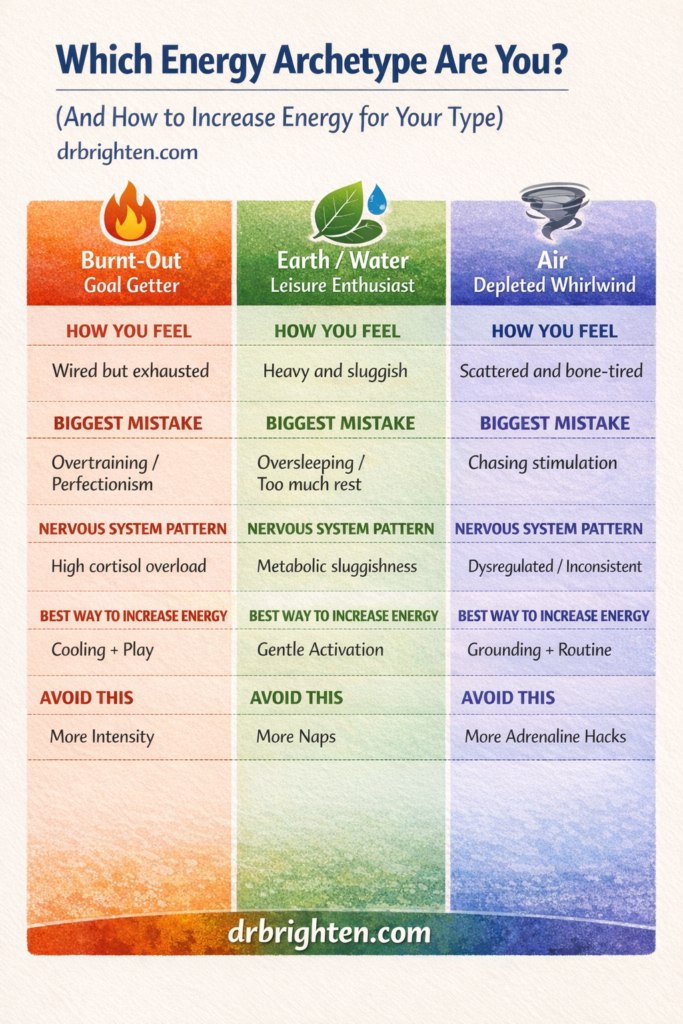
- The three energy archetypes — the Burnt-Out Goal Getter, the Leisure Enthusiast, and the Depleted Whirlwind — and how to identify which one you are.
- The surprising reason oversleeping and excessive napping may worsen fatigue for some women.
- Why high-intensity workouts can create a temporary adrenaline spike — and then leave you more depleted than before.
- How perfectionism and all-or-nothing thinking quietly sabotage your efforts to increase energy.
- The cultural conditioning that rewards burnout — especially for high-achieving women.
- Why some women feel “bone tired” even when they appear productive and successful.
- How caffeine can help in the short term but drain energy long term.
- The hormonal connection between chronic stress, cortisol overload, and stubborn belly weight gain.
- Why women who rest strategically may actually burn more calories than those who constantly push through fatigue.
- The afternoon energy crash: why it’s not always about carbs — and what your body might actually need instead.
- How eating protein in the morning can prevent the dreaded 2–3 PM crash.
- The role of digestion, bowel movements, and circadian rhythm in maintaining steady energy.
- Why eating earlier, lighter dinners can dramatically improve next-day vitality.
- The concept of romanticizing your life as a legitimate nervous system intervention.
- Why consistency beats intensity when it comes to sustainable energy.
- The truth about trendy wellness hacks like cold plunges and whether they’re helping or harming you.
- How food qualities — not just calories or macros — influence energy regulation.
Throughout the episode, we unpack women’s health–specific factors like cortisol dysregulation, hormonal adaptation, metabolism shifts, and how modern hustle culture uniquely impacts female physiology.
If you’ve ever felt judged for being tired — or judged yourself — this conversation reframes fatigue as a biological signal, not a character flaw.
How to Increase Energy Without Burning Out
When women search how to increase energy, they’re often handed extreme solutions: detoxes, elimination diets, high-intensity programs, strict routines, or complicated supplement stacks. But this episode makes a powerful case for something more nuanced: energy regulation before energy stimulation.
We explore why:
- Burnout isn’t weakness — it’s a predictable stress response.
- Hormones don’t “malfunction” — they adapt to your environment.
- Cortisol is not the enemy — but chronic overload is.
- Digestion and elimination play a foundational role in energy.
- Circadian rhythm consistency may matter more than going to bed earlier.
- Skipping meals can destabilize metabolism and create reactive eating later.
- Eating right before bed can impair overnight restoration.
- Warm hydration in the morning may support digestive motility and energy regulation.
- Creative energy peaks in the afternoon — if you allow space for it.
- Nervous system grounding can be more powerful than stimulation for certain women.
Instead of chasing constant productivity, this episode introduces the idea that homeostasis is the goal. Energy isn’t something you force — it’s something you create conditions for.
We also discuss how different archetypes require different interventions:
The Burnt-Out Goal Getter may need:
- More play.
- More pleasure.
- Less perfectionism.
- Cooling foods and calming rituals.
- Permission to stop chasing intensity.
The Leisure Enthusiast may need:
- Gentle activation.
- Light, invigorating movement.
- Lighter food choices.
- Reduced daytime oversleeping.
- Structured consistency.
The Depleted Whirlwind may need:
- Grounding practices.
- Body-based regulation.
- Regular meal timing.
- Less stimulation.
- Soothing, tangible rituals.
One of the most powerful takeaways? Automation beats willpower. Sustainable energy comes from rhythm and routine — not discipline and self-criticism.
This episode also highlights the intersection of digestion and energy. We discuss:
- Why morning bowel movements matter.
- The connection between digestive stagnation and sluggishness.
- Why protein-forward breakfasts can stabilize blood sugar.
- How carb-heavy mornings may contribute to afternoon crashes.
- The role of ginger and digestive stimulation for certain archetypes.
If even one of those patterns made you think, “Wait… that’s me,” Listen to the full episode to hear the exact interventions for your archetype — including the mistakes most women don’t realize they’re making.
And perhaps most importantly, we unpack how many women are unintentionally reinforcing their fatigue by following advice that doesn’t fit their nervous system.
If you’ve tried:
- Sleeping more
- Working out harder
- Cutting carbs
- Adding caffeine
- Adding supplements
- Tracking macros
- Overhauling your routine
…and you still feel exhausted, this episode offers a different path.
Energy is dynamic. You may experience different archetypes at different times depending on stress load, travel, illness, or lifestyle shifts. The goal isn’t labeling yourself permanently — it’s increasing awareness so you can intervene earlier.
Instead of waiting until you’re completely depleted, you can recognize early signs:
- Irritability
- Brain fog
- Afternoon crashes
- Digestive shifts
- Motivation swings
- Overcommitting
- Emotional flatness
- Feeling heavy or wired-but-tired
And then respond intelligently.
The conversation also touches on how hustle culture and wellness messaging reinforce all-or-nothing cycles. Many women equate pushing harder with virtue. But this episode reframes rest as strategic — not lazy.
Increasing energy isn’t about becoming more intense. It’s about becoming more aligned.
If you’ve been searching how to increase energy without wrecking your hormones, this conversation will shift everything. Watch the full episode to learn how cortisol, digestion, and circadian rhythm are quietly shaping your energy every day.
This Episode Is Brought to You By
Dr. Brighten Essentials
Want science-backed supplements formulated by a doctor who actually understands women’s health? 🌿 At Dr. Brighten Essentials, every product is crafted to support your hormones, boost your energy, and help you feel your best—inside and out. From targeted nutrients for glowing skin to essentials that fuel your daily vitality, you’ll get the highest-quality ingredients in forms your body can truly use.
Exclusive for podcast listeners: Use code POD15 at checkout for 15% off your order.
LMNT Electrolytes —Want a clean, science-backed way to stay hydrated and energized? At LMNT, electrolytes are formulated with a precise balance of sodium, potassium, and magnesium — with no sugar, no artificial ingredients, and no unnecessary fillers. Designed to support hydration, muscle function, and daily energy, LMNT helps you feel your best through workouts, busy days, and everyday life.
Exclusive for podcast listeners: Visit DrinkLMNT.com/Brighten to receive a free sample pack with any purchase.
Sunlighten Saunas —Want a gentle, science-forward way to sweat, recover, and unwind? At Sunlighten, infrared saunas deliver soothing heat that supports relaxation, muscle recovery, and deep, comfortable sweating—without the stifling temps of traditional saunas. With low-EMF tech and options for near, mid, and far infrared, you get a calm, restorative session tailored to your goals.
Exclusive for podcast listeners: use the code DRBRIGHTEN to save up to $1,400 on your sauna
Links Mentioned in This Episode
- Hadlee Garrison’s Instagram: @happyhealthyhadlee
- Hadlee Garrison’s Website: happyhealthyhadlee.com
- Hadlee Garrison’s energy quiz: https://hadlee.kit.com/energyquiz
- Schedule a discovery session with Hadlee: https://calendly.com/hadlee/healthgoalssession
Related Episodes
3 Causes of Fatigue We Rarely Talk About + How to Get More Energy | Dr. Jolene Brighten
Discover the overlooked hormonal, neurological, and stress-driven causes of fatigue—and the science-backed strategies that actually help women reclaim steady, sustainable energy.
ADHD Burnout? Your Hormones Might Be Sabotaging You Learn how estrogen, cortisol, and blood sugar dysregulation can intensify ADHD burnout—and what to do to stabilize your brain and restore focus.
Related Articles
18 Causes of Fatigue and How to Find More Energy A comprehensive guide to the most common and surprising root causes of fatigue—from thyroid and iron issues to stress and gut health—plus actionable steps to feel energized again.
Extreme Fatigue in Perimenopause: What's Really Going On Unpack the hormonal shifts driving crushing exhaustion in perimenopause and the targeted strategies that help rebalance sleep, cortisol, and metabolism.
Menopause Fatigue Solved: Proven Ways to Reclaim Energy, Focus, and Vitality Evidence-based solutions to menopause-related fatigue, including hormone therapy insights, nutrition shifts, and nervous system support to restore clarity and stamina.
Frequently Asked Questions About How to Increase Energy
Sleep quantity does not guarantee sleep quality. Late-night eating, inconsistent bedtimes, stress, and digestive overload can all impair restoration. Certain archetypes also oversleep in ways that worsen fatigue.
Yes. While caffeine can temporarily increase alertness, overreliance can contribute to energy crashes and nervous system strain over time.
Not necessarily. Blood sugar instability can contribute, but lack of movement, lack of creative engagement, nervous system overload, or circadian rhythm dips may also play a role.
Chronic stress elevates cortisol, which can impact metabolism, belly weight storage, sleep quality, and hormone balance — all of which affect energy.
It depends on your archetype. For some women, high-intensity exercise increases vitality. For others, it deepens depletion.
Absolutely. Poor digestion, irregular elimination, and inconsistent meal timing can destabilize blood sugar and impair metabolic efficiency.
Earlier, lighter dinners and consistent bedtimes benefit nearly everyone. Beyond that, personalization matters.
Begin with one rhythm anchor: consistent bedtime, protein-forward breakfast, or structured meal timing.
No. For certain archetypes, too much rest worsens lethargy.
That’s normal. Many women fluctuate depending on stress load and life stage.
If you’re ready to stop fighting your body and start working with it, this episode will change how you think about fatigue forever.
Energy isn’t about force. It’s about fit.
Transcript
Dr. Brighten: [00:00:00] You talk about women having different energy archetypes, what does that mean?
Hadlee: I have found that there are three different archetypes. I like to call the Pitta archetype or the fire one, the burnt out go-getter. The leisure enthusiast. It's like the cuddly person that you love hanging out with. When you're sad and you just need a hug.
The depleted whirlwind, that person tends to wanna do everything all the time, want to overcommit. When you know your own archetype, you can start to decipher what your own body needs, what your mind needs to get back to a place where you have the kind of energy that you wanna have.
Dr. Brighten: Hadley Garrison
if your ambition is high, but your energy is constantly falling short.
Hadley Garrison is the expert you wanna hear from a holistic health counselor and behavior change specialist. She blends neuroscience, nervous system regulation, and ancient wisdom to help women uncover the real root of their fatigue, and finally feel energized, grounded, and back in sync with their bodies.
If a woman came to [00:01:00] you saying, I wake up tired, crash mid-afternoon and I can't wind down at night, what would be your first move?
Hadlee: What I would start with is
Dr. Brighten: welcome to the Dr. Brighton Show, where we burn the BS in women's health to the ground. I'm your host, Dr. Jolene Brighton, and if you've ever been dismissed, told your symptoms are normal or just in your head or been told just to deal with it, this show is for you.
And if while listening to this, you decide you like this kind of content, I invite you to head over to dr brighton.com, where you'll find free guides twice
weekly podcast releases, any ton of resources to support you on your journey. Let's dive in.
You talk about women having different energy archetypes.
What does that mean?
Hadlee: A lot of times I see on social media, Instagram, TikTok, whatever, I see a lot of. If you're tired, do this. Mm-hmm. If you're, you know, if you're feeling exhausted, you actually need more rest, you need more sleep. [00:02:00] Or on the other side it might be like you actually need more movement. Right.
So really what we need is to look at what we're actually experiencing. And I have found that there are three different archetypes. I do a lot with Ayurveda, so there are three different doshas in Ayurveda. Mm-hmm. And so I've kind of used the doshas as well as my background in behavior change science and, and all of the things to kinda come up with these three different energy archetypes.
And when you know your own archetype, you can start to decipher what your own body needs, what your own body needs, what your mind needs to get back to a place where you have the kind of energy that you wanna have. So, for example, someone who. Has really low energy because they have totally depleted themselves.
They're, you know, they're like, have this fiery energy. They're totally burnt out. If they are told to [00:03:00] go do like a high intensity interval training workout, and like, that'll give you more energy, it will, because it'll make you have a, an adrenaline spike, right? It will have you have more energy for a moment, but then it'll deplete you, right?
Because we know that stress and cortisol levels and all of that kind of thing are exacerbated by exercise. So if we have too much of that from the start, that's going to exacerbate with exercise. So likewise, if we have someone who is feeling super lethargic, like heavy dense energy, super, uh, super sluggish.
That person is actually not going to benefit from taking like a two hour nap. Mm-hmm. In the middle of the day, right? Like they're actually going to be more tired and then it will probably mess with their sleep and all of that kind of thing. So we have to be mindful of our own energy archetypes. And that's not to say that you can't experience any of the [00:04:00] energy archetypes.
Typically we have one that's the most prominent, but once we know all three of them, we can kind of decipher what it is that we need at any given time.
Dr. Brighten: So you've kind of described like the Pitta.
Hadlee: Yeah.
Dr. Brighten: Then the Kaa
Hadlee: Uhhuh. Yes, yes.
Dr. Brighten: So there's the Vata,
Hadlee: then the
Dr. Brighten: Vata. So, well let's go through what are the three energy archetypes?
Hadlee: So the, I like to call the Pitta archetype or the fire one, the burnt out go-getter. So it's the person, the type A person, the person that has like a lot of like perfectionism, tendencies, uh, really wanting to. Reach their goals, achieve high performance, that kind of person who tends to then burn out.
That's, that's what happens for that person. So that's the fire one. The Kapha is, the elements of Kapha are water and earth. So if you mix water and earth together, you get mud. So that's the person that feels the heaviness, the the lethargy, the sluggishness. And I like to call that archetype, the leisure enthusiast, because it's [00:05:00] like the cuddly person that you love hanging out with when you're sad and you just need a hug, and you need someone who is there for you and can be really caring and loving.
But they, their, their tendency when they have low energy is that heaviness, that density. And so what they need is something more invigorating. Mm-hmm. Right. So, and then we have the Vata archetype, or I like to call it the depleted whirlwind. So it's the person that, you know, that's like the tornado. Right.
Or you might be that, uh, for me it's my mom. My mom is the, is the va the depleted whirlwind. Sh
Dr. Brighten: don't listen
Hadlee: to mom. Yeah. Right. She knows, she knows it's okay. She's, she's aware, she actually introduced me to Ayurveda way back in the day, which was really cool. Um, but, so that person tends to wanna do everything all the time.
Tends to want to overcommit. And so there can be some tendencies with pza that with, with the [00:06:00] burnout, um, archetype that, that flows into this as well. But this person is more like, the energy is kind of like up in the head, moving around very Mm. Windy, essentially. Mm-hmm. And that's the element of Vata and Ayurveda.
So that person is, their tendency for, for depletion is more of a, an emptiness, a hollowness. So it's different from the leisure enthusiast that has this like exhaustion, but it's a, a, a heavy exhaustion. This person has an exhaustion that is like bone tired.
Dr. Brighten: Mm.
Hadlee: Is weak. There's no, like, there's no, uh.
Battery left, essentially, it's like you have completely drained your, your battery, so that person is gonna need actual rest, right? That person is gonna benefit from probably taking some naps, [00:07:00] doing a lot of like, on the floor kind of, um, activities, whereas the leisure enthusiasts is gonna need a little bit more invigorating, stimulating activities.
Dr. Brighten: Okay. So if somebody's listening to this right now, and maybe they're like, oh, I can't really tell, I can't differentiate between this like, fire archetype versus this whirlwind archetype, like, um, is there like, um, a checklist or, I, I mean this is kind of more in depth, but like a quick quiz that someone could do to evaluate themselves?
Hadlee: Indeed, I have one.
Dr. Brighten: Okay.
Hadlee: So you can check out my quiz. I'll give you the, the, uh, link for the show notes. But yeah, the, the quiz is super helpful to be able to decipher what it is that your tendency is. Now again, you can fall into any of the archetypes depending on like. How much you've been achieving. Like, you know, you've been go, go, go.
You might, even if your tendency is not burnout, like you can obviously still burnout, right? Um, or if maybe let's say you've been just, [00:08:00] um, on vacation, eating a lot of food that doesn't really serve your body. Uh, maybe you haven't been moving as much. Like you could fall into the more like heavy density archetype that like needs a little bit of light, lightning, invigorating energy.
Mm-hmm. Um, so, so you can fall into any of them, but the quiz is super helpful to be able to be like, this is what I should watch out for so I can nip it in the bud. Before I get to like the totally depleted state,
Dr. Brighten: could we go through each one of these and identify what's the biggest mistake they make when they're trying to boost energy?
Hadlee: Yeah, absolutely. Okay. So I would say for the leisure enthusiast, the biggest mistake is. The sleep, like oversleeping, essentially. Oh,
Dr. Brighten: okay.
Hadlee: So, and I, I hesitate to say that because some people, like myself, when I was learning about Ayurveda and I was learning about all of these things, uh, back in college in undergrad, I actually thought that I [00:09:00] was mostly that leisure enthusiast archetype.
But really I was the burnout archetype. And so I was like, oh, I just need to do more high intensity stuff. I need to sleep less. That kind of thing. My body needs sleep.
Dr. Brighten: Like, okay. So what we're caught issuing people right now that like you're not saying get less sleep, what you're saying Yes. Is that you might not need 10 to 12 hours.
Hadlee: Exactly.
Dr. Brighten: Okay. Yeah.
Hadlee: Yes. So like, get your sleep. And you might, some people are like, oh, but I'm like sleeping like nine hours a night and I'm like, but you might be the person that needs nine hours of sleep a night. Mm-hmm. 10. 11, 12, probably not. And there's something that we should, you know, address here.
Dr. Brighten: Yeah.
Hadlee: Um, or if you're like, I sleep, you know, my eight hours, nine hours a night, and then I take naps during the day and I, you know, I'm, I'm just so, so depleted there. Uh, the naps during the day are probably not going to be super helpful for you. So that's the, and then also the, um, just like rest more that, that advice [00:10:00] for people when they're in that state.
I remember when I was in that state, and I've had clients who are in that state before and they get so frustrated because they're like, yeah, I feel like I'm resting enough and maybe too much. And so the advice to rest more is like really frustrating. Uh, so not all rest is created equal. I'm a big, big proponent of energy management and not all tasks are created equal, you know?
People ask me about like time management and stuff. And I'm like, well, not all things that you're doing in your day that take the same amount of time, take the same amount of energy. So the same goes for not all rest actually rejuvenates you. Right? So the, the rest for this person might be more like slow walks, slow yoga practices, things like that, that get you moving a little bit, but aren't, like, you don't have to be super overstimulated if you're feeling really, really, really exhausted.
Dr. Brighten: [00:11:00] Okay. So that's the leisure type? Yes. What does the fire type get wrong when they're, when they're trying to lose their
Hadlee: energy, man? Yes. I mean, the number one thing is like perfectionism. That is, and coming from someone who, this is my archetype, uh. Really the perfectionism of like, I need to get my health perfect.
I need to do things perfectly, like clean perfectly. I need to do things perfectly at work. I need to do all of these things. And even if you don't resonate with the word perfectionism, you might resonate more with like the all or nothing. So where you're like, I'm either gonna do this balls to the wall, or I'm going to take a, you know, take a backseat, not do it at all.
Right? Because if, if I'm not doing it, quote unquote, right, what's the point?
Dr. Brighten: Mm-hmm.
Hadlee: So I would say for that person, it's like. Bringing in, honestly, play is [00:12:00] super important for that person. We can get really, really serious when we're in the burnt out archetype, um, the fiery archetype. And so bringing in levity, lightness, playfulness, and not taking everything so seriously.
Dr. Brighten: Okay. Mm-hmm. And then how about the whirlwind? What are the biggest mistakes this archetype makes when they're trying to boost energy?
Hadlee: So this is really interesting because a lot of the current wellness hacks are actually not super ideal for this person. So like doing things that are. Really intense and give you that adrenaline rush, which is what, you know, high intensity, uh, cardio, like super, super intense cardio things.
Um, cold plunging even this can give you that temporarily.
Dr. Brighten: I'm
like,
Hadlee: a
Dr. Brighten: thought to cannot survive cold plunging,
Hadlee: right?
Dr. Brighten: Yeah,
Hadlee: totally. I'm like, ooh, actually, so the, the like trendy, intense stuff is. And [00:13:00] the thing about the whirlwind is like, they probably like love that stuff too. Like they get like high off of it.
So, because that adrenaline rush just is like, oh yes, this feels so good. So what we wanna do for this person is less intensity and more gentleness. Mm-hmm. Essentially. Mm-hmm.
Dr. Brighten: So what I'm curious though is that is, are these hard and fast rules? Like, okay, whirlwind never can you cold lye? Mm-hmm. Like, um, you know, fire type, never can you like go hit training and, and hit it hard?
Or is there a balance in all of this?
Hadlee: Yeah, totally. There's a balance really. It's about when you're depleted, you, you wanna avoid these things. Mm-hmm. But if you're like in balance and you're feeling pretty good, you're not at that empty level. Great. Bring in the coal punch if that like feels fun to you.
Bring in the high intensity workout. I mean, we all need cardio, right? Like we do all need some intense [00:14:00] movement. Mm-hmm. Um, if we can do it right. Um, but the person that is more of that archetype, I would say they don't need quite as much intensity. Okay. As the person that's like the leisure enthusiast archetype, that person and anyone who's out there who's listening and is like, oh no, that's me.
I'm the leisure enthusiast. That means I need more like cardio and more intense exercise. What you can do is just start with something very gentle, because it is hard for that person to get moving, but once you do get moving, it's the easiest for you to keep going. You have the most endurance.
Dr. Brighten: Mm-hmm.
Hadlee: So I wasn't like, I was an endurance swimmer, and that's kind of my secondary archetype is this leisure enthusiast.
And so. Once I get started. And, you know, remain moving. It's a lot easier for me to keep going than say my husband who has more of the whirlwind archetype. [00:15:00] And he, it's really easy for him to get started on stuff. Mm-hmm. But then he feels depleted if he goes too too long.
Dr. Brighten: Yeah. Oh, I think that's a good thing for people to understand.
So I'm definitely more the fire type, but secondary, like having the Kapha archetype, the leisure. And so for me, I wanna go hard. I wanna be intense, but I also know that consistency is the most important because the momentum. Is the hardest gain. And if I can get the momentum, then I'll be able to keep, like, you know, falling through.
And it's a, it's a really clear balance that has to be struck because that fire archetype wants to go so hard. And I think being in my forties, I'm very like, protect your knees, protect your back, protect the wisdom is there now. But I did not have that wisdom in my twenties. Like, and I would literally be doing, like I taught group fitness classes.
I'd be doing like 20 group fitness classes a week. Yeah. And then I'd be like, why am I in so much pain? And then I would stop and then it'd be so hard to like get started again because it was like, it's either gotta be the most intense [00:16:00] thing or nothing at all. So that all or nothing totally resonated.
Hadlee: Yes. And that I was exactly the same way in my early twenties. It was like,
Dr. Brighten: and we could get away with it.
Hadlee: Yeah. Right, right. So it was like, okay, go super hard with the fire. And then once I burnt out, I kind of went into the leisure enthusiast. So this is a thing that happens for those of us who have. The Pitta, the fire as our, our primary archetype.
Mm-hmm. We will usually go into, either, once we burn out, we will go into one of the two where we feel like the emptiness, hollowness depletion, which is the whirlwind archetype. Or we'll go into the like heavy dense, can't move off the couch like I am just a bump on a log now. Mm-hmm. For, for days. Right.
And so we do wanna be so mindful about like, the consistency and that's where my, my background in behavior change science is so important because a lot of times women like want to, [00:17:00] like, they want to. Do what's healthy for them. Right? Like almost every single woman I talk to is like, of course I want to do what's healthy for me, but I'm not doing it.
Mm-hmm. Or I'm, or I'm not doing it consistently. I'm like on or off the wagon all the time. And I'm like, okay, we gotta, we gotta switch some things around. And even our current wellness industry, I would say, perpetuates the all or nothing cycles where it's like. Oh, you are bad if you're not doing this.
Dr. Brighten: Mm-hmm.
Hadlee: And then, oh, you're doing so great right now. You are good. And so this perpetuates this idea that like when I'm on the wagon, I'm good. When I'm off the wagon, I'm bad. And that can create this sort of like a shame. A shame cycle, essentially. Mm-hmm. So we gotta, we gotta decondition all of that.
Dr. Brighten: I wanna get more into that, but I wanna play two truths and a lie with you.
Okay. So I wanna, um, I'm gonna do three statements. We're gonna give the audience some time to pick which one they think is the lie. So [00:18:00] everyone, you can run to YouTube, leave a comment there, and, um, I'm gonna state these and then I'll give you ties into answer and then we'll come back to them. So here's the three statements, and this will give you some time to think on it.
So one, caffeine can drain your energy long term, even if you feel like you can't function without it. Two women who rest strategically burn more calories than those who push through fatigue. And three, if you feel low energy every afternoon, you just need more carbs. Oh, don't give it away. Alright. So they're gonna go take a guess.
Yes. But you teach often about aligning your energy archetype. Mm-hmm. But I'm wondering if there's ever been a time where somebody kind of goes against their archetype and there's been a breakthrough.
Hadlee: Ah, okay. So, so like they balance it out and they, and there's a breakthrough. Absolutely. Oh my gosh. So I'll start with the, the leisure enthusiast.
I had a client who was [00:19:00] literally, so every morning she would wake up, she would be exhausted, she would do whatever work she needed to do during the day and then go back to bed, like. As much as she possibly could. She would get outta bed to do whatever she needed to do. She would go back to bed. It was, and it was a heavy, dense feeling of sluggishness, exhaustion, lethargy.
And now I wasn't, someone had actually told her because of Ayurveda being like, oh, you need to do intense exercise. And that actually was depleting her more. And I was like, okay, what we need to do here is start by respecting where you are. 'cause that is important here, and I'll give examples for each one.
But it is important to start where you are. And so to start just doing very small movements, starting to bring in some lightning, starting to bring in some, um, invigorating activities. So what we did was I was like, I just want you to get out of bed.
Dr. Brighten: Mm-hmm. [00:20:00]
Hadlee: That's it. When your alarm goes off, I just want you to get out of bed.
You can go sit on the floor or lie on the floor or on the couch or whatever, but just get out of bed. So we started with that in the morning. We also started with, uh, the night before of getting to bed at the same time every night, all of that kind of thing, which are kind of the basics. But just doing that and then once we get that automated, 'cause I'm a big fan of automation over discipline.
So instead of like, I have to be doing this, I need more willpower, more discipline, I'm a big fan of let's just get it automated to where you're like, this is just how I do my mornings. So we got that automated. Then we brought in just like a little bit of movement and then that grew and grew and grew and grew.
And she, and after maybe like two, three months, she was like. I cannot believe how much energy I have. Like just those little shifts
Dr. Brighten: mm-hmm.
Hadlee: Are massive. And [00:21:00] so we also worked on food stuff. The cool thing about food as far as Ayurveda is when you look at food from a lens of what their qualities are, you can, you can start to balance out what qualities you are experiencing that you don't like experiencing.
So say you're feeling really sluggish, lethargic, all of that kind of thing. If you look at foods that are lighter, less dense, heavy, that kind of thing, you'll start to feel lighter. Like, you know, there's some nuance to it, but it really does
Dr. Brighten: Examples of like lighter foods for
Hadlee: people listening, like Yeah.
Yeah. Um, so I like to think about like the plant itself. So. The lightest part of the plant is the leaves, right? Versus the heaviest part of the plant. The densest part of the plant is like the roots, the seeds, the things that are under the ground. Those are more grounding, which can be helpful for the, the depleted whirlwind archetype, which we'll talk about, but bringing in [00:22:00] more leafy greens, bringing in, um, even like salads and stuff like that, um, that can be massively, massively helpful for people.
And, you know, avoiding things that are like fried and, and super dense and, and that kind of thing. Um, so just bringing in that little bit of knowledge can be helpful. Obviously we can talk about like specific nutrients and all of that kind of thing that can be helpful for specific hormones and all of the things, but that's a really good place to start.
Um, so bringing in all of that, the lightning, the invigorating, and she felt. Just like a different person. She was like, I feel like a completely different person. She actually started a, a new career, um, and was like, I have so much energy. This is amazing.
Dr. Brighten: Yeah. So
Hadlee: that's like, that's the leisure enthusiast archetype, um, example from the burnt out, uh, archetype.
So [00:23:00] this one is so interesting because again, we get. Rewarded for this archetype a lot. So
Dr. Brighten: hustle culture.
Hadlee: Yeah.
Dr. Brighten: Biggest praise. I used to have like in my early thirties, uh, a shirt that said hustle and like golf, and I was like, sporting that and stuff. And I was like, yeah, I hustle and I'm part of, and I look back at that and I'm like, oh man, your adrenals, they were working for you.
Like, no, but I remember I did a, um. I did an adrenal, uh, cortisol panel testing, and it was like the worst I'd seen outta my whole clinical practice. I was like, the worst. And I was like, girl. And I was like, I'm running three clinics and I'm like doing all this stuff and I'm like, this, this is a sign right here.
But you get praised for it. You're right. And when you're in it, it feels so good. Mm-hmm. Like, you feel so good until you hit that wall. Totally. And I'm so grateful that like, well, let me just say like I am really blessed to be like, I'm a hormone doctor. So I caught that and I was like, hell no. Shut that down.[00:24:00]
Start changing everything. Because I was like, I know, I see the end stage, like hormone panels that come in and I don't want to be there.
Hadlee: Yes, yes. Totally. So, yeah, we. It's like we get praised for it in our careers. We get praised for it. I mean, in school we get praised for it. We get praised for it. In wellness, like I would say, hmm, there's so much, especially like on Instagram and stuff where you see just the little clips and there's not a lot of nuance.
Dr. Brighten: Mm-hmm.
Hadlee: We get praised for being pretty intense about our wellness. Right. So doing a detox, doing a, doing cold plunges, doing all of these things that, you know, once we do them, we feel like, oh, I'm doing everything right. So this archetype. For my Pitta girlies and men, but the, but the people who have that burnout, uh, tendency, again, bringing in, bringing in the play.
Bringing in like romanticizing your [00:25:00] life. I know that's become kind of trendy right now, and I, I love that trend.
Dr. Brighten: What does it mean for people who don't know?
Hadlee: Because
Dr. Brighten: I haven't heard romanticize your
Hadlee: life. Oh, yeah. Oh, it's the best, especially for this archetype. So if you listen up.
Dr. Brighten: Yeah, I'm listening.
Hadlee: So this is like making things as yummy as possible, so, you know. If you are drinking coffee in the morning, which this, this archetype doesn't super benefit from coffee, but I am, I
Dr. Brighten: will never give it up.
Hadlee: I am never going to take away someone's coffee. Like, I'm like, we're just, if you wanna add some, add some cream or add some fat to it, that can be helpful for this archetype.
So it's not just like the spike of caffeine, all of that kind of thing. You could also add cardamom, which cools it down a little bit. Ayurvedically, it's, it's, it's also delicious, but, okay, so if you're drinking coffee in the morning, instead of taking it on the go, like maybe you just like have a, at just the first three sips, you sit and you allow [00:26:00] yourself to just be with it and enjoy it and romanticize it.
It's kind of like. Um, picturing yourself in a movie, like you're, like, you're in this little vignette where you're just like, oh, I'm so cute and cozy and I have this little drink with me.
Dr. Brighten: Mm-hmm.
Hadlee: That's the kind of thing that you could do to, to romanticize your life. And so bringing in, uh, a. It might not be anything different from what you're actually doing.
It might just be noticing and romanticizing it and being like, oh, I'm like the main character in this movie.
Dr. Brighten: Yeah.
Hadlee: Essentially.
Dr. Brighten: That's fun. Okay. Everybody listening, if you try this out, let me know. And then you can also hold me accountable. I will do some things too. I'm already like getting ideas. There's this coffee shop that I like to go to and they do cardamom and lemongrass and I think star Anis in their coffee.
And yeah. And like, um, with a really fatty cream, I'm all about it. Yes,
Hadlee: yes, yes, yes. To the fatty cream for this, for this archetype. Like, we want that for sure. Yes. For their coffee. Um, you know, other things that we can do are [00:27:00] just, you know, if you're working like light a candle
Dr. Brighten: mm-hmm.
Hadlee: Just do things that make you feel delicious.
Essentially. Bring in, bring in loveliness. Have flowers, you know, that kind of thing is,
Dr. Brighten: oh,
Hadlee: IM all
Dr. Brighten: about
Hadlee: that. Absolutely helpful.
Dr. Brighten: Yeah. Like I love, like at this moment I don't have fresh flowers in my house 'cause I'm about to leave on a trip. But that is something that I'm always like, I want fresh flowers in as many rooms as possible.
And there's so many where I live, so many, um, local, uh, growers and people that I'm like, I also get to support my community. But like, I'm very big on the, like the treat yourself of like, get yourself. I'm not gonna wait around for someone to buy me flowers. I'm literally gonna design my own bouquets and set them up in my house.
Hadlee: Oh yes. I love it. I love flowers so much. And there's especially helpful for this fiery person, like,
Dr. Brighten: okay, I'm doing something right
Hadlee: here. Floral. The floral, even like floral smells, different things like that. If you can bring in as much like, like luxuriousness and just soaking in your life, that [00:28:00] is the antidote mm-hmm.
For this archetype. And then of course we can bring in different foods, um, bringing in some exercise that is a little bit more gentle. Now for those of you who have this archetype, you might be like, no, I love the high intensity stuff. I love like weightlifting and doing the intense cardio and all of that kind of thing.
And that's allowed, you're allowed to do all of that. And when you're feeling, when you're starting to feel that burnout, like bringing in more yoga or I love doing dance. Um, just like a dance party for myself, not mm-hmm. Not like even a dance class. 'cause even that can be, we can take ourselves really seriously in a dance class if we have this archetype.
So just allowing your body to move in whatever way it wants to move. Massively helpful for this archetype too.
Dr. Brighten: Okay.
Hadlee: Yeah.
Dr. Brighten: I'm gonna, we're gonna come back to the whirlwind.
Hadlee: Okay.
Dr. Brighten: But I'm gonna, we're gonna do the two truths and a lie, so
Hadlee: yes.
Dr. Brighten: Okay. First statement. Caffeine can drain your [00:29:00] energy long term, even if you feel like you can't function without it.
True or false?
Hadlee: True.
Dr. Brighten: Mm-hmm. I know.
Hadlee: Unfortunately, true.
Dr. Brighten: As a caffeine lover, guys, I, I mean, I love my coffee. Yes. But it is something that like, if you are using caffeine to neg, like get you out of the not sleeping, you know? Yeah. To try to overcome not sleeping, or to push you through afternoons when you really need a brain break, like mm-hmm.
It's gonna sabotage you. Okay. Number two, women who rest strategically burn more calories than those who push through fatigue. True or false?
Hadlee: True.
Dr. Brighten: Why is that
Hadlee: true? Totally true. Well, when we think about like hormonally women, you know, we can have a cortisol. Overload when we are overstressing our bodies and not giving ourselves enough rest.
And that essentially makes it so that we have like the, the belly fat, um, weight gain in the belly, that kind of thing, which is also, uh, correlated with this burnout archetype. Mm-hmm. The fire archetype. [00:30:00] We, there's a tendency to, to get that because we push ourselves too much, we do too much, and we have that stress and all of that kind of thing.
Um, to when we actually rest strategically and exercise strategically too, like, um, engage strategically both rest and engage strategically. We will essentially burn more calories, have less cortisol, um, and balance not just our hormones, but. Essentially come to homeostasis in our body.
Dr. Brighten: Yeah. I I love that you frame it as homeostasis because I think often people think like high cortisol, high insulin, this is your body, dysfunctional, this is your body, um, misbehaving and reality.
These are physiological adaptations to your lifestyle that are enabling you to survive. Yes. And so the homeostasis requires the shift in the lifestyle and the environment as well. Yeah. So we know this one's false, but I wanna hear why if you feel low energy every afternoon, you just need more carbs.
Hadlee: Ah, [00:31:00] yes.
So if we're feeling low energy every afternoon, like you said just a moment ago, like you literally might just need a brain break. Like you literally might just need to. Stop, drop. And I mean, I literally will just lie on the ground in Starfish.
Dr. Brighten: Starfish. Are you rolling though? Because like the stop drop roll, like every kid from the eighties is like, wait a minute, you gotta finish that.
Hadlee: Stop, drop, lie on the ground or roll. You could totally roll. And honestly, as much silliness as you can bring in, if you're like rolling around on the ground, great. Mm-hmm. I love that for you. So bring that in. Bring in as much play as possible. Essentially in your brain break for the, for the afternoon, a lot of people will reach for the coffee and I have had so many clients be like, I've just hit such a wall at 2:00 PM 3:00 PM
Dr. Brighten: mm-hmm.
Hadlee: And I'm like, well, your body, your [00:32:00] body needs a break. Your body needs that. Um, and if we, if we look in in terms of Ayurveda, how our body works with our circadian rhythm. It's cool because it's like Ayurveda tell tells us this. And then also modern science is telling us this with circadian rhythm research when around like two, two to 5:00 PM is actually when our body and our mind is at like, its most creative.
It's sort of like when the the depleted, whirlwind archetype comes up. And that whirlwind energy actually has a lot of capacity for creativity. And so if you can't, and now this isn't always possible for everyone, but if you can bring in some sort of creativity in the afternoon with your work, or if you just take a break and do something creative that will essentially bring you back.
Now you have to practice it over time. It's not gonna be just like a one-time thing, but [00:33:00] that can essentially bring you back. Now carbs as far as carbs, the carbs might actually be causing the crash in the middle mm-hmm. Of the day. Right? So if we're eating. Especially if we're eating carbs first thing in the morning, as for breakfast, that can actually cause the crash midday or uh, like mid-afternoon.
Uh, so bringing in more protein in in the morning can actually be incredibly helpful for that. I had a client who shifted just that one thing. She shifted from oatmeal to eggs in the morning. And now she just doesn't get the, the crashes anymore. It was, that one was pretty immediate. So we love a quick, we, we love a quick fix that is actually sustainable,
Dr. Brighten: you know?
And, and to say that, that switch, so when I was getting my degree in nutrition, it was like eating a bowl of oats was like American Heart Association. Everybody says it's the best thing. And I thought something is wrong with me because if I eat a bowl of oats, I hate the world two hours later. Like, I am not a nice person.
[00:34:00] Totally. And everybody was like, this is not what happens. I remember just being gaslit about my own body and I was like, yeah, but like, if I'm doing like nuts and seeds with it and like I throw, I throw in a scoop of nut butter and like had this whole like, you know, way of eating. Uh, then I felt fine.
Hadlee: Yes.
Dr. Brighten: And I just remember like sitting in and like, you know, sitting in that didactic class and hearing that and then going into the science classes and then they started talking about like macro interactions, blood sugar, stability, and like presenting the science. And I'm like, why in the hell are we teaching that a bowl of oats works for people in the morning?
Yeah. And so I share this story because anyone who's listening, I think. We're, we're still learning about protein right. In the morning. We're still talking about that. But there's a generation of us who were told a bowl of oats in the morning was like the gold standard and then gaslit about it when we're like, no, especially, so if I eat oats, I eat them raw.
I don't even eat them cooked anymore because if I eat them raw, then my gut feels better [00:35:00] and I have more sustained blood sugar. And so, and I mix them with like, you know, super fatty yogurt because I eat full fat. Yes. Like protein yogurt. Um, and that helps sustain my blood sugar. And I think we have to give people permission to understand that.
Like you have how foods actually interact with you.
Hadlee: Yes, totally. And that, I love that you said that about if I just, if I add nuts, if I add almond butter or nut butter or whatever, then I'm fine because. That's the, that's a huge part of this. Like combining foods in a way that actually serves our body is really, really helpful.
And then you don't have to necessarily give up your oats in the morning if you're like, I actually really love having that.
Dr. Brighten: Mm-hmm.
Hadlee: Um, then you can do that. And my client also, I was like, you know, you could. She was like, I really do love having oatmeal. And I'm like, you know, you could eat that for lunch or dinner.
Like you, you, you get to decide what you do in your life. Mm-hmm. Like, no parents, like my, my husband and I [00:36:00] always are like, what should we do today? I don't know. No parents, like we have. More autonomy than we think we do.
Dr. Brighten: Yeah.
Hadlee: And so yeah, you're allowed to switch things around. Whatever actually works for your body, you have the authority.
Dr. Brighten: Mm-hmm.
Hadlee: You know?
Dr. Brighten: Yeah. And we made arbitrary rules around what's dinner and what's breakfast. Yes.
Hadlee: Yeah. I know,
Dr. Brighten: right? Right. Like people are like, oh no, you can't have soup for breakfast. Yeah. Yes, I can.
Hadlee: Totally. And I eat scrambled eggs for lunch all the time.
Dr. Brighten: Same. Especially when it's like a busy day and I'm like, this is so easy.
The easiest
Hadlee: lunch.
Dr. Brighten: Or it's like, you know, I'll, I do, um, homemade granola and I'll do yogurt, granola, and fruit. Mm-hmm. Although I think Ayurveda says not to combine yogurt and fruit.
Hadlee: It is true.
Dr. Brighten: Yeah. I disagree with that. They out 10 Ayurveda, like on that recommendation, it's, it's seriously like one of my favorite things to like, have together, especially when I'm like, oh, raspberries.
And then like a high protein yogurt is like, you've got your fat and your protein and your fiber fiber and, and I'm like, I'm winning right now. Yes. Okay. Sorry Ari pta, but I'm winning.
Hadlee: I know. Totally. And I'm like, [00:37:00] I like to say that I'm an Ayurveda rebel because. I, I'm so of the mindset that we have to meet people where, where they are.
Dr. Brighten: Mm-hmm.
Hadlee: I know so many Ayurvedic practitioners and stuff that are like, no, no, you cannot do this. You cannot have leftovers. Like there's a thing in Ayurveda that you can't there leftover food. Yeah. And I'm like. I literally eat leftovers every day.
Dr. Brighten: But also like, how are you gonna tell a mom with kids?
Exactly. You just need to cook every night.
Hadlee: Exactly. I know. I'm like, I think that is malpractice to tell someone that, because then that exacerbates the all or nothing. Like, oh, well if I can't make, if I can't cook for myself every single meal. Are you kidding me?
Dr. Brighten: Yeah.
Hadlee: Then I'm just, whatever.
Dr. Brighten: But you know, at its inception when Ayurveda was created, we didn't have refrigerators.
Right? Yes, exactly. We didn't have all of these things. And so I think we always have to understand that like, as we have evolved mm-hmm. And gotten really clever with our food [00:38:00] that, you know, while once upon a time, that was really smart.
Hadlee: Yeah.
Dr. Brighten: Really smart. Because, um, pathogens are real. And I think bacteria,
Hadlee: yeah.
Dr. Brighten: Food poisoning is the dumbest way to die. Try to avoid it. Like, I always like tell my kids that like, when in doubt, throw it out because Yeah, it is like, food poisoning is such a dumb way to die in modern society because we should be able to control this. And um, and so I think it's important to view things through the lens of like, at the, like, you know, in even the best Chinese medicine practitioners are like, at the time this was really practical, but given how we've adapted now, not so much.
Mm-hmm. But I think, I think there are people who believe that, um. The rigidity and the absolute like pursuit of control will ultimately re like result in health. And I think I'm living proof, as I told you. Yeah. Freak accident just sitting on the ground. I moved my foot and suddenly cartilage breaks off my patella.
I'm like, I didn't even do anything fun. I was like, people were like, were you playing basketball or something? I'm like, I, that's boring. But yeah, I wish at least it [00:39:00] was that or something. But um. I think it was a really humbling moment for me to be like, I have spent decades guarding my knees and being so gentle and so protective of them and making sure I had muscles around them, and just the freak accident of something that can happen.
And it, it is something that I think, um, people listening, like learning from others who have had these experiences to say to you that you can live the perfect life and do everything right and things still happen. So it is better to live a well lived life than the perfect life.
Hadlee: Absolutely. Yes. And I think this archetype actually is the one that craves the most control.
It's like the most,
Dr. Brighten: the fire
Hadlee: type. Yeah. Yeah. Mm-hmm. It's the most like, okay, I need to do everything, you know, again, perfectly, or not even just perfectly, but like, right, right. Yeah. Like, I need to do this. Right. And if not, you know, something bad is going to happen. That's, I mean, in psychology it's like, it's magical thinking, right?
Mm-hmm. It's like if I do this. Then I will get the result that I want. And that's [00:40:00] not always the case. So when we can really peel that back, and it's hard.
Dr. Brighten: So you just want life to be like A plus B, equal C uhhuh and life's like, ha ha, dropping different variables in and you're like, dang it, that doesn't, the math's not nothing.
Yes,
Hadlee: yes.
Dr. Brighten: So lemme ask you about the whirlwind type because before we, uh, we revealed the two truths in a lie. You were talking about the fire, you talked about the leisure. But tell us more about the whirlwind.
Hadlee: Yes. So the whirlwind, what we can do for the whirlwind is bring in now honor where the whirlwind is at, and bring in soothing, calming, essentially, um, and grounding.
We want, we want as much grounding as possible for this archetype, but again, we wanna meet them where they are. So in. I do not recommend this archetype to be like, okay, now I'm gonna do a silent meditation for 20 minutes, twice a day. Not going to be helpful because your mind is gonna be just [00:41:00] like, mm-hmm.
And I, I tried to do that for a while where I was like, I'm just doing like 20 minutes, twice a day silent meditations. Again, I'm the all or nothing archetype. So that was not helpful for me. So if you can bring in a little bit of gentle movement to bring you into a meditation or a nervous system practice or something like that, that's awesome.
I also highly recommend bringing in body-based practices. So this person can tend to have a lot of energy in the mind and, and a lot of energy is just like all over the place, like even like up and out of the body. So bringing attention to the body, and not just attention, but literally bringing your hands to your body.
This can be helpful for all the archetypes. I love this. The practice of like just self massage, just rubbing oil on your body massively, massively helpful, especially for this archetype, [00:42:00] but all of them, it can be helpful for. So I would recommend bringing in as much like tangibility as possible. So if you have, you know, like fidget toys or things like that where you're like, I'm here.
I'm in my body, here's my body.
Dr. Brighten: Mm-hmm.
Hadlee: That's gonna be massively helpful for this archetype. Um. Other things that we wanna do food-wise, we wanna bring in the things that are more grounding, like I talked about with the roots of the plant. Mm-hmm. Or the seeds of the plant. We can think about what are the types of foods that we're, that we are eating and where do they come from as part of the plant.
Dr. Brighten: Let's talk about roots for a second though, because when you say that, I think everybody might think potato
Hadlee: at
Dr. Brighten: that, but there's more root vegetables. Yeah. And I'd love to just like chat about those. It is, if you're thinking about grounding yourself. Yes. What are the root vegetables that can support you?
Hadlee: Carrots, beets, um, turnips, uh, bringing in sweet potatoes. [00:43:00] Awesome, awesome. Um, a lot of the like, uh, squashes and stuff as well. I know those aren't roots, but they do, when you think about how they're growing, they're growing on the ground.
Yeah.
Hadlee: Uh, so thinking about your, thinking about your food from a lens of like, what is, how do they actually grow can be really helpful for this to, uh.
To show us what the qualities of the foods are, but also to break us out of the mindset of like, I need to track all of these nutrients and all the things which again, would, with the, with the burnt out type can, we can get really like over overdo it there.
Dr. Brighten: Mm-hmm.
Hadlee: So we can break out of that by thinking about the qualities of the foods that we're eating.
It becomes like a little bit more playful. It becomes a little bit more like, oh, what is, how does this plant grow? Okay, cool. I can give myself what qualities my body needs from knowing that.
Dr. Brighten: I love that. And you know the other thing about when you talk about eating these roots, so there's also. [00:44:00] I tell people, go into the Asian section, go into like, you know, the, so we'll call it like the ethnic section sometimes like, you know, or the Mexican section, you'll find different seeds, herbs, um, roots.
It's also something like living on a tropical island, it was like so many different roots I'd never seen before.
Oh yeah.
But as you sail of this and you're like, oh, it's grounding. This is all very good for the microbiome as well. Yeah. And that variety and that differentiating actually helps the microbiome flourish.
So I'm just wondering like from the perspective that these foods, these root vegetables are offering variety, giving more support to the microbiome. Like how does that fit into the framework of what we're talking about?
Hadlee: All of the archetypes need all of the foods.
Dr. Brighten: Mm-hmm.
Hadlee: It really just comes down to like, I don't wanna say portions because I'm not like super into portion control.
It can be helpful at times, but again, we can get over overdo it. But bringing in more roots for the person that has, that needs the grounding. Mm-hmm. That has like the whirlwind archetype [00:45:00] and bringing in more leafy greens stems, like celery stocks, that kind of thing. Mm-hmm. Uh, those are the lighter veggies.
So bringing in that, that kind of thing, while also giving yourself some, some root veggies. Um, lighter root veggies are also helpful for the more leisure, leisure enthusiasts. So like, um, parsnips are lighter. Uh, I said turnips. That's actually really helpful for. Like a lighter root veggie. That again, that's helpful for the microbiome, but it's not gonna be overly, uh, heavy for, for that archetype.
Um, what are some other ones? Uh, radishes. Radishes are amazing for the leisure enthusiasts. And if you have ever had a radis, you know that they are much lighter
Dr. Brighten: mm-hmm.
Hadlee: Than a sweet potato. Right.
Dr. Brighten: Yeah.
Hadlee: That's gonna be so much heavier and denser. So again, qualities.
Dr. Brighten: Yeah. And then what about the leisure type?
When you look at like, having root vegetable, so, so my understanding leisure type [00:46:00] tends to have a more sluggish digestion, whereas the world wind tends to have more of that rapid digestion.
Hadlee: Yes. And, and variable digestion too.
Dr. Brighten: Yes. It's very unpredictable. Yes. They're unpredictable people overall.
Hadlee: Yes.
They're the whirlwind. They're literally like, who knows where it's gonna go next? It's like the TAs Tasmanian devil. Yeah. Kind of. Um. So what we wanna do for as far as like even timing of food is really, really helpful for the whirlwind archetype because the tendency is to be more like, oh, I forgot to eat, you know, oh, um, I haven't, oh man, I haven't eaten all day and it's 4:00 PM and now I'm gonna like, eat everything in sight, right?
Dr. Brighten: Mm-hmm.
Hadlee: So what we wanna do for that is like, having regular meal times is really, really beneficial for that archetype. Now having like alarms for that can be helpful. Having external, um, stimulus for that is [00:47:00] gonna be really, really helpful. Um, if you're. Actually not hungry at those times. We can do some things to help your, your appetite and your metabolism to basically kind of like know when food is coming.
Mm-hmm. Because if we, if we have a really variable appetite, our body is like, I have no idea when food is coming. So there's not like a rev of metabolism. So that can kind of be hard for the, the whirlwind archetype. So having those regular mealtimes, having maybe like ginger tea before your meals that can stoke that digestive fire a little bit a k your metabolism so that it's easier for you to digest food.
S same goes actually for the leisure, leisure enthusiast who has more of a sluggish, slow, dense metabolism.
Dr. Brighten: Mm-hmm.
Hadlee: Which, that's me, uh, having ginger tea beforehand or even just like taking a slice of ginger and like chewing on it. That's massively helpful for just [00:48:00] getting those digestive juices flowing.
Digestive enzymes can be really helpful too. Um, but ginger, ginger is like one of the quintessential Ayurvedic things that, that people use.
Dr. Brighten: Mm-hmm. Sure.
Hadlee: Now, if you have the fire archetype, you probably don't have any issues with that. Your, your digestif fire is like pretty strong. Um, now if you have, if you have both the burnout archetype and the leisure enthusiast archetype, you might tend more toward the slow metabolism like I do.
Dr. Brighten: Mm-hmm.
Hadlee: Um, and so you can bring in some of that, some danger and stuff. And
Dr. Brighten: if you're the fire type though, and you are in, you're balanced.
Hadlee: Yes.
Dr. Brighten: Uh, bringing in ginger, could that possibly be stoking the fire too much, too
Hadlee: much
Dr. Brighten: and be problematic?
Hadlee: Exactly. Yes. Yeah. So if you, and especially if you, this archetype tends toward too fast of a metabolism.
Mm-hmm. Like things like. Go through you. Um, and that can [00:49:00] cause all sorts of issues. Like basically when we think of like too much fire in the digestive tract, it's like there's burning, there's heartburn, there's mm-hmm. Diarrhea, there's, you know, just inflammation. Anything that's burning, that's fiery. Uh, so bringing in something that stokes the fire.
Not super helpful. We actually want more, uh, foods that are more cooling. Uh, soo we wanna think cooling, soothing and play for that archetype, for the burnout archetype.
Dr. Brighten: So I think aloe, we're straight off the bat
Hadlee: that yes, when you say that. Amazing.
Dr. Brighten: What else would be helpful?
Hadlee: Coconut. Um, cucumbers. Uh, I said cardamom earlier.
That's a spice that is cooling. Mm-hmm. Most spices are heating. Um, but there are a few spices that are also, that are, that are actually cooling. Um, cardamom, turmeric, coriander. Those are all really helpful for this, this fire archetype. Also, uh, leafy greens are really, [00:50:00] really, really helpful for this archetype because they have a cooling property as well.
Dr. Brighten: Mm-hmm.
Hadlee: So, uh, so yeah, so bringing in, if you think about. Anywhere that the climate is warm. So tropical places, or if you're like, if you think about just summer foods in general, those are the foods that Mother Nature gives us that cool us down. Mm-hmm. Essentially. So it's like, okay, so there's coconut, there's mango, there's all these different fruits in the tropics that cool us down.
Or you can think about in the summertime, we've got what's in season in the summer, right. All of these, these, uh, blueberries, strawberries, um, peaches, all of that kind of thing that's also gonna be cooling helpful. Um, so, so bringing in, again, the qualities of the food. Super, super helpful.
Dr. Brighten: Alright, so I wanna move into the part of the [00:51:00] show that's like the protocol playground where we do rapid fire.
I give you a scenario you give me like love it. Quick answer. Yeah. So if a woman came to you saying, I wake up tired, crash mid-afternoon and I can't wind down at night, what would be your first move?
Hadlee: What I would start with is. Earlier, lighter dinners and not eating late at night. So a lot of times people start with the morning, but I always start with the night before and that's actually gonna be helpful for everyone to not eat right up until bedtime.
Because even if you're getting the quantity of sleep that you need, you might not be getting the quality of sleep that you need if you are eating right up until you fall asleep. Our bodies need so much restoration in the in the night, and if our bodies are digesting our food during that time, it's not, they're not gonna go to our brain and, you know, taking out the trash as far as like our liver and all of these different systems in our bodies, they're gonna be like, oh, we gotta digest this [00:52:00] food, and then if we have time we can get to all the other systems.
So that's what I'd start with. And then I would start with a consistent bedtime. A lot of times I work with people and they're like. I'm gonna get to bed early tonight, and I'm like, hang on. What I want you to do is what time do you usually go to bed? If that's super variable, let's just pick a time. It doesn't have to be way earlier.
If you're like, okay, sometimes I go to bed at nine, sometimes I go to bed at 11, sometimes I go to bed at 10 30, you know, all over the place. I would say, let's go with 10 and, and just create a consistency there. That's gonna be massively helpful for your circadian rhythm more than if you were like trying to get to bed early some nights and then getting to bed later, other nights.
So I'd start with that. Then protein for breakfast for sure, if they're having that midday slump, having some protein, um, for breakfast and then, um, bringing [00:53:00] in some movement for sure. I would go with whatever the, the person is. Uh, feeling like she has the energy for and kind of increasing it, like, like dosing it out essentially.
Mm-hmm. That's what I would do.
Dr. Brighten: Okay.
Hadlee: Yeah.
Dr. Brighten: Let me ask you, is there a universal starting place that everyone should look at if they wanna optimize their energy, or is it always different based on the archetype?
Hadlee: Great question. Yes. I believe that there is the, the universal thing is earlier, lighter dinners get to bed at the same time every night.
Um, I would also say the number three thing is that no one is really talking about is pooping in the morning. So not just like pooping every day, but it's super helpful to be able to poop in the morning. Now, the earlier, later dinners is going to help you achieve that because the food will have moved through you enough so that you can in the morning.
Mm-hmm. The other thing is hydrating, but [00:54:00] hydrating with warm water. It's like. Magic. It's, it's so funny. Like, it's literally, my, my clients are always like, I can't believe how effective this is. So I usually do my water at maybe one 20 degrees. Some of my clients do, um, warmer water
Dr. Brighten: summer. Me is like, no girl.
Hadlee: Yes.
Dr. Brighten: No.
Hadlee: So summer I do like a hundred degrees.
Dr. Brighten: Oh man. I wonder, I wanna hear from people in the comments, do you drink ice water? Do you drink room temp water? Or are you heating your water? Yes. And how does that work for your digestion?
Hadlee: Yes. Yes. So Ayurveda is like, you should drink warm water all day long.
And I'm a, I'm a pizza girl, I'm a fire archetype. Like that's a no-go for me. I'm just, I would be sweating all day long mm-hmm. If I just drank warm water all day long. Uh, but room temperature water does really wonderfully for me. Yeah. And it's really helpful for just, for digestion and, um, moving things along essentially.[00:55:00]
So. The warm water in the morning though I do. I like, kind of just like chug it, get it down, let's go. And that starts peristalsis. So it's, you know, and I drink like a lot, like maybe like 16 to 20 ounces, like a lot of of warm water in the morning. And then I'm, I'm ready to go. I can, I can go to the bathroom.
Uh, I would recommend doing that, even if you are like, Ugh, it doesn't make me have to go to the bathroom. You can kind of train, train it. I would recommend just doing it for a long, longer period of time. Uh, it makes it so that you, if you go to the bathroom first thing in the morning, it makes it so that you actually can kind of understand your hunger cues a lot better so that you can make decisions for eating throughout the day that are more intelligent and aligned with your, what your body actually needs.
Stressful.
Dr. Brighten: What's, what's the problem with not pooping first thing in the morning?
Hadlee: So when we don't go, essentially we are, when when we do go, we're like releasing. [00:56:00] The crap from the day before. Right? So as far as the hormones that haven't been done, like well, the hormones that haven't been eliminated, the toxins that haven't yet been eliminated, that you know your liver has processed and all of that.
When we don't go, they essentially get reabsorbed into the bloodstream and go back into your body, go back into your liver, create liver stagnation. Your liver can't process it. Your liver's like, I'm trying to keep up and I can't. And so it causes a whole host of issues down down the road. So if we can do that first thing in the morning, and the other thing is like once you do it, you're like, oh yeah, I feel.
A billion times better when I do that in the morning. So you, you'll, you'll know once, once it happens that you're like, oh yeah, this is definitely good for me.
Dr. Brighten: Mm-hmm.
Hadlee: Um, but physiologically that's the, the reason
Dr. Brighten: it's very interesting because it is, [00:57:00] conventional medicine is the only paradigm, um, in medicine, in the history of humanity that has ever said, going once a week or twice a week is okay.
Yeah. And saying, I meet medical doctors who are like, no, if you go every three to four days, that's normal. And I'm like, you know, here's the thing. And, and so everybody knows I'm not dissing conventional medicine, but it's that there's a lot of things they say that are not based on evidence, though. They claim evidence, um, that they'll say and they'll say it and they'll say it because somebody said it before them and it just becomes dogma.
Mm-hmm. And then science will come out that validates what Ayurveda, Chinese medicine, um, I mean, just. Ancient cultural practices have always said, and then conventional medicine's, like that's our thing. We own that now. And like always been, they're always like, we've always been saying that. Yeah. And I'm like, uh, no, not so much.
I mean, really. Um. Lifestyle, nutrition and lifestyle medicine wasn't respected and brought into [00:58:00] conventional medicine until post pandemic. And that's when we really saw it start to ramp up. And it is only because at a global level, we realized that the lack of lifestyle and nutrition practices the individual takes on on a daily basis left them susceptible to something.
And at that point, it was so funny to me because it's like 2022 and I'm seeing all these doctors now being like, well, I'm board of certified in lifestyle medicine and I'm an expert here and I, and I took a weekend course in nutrition, or I always love, I took a weekend course in acupuncturist so I know so much and I'm like, oh geez, the hubris of medicine has got to stop because it actually does harm.
And if the tenant is first do no harm, then humility has to be the, it it the thing that we embody most in medicine.
Hadlee: Absolutely. I 1000% agree and I love when. Ancient practices and the modern science can, can like, merge. And they're like, yeah, we, we do prove each other. But there definitely needs to [00:59:00] be more, uh, acknowledgement of that, of the ancient practices and, you know, especially like different places around the world and like having respect for the cultures that they come from.
And it's like, ah,
Dr. Brighten: that is something. There is no respect. I feel like that is, um, you know, that is something that is done, you know, in the United States. I don't, I, that's what I can speak to where something that has been a historic practice, um, the cultures are forgotten. It becomes commodified, it becomes something that's stripped away and just reduced to the science.
And so, uh, you know, what comes to mind just. Thinking about this is, um, saunas and how the research started coming out at Spot Saunas and the Finnish people were like, we don't care. Like, you know, what you say about like, we're gonna still do it the way we've always done it. And like, you know, there's this like whole practice.
I mean, we, you know, I visited Iceland, everybody's in a sauna and doing a cold plunge that's just like what you do and you're doing it in the lake. And like, I did not love that, but I did it. I like got in the lake and I was like, oh my God. [01:00:00] I also went snorkeling in glacier water. So I'm like, um, cool. That was fun.
But. It is something that I'm like, we, you know, we get so excited. We're like, oh, the science. And then when you go and you talk to the culture, the culture's just like, yeah, that's great that you're like, you need to do it two to four times a week. And they're like, we're just gonna do it the way we've always done it.
Yeah. Thanks for that. And so I love when science validates it, but I think we also don't need to disrespect the cultures either and be like, no, you got, because that's, I've seen that play out online where people are like, oh, like, you know, there, because there's other cultures too that do saunas and they'll be like, oh, they're doing it every day, but actually all you need to do is this for the science.
And I'm like. Okay. Like, but like there's more to these health benefits than just the sauna. There's community, like, there's like a ritual, right? There's like, uh, a commitment to yourself that people are doing more around that. So, as a bit of a tangent, I wanna go into like what your personal non-negotiables are and your three daily energy rituals and why.
Hadlee: Ooh, yes. So what I, what I [01:01:00] said with the earlier, later dinners, getting to bed, uh, and then waking up, hydrating and eliminating, that's like core for me. I, as someone who has more of that leisure enthusiast, it is an absolute non-negotiable for me to move my body every single day.
Dr. Brighten: Mm-hmm.
Hadlee: So, you know, a lot of times people are like, oh, you just need to work out three to four times a week, or whatever.
That's great for someone who's the, the depleted whirlwind, right? Like, that can be absolutely true for someone who is, has that like the heavier, denser lethargy, uh, or who has that tendency to go into that when they're out of balance. It is absolutely non-negotiable to move your body every day. Now, that doesn't mean that you have to be doing a high intensity workout every day.
It could be walking, it could be swimming, it could be, um, yoga, it, it could be stretching if you're, you know, if you're like on your period or if you have just been exhausted, like just doing some [01:02:00] light stretching. Great. Mm-hmm. But really getting into your body, for me, as that archetype, as having a lot of that archetype is, is absolutely non-negotiable for me.
Dr. Brighten: What's one wellness habit that women think is helping, but it's actually hurting their energy?
Hadlee: Here's one. Okay. So for the person that has the burnout archetype, the fire archetype, this whole vinegar. Craze that we've got going on where you take shots of vinegar before your meals and stuff that is not helping our fire girlies.
We already have a lot of fire and that vinegar is very heating. Mm-hmm. And so that can cause gastritis, that can cause irritation to our, like the lining of our gut. It can cause inflammation, it can cause all sorts of issues. And the, the sad thing here is that the, [01:03:00] the fire women who, who have more of that archetype are the more likely ones to actually do this trend because they're like trying to optimize their health
Dr. Brighten: mm-hmm.
Hadlee: And, you know, be like high achievers and stuff and it's actually doing more harm than good.
Dr. Brighten: Yeah. How do you modify it for them if they're
Hadlee: lemons?
Dr. Brighten: Okay. So I love this that you said this. So, um, apple cider vinegar diluted is something that I have recommended mm-hmm. For. Oh my God, I've, I've been in practice for a long time, so over a dozen years.
And, um, I do it diluted because I like people's teeth and I like people keeping their teeth. Yeah. Very, very important. And to help their digestion, but is absolutely, I've seen, if somebody says I can't do vinegar, I'm like, let's do lemon water instead and warm lemon water. Yes. Um, and again, I like that, you know, to be diluted and also, I mean, if you can drink through a straw even better.
Um, the dentist right now are being like, please, yes. Um, that part, um, it just is, [01:04:00] uh, I just find that it works more effectively for those people. I'm also the PE person. If you give me straight up ginger chews, I'm gonna be so sick if you give me the, someone had me try those, um, I think it's goalie apple cider vinegar chews, which I was like, that's a horrible idea to put against your teeth, but I'll try it.
And I tried it and I was like, my stomach hates life right now, like I'm on fire. Um, it just does not work for me. So talk a little bit why lemon is a better alternative.
Hadlee: Yeah, so lemon is just less heating it, it is slightly heating. So if you're having issues, you know, digesting things, it can be, it can be helpful to bring in a little bit of that di like stoking the digestive fire and getting the enzymes, uh, moving into, you know, into your stomach and into your small intestine and all the things.
Um, but it's not as heating as vinegar, it's not fermented. Like even apple cider vinegar has that fermentation process. And so, uh, so it can be [01:05:00] helpful. To stoke the digestion but not be overheating. Now, even, so some of my pizza or fire women, uh, they can't even do lemon because it is heating.
Dr. Brighten: Mm-hmm.
Hadlee: Lime, lime is actually cooling.
So there's a, there's still, you're still getting the, the digestive enzymes and all of that kind of thing.
Dr. Brighten: Mm-hmm.
Hadlee: Without the heating. So if you're really, really, really fiery. Do some lime.
Dr. Brighten: So in Spanish, lime is lemon. Uhhuh, same thing.
Hadlee: It's so confusing. But
Dr. Brighten: um, I
Hadlee: dunno if you passed lemon or Limon. Ver I
Dr. Brighten: don't dunno if you pass my, uh, my lime tree outside.
Hadlee: Oh no.
Dr. Brighten: Yes. Oh my
Hadlee: gosh, I love it. Yeah,
Dr. Brighten: that's like my go-to. But also like, uh, are you a Mexican if you don't eat limes with like, everything? Yeah. I don't know.
Hadlee: Right. And it's cooling, which is awesome because typically Mexico is warmer and so
Dr. Brighten: not Mexico City.
Hadlee: Not Mexico City. I know it is, it [01:06:00] is definitely cooler here, but that makes, it makes sense for the cuisine that it would be, that limes would be so ubiquitous in everything.
Yeah. Because they're cooling.
Dr. Brighten: Let me ask you, what is the worst wellness trend for those who are the world when to be adopting?
Hadlee: Uh, well, cold plunging kind of comes to mind now. It's not to say that it, there's never a time and a place for cold, cold plunging. Um, but. That can be way too intense for the nervous system.
Dr. Brighten: Mm-hmm.
Hadlee: Um, I mean, and other systems of the body as well. If you're going to do cold plunges, don't have them be as cold, especially for women.
Dr. Brighten: Yeah. Well, all the research that was done on men Shocker. Yeah. Wasn't right for women. And they're like, you actually need to raise it by at least five degrees. Yes.
Yeah. And I'm like, well that makes so much sense, especially I think, um, in your luteal phase where your core temperature can be elevated and you can have a harder time Thermoregulating.
Hadlee: Yes. Yeah. My dad has [01:07:00] a cold plunge in, um, in his house and he absolutely loves it, but it's way too cold for my mom. And my mom is is that whirlwind archetype?
Yeah. And she's like, yeah, there's no way I can't, I cannot do this. Uh, so yeah, so the, the cold plunging is, uh. It's definitely an interesting one. And then the other thing that I'll say for the whirlwind archetype is, uh, salads and smoothies, raw food, and this is a traditional Chinese medicine thing as well, but especially for this archetype, having a lot of raw foods is really hard because they have the variable digestion where it's like not, we don't know.
And wait when they on your salad
Dr. Brighten: in
Hadlee: this instance, right? Yes, exactly. Yes. Yeah. And if you can marinate the salad ahead of time. Wonderful because,
Dr. Brighten: so good. Massage your kale
Hadlee: down. Yeah. Massage that kale down if you can. I have recommended doing like steamed salads, like warm salads for this archetype.
Mm-hmm. Um, just, just a little bit, like it doesn't have to be like, you know, so wilted and like gross. Like a, [01:08:00] like gross.
Dr. Brighten: No. Like, um, I love in the fall making like, um, like a butternut or acorn squash and then sauteing lightly like chard and kale and then like having your pumpkin seeds and stuff. Like, it's a, I really, um, it come like by the time summer's wrapping up, I'm like, I need to get back to that salad.
Yeah. I miss that.
Hadlee: So good. Yes. And the seasons, we also see these archetypes in the season, so fall is that like depleted, whirlwind. Season we can kind of picture, you know, there's more wind this time of year, it's tends to become drier. Um, so that's what what's happening in the external world. It's also what's happening in our bodies.
So this archetype especially needs to watch out for the fall where it's like, let's, we gotta bring in as much like cooked food as possible. Mm-hmm. And doing like a cold smoothie in the morning is. Is dangerous for this archetype's, uh, digestive fire. It's like dousing the fire.
Dr. Brighten: Alright. What is [01:09:00] the top wellness trend that the leisure type should be avoiding?
Hadlee: Hmm. Okay, so, so this one is like, there's so much talk about rest now because we've kind of like swung the pendulum from like hustle culture and then there's like this whole area in, in like online that is like, no, we need to rest as much as we possibly can. Yeah. Like
Dr. Brighten: lazy girl.
Hadlee: Yeah, yeah, yeah. And I'm like, well, I mean, that's fine.
You're not better or worse regardless of what you do if you're quote unquote lazy, which I don't really believe is a thing. But if you are like, just like wanting to laze about like, you are not worse for doing that and you might not feel that good. You might feel crappy if you do that. So let's bring in the kind of rest that actually rejuvenates and knowing that for yourself is so.
So helpful. And people don't really think about that. People are like, oh, well this is what so and so told me that I [01:10:00] should do, and so therefore that should be rejuvenating for me.
Dr. Brighten: Mm-hmm.
Hadlee: But is it actually like, it's like the oats in the morning, like this should be the perfect breakfast, but is it?
Dr. Brighten: Yeah.
Hadlee: Listening to our own bodies is, wow, what a concept. And I know you're all about that. So how can I bring in rest that actually rejuvenates here?
Dr. Brighten: If you were to challenge our listeners to a seven day challenge to start to improve their energy right away, what would that be?
Hadlee: I mean, I would go back to the earlier, lighter dinners.
Getting this, the going to bed at the same time each night, and then hydrating, uh, first thing in the morning. I would just do those three things because I don't want you to get all or nothing about it.
Dr. Brighten: Okay. So let's say everybody listening, they're like, I'm gonna commit, I'm gonna go to bed at the same time.
Mm-hmm. I'm going to eat dinner like 6:00 PM latest. Mm-hmm. And I'm gonna start the day with like eight to 10 ounces of [01:11:00] warm water. Yes. What will they experience if they do that every day for seven days? What might that look like in the end?
Hadlee: After the first day, honestly, you'll be like, oh, I feel so much better.
I'm less puffy. I, you know, have more energy just from the get go. I am potentially, you'll be able to eliminate first thing in the morning, which also feels just amazing. Um, you'll probably find that your nervous system can handle more as well. You'll have more capacity. Um, that's, that's my whole goal with, with health is like, not just health for the sake of health, but health for the sake of like.
Doing what you wanna do in the world, right? Mm-hmm. And like living your life. And so you might find that your nervous system has more capacity as well, even without doing like nervous system regulation practices and like doing all of these things, just those three things, they are super helpful for your circadian rhythm.
That's like the main thing here. Our bodies are nature. [01:12:00] We are not separate from nature. Our bodies, we are diurnal, not nocturnal animals. So having the, the sleep is really important. But also having these things around the sleep, which the earlier later dinners and then the morning hydration. Is going to set our circadian rhythm so that our nervous system can handle more.
Dr. Brighten: Mm-hmm. What's the biggest energy myth you want women to stop believing today?
Hadlee: That you need better time management? Mm-hmm. Um, I think, yeah, this one, this one gets to me because I've had, I've had clients before who are like, can you help me, like look at my calendar and do time blocks and do all these different things?
And I'm like, but the thing is. Not all tasks are created equal as far as energy. So how can we obviously like, do all the things that we need to do for your health to optimize your energy levels, but also let's bring in activities that give you more energy. So again, like resting isn't always going to [01:13:00] rejuvenate you.
And doing engaging, doing things in life isn't always going to deplete you. You actually might get more energy from doing something. And I think there's a, there's a misconception that like, you just need more rest right now. And that's, it's missing the mark.
Dr. Brighten: When you say that not all tasks are created equal, can you break that down a little more For women,
Hadlee: for example, um, you have something during your workday that is.
Super draining for you, right? If you do that for 20 minutes, that's gonna feel really draining for you. If you do something for 20 minutes, that's like life giving. That's like, oh my gosh, I could just do this for hours and hours and hours. I love this so much. You're actually, you're not just going to be neutral after that.
You're actually gonna have more energy to do more things.
Dr. Brighten: Hmm.
Hadlee: So taking an audit, like in your [01:14:00] workday can be really helpful. Like, what are the things that that give me more energy? And what are the things that deplete my energy? Now we're not gonna be able to take out all of the things that deplete our energy probably, right?
But we can buffer those things so we can bring in more activities that bring in more energy and maybe like sandwich the depleting the depleting tasks by things that give us more energy. So that the thing that I was talking about earlier about doing something creative in the afternoon, that could be something that gives you more energy so that then you have the energy to, to go into the rest of the day and get the stuff done that you need to get done.
Dr. Brighten: Mm-hmm.
Hadlee: Yeah.
Dr. Brighten: Well, this has been so helpful, so insightful. Thank you for taking the time to sit down with me today.
Hadlee: Absolutely. It was so fun. Thanks for having me.
Dr. Brighten: Yeah. Thank you so much for joining the conversation. If you could like, subscribe or leave a review, it helps me so much in getting this information out to everyone who needs it.
[01:15:00] If you enjoyed this conversation, then I definitely want you to check out this.