



When news broke about James Van Der Beek colon cancer, it forced a conversation many people have been avoiding. Colon cancer has long been considered a disease of older adults. But that narrative is outdated. Rates are climbing in younger people. Women are being diagnosed earlier. And far too many are told their symptoms are “just stress,” “just IBS,” or “just hormones.”
In this episode, we unpack what’s really happening with colon cancer trends, what the symptoms of colon cancer actually look like (especially in women), and what you can do right now to lower your risk. This is not fear-based medicine. This is informed, proactive prevention rooted in science. We break down colon cancer screening options, the data on early-onset disease, and the often-overlooked causes of colon cancer—from dietary patterns to microbiome shifts to hormone changes in midlife.
By the end of this episode, you’ll understand how to protect yourself and your family with clarity instead of confusion.
What You’ll Learn About Symptoms of Colon Cancer, Screening, and Causes of Colon Cancer
In this episode, we dive deep into the science behind the headlines. Here’s what you’ll learn:
- Why colon cancer is rising in adults under 50, and what researchers believe is driving this shift
- The alarming statistic that younger adults are seeing some of the fastest-growing rates of colorectal cancer
- How the story around James Van Der Beek colon cancer reflects a much larger public health pattern
- The most common—and most dismissed—symptoms of colon cancer in women
- Why persistent changes in bowel habits should never be brushed off
- The difference between rectal bleeding from hemorrhoids vs. red flags that need evaluation
- How chronic inflammation and microbiome disruption may be linked to the causes of colon cancer
- The surprising data on processed meats and colorectal cancer risk
- Why fiber isn’t just about digestion—it’s about feeding protective gut bacteria
- What declining estrogen may mean for your microbiome and colon health in midlife
- The real difference between Cologuard and colonoscopy when it comes to colon cancer screening
- When to start colon cancer screening—even if you feel perfectly healthy
- Why waiting for symptoms can be dangerous in early-stage disease
- The specific risk factors that make colon cancer more likely in women
- What lifestyle changes actually move the needle when it comes to prevention
This episode is designed to leave you informed, not overwhelmed. You’ll walk away knowing what matters, what doesn’t, and how to take action.
Save this episode and share it with one woman you love. Colon cancer is rising in younger adults and knowing the early symptoms of colon cancer could literally save a life.
Causes of Colon Cancer Explained
Let’s start with what’s changed.
For decades, colon cancer was considered a disease of aging. Screening was recommended at 50, and that seemed sufficient. But in recent years, the data has shifted dramatically. Rates of colorectal cancer in adults under 50 have been rising. Because of this trend, guidelines now recommend beginning colon cancer screening at 45 for average-risk individuals.
So what’s behind this shift?
Researchers are examining multiple contributing factors when it comes to the causes of colon cancer:
1. Ultra-Processed Foods and Processed Meats
One of the most consistent dietary associations is processed meat consumption. Deli meats, bacon, sausage, and hot dogs have been classified as carcinogenic to humans when it comes to colorectal cancer. These foods can promote inflammation and introduce compounds that damage colon cells over time.
2. Low Fiber Intake
Fiber plays a crucial protective role. It feeds beneficial gut bacteria that produce short-chain fatty acids like butyrate, which support colon cell health and reduce inflammation. Diets low in fiber are consistently associated with increased colon cancer risk.
3. Microbiome Disruption
Your gut bacteria influence immune regulation, inflammation, and even estrogen metabolism. Shifts in the microbiome—whether from antibiotics, poor diet, chronic stress, or environmental exposures—may contribute to the causes of colon cancer.
4. Chronic Inflammation
Inflammatory bowel conditions increase risk, but even low-grade systemic inflammation may create an environment that promotes tumor development.
5. Hormonal Changes in Women
Estrogen appears to have protective effects on colon tissue. As estrogen declines in perimenopause and menopause, changes in the gut microbiome and immune signaling may alter colon cancer risk. This is an area of ongoing research, but it highlights why women’s health conversations must include colon health.
Now let’s talk about the symptoms of colon cancer.
Early-stage colon cancer often produces subtle signs. This is why colon cancer screening is so important. Waiting for severe symptoms can mean the disease has progressed.
Common symptoms of colon cancer include:
- Persistent changes in bowel habits (constipation, diarrhea, or narrowing of stools)
- Blood in the stool or rectal bleeding
- Ongoing abdominal discomfort
- Unexplained fatigue
- Iron deficiency anemia
- Unintentional weight loss
In women, these symptoms are frequently misattributed to stress, IBS, hormonal shifts, or hemorrhoids. That dismissal can delay diagnosis.
Colon Cancer Screening Options
Colon cancer screening saves lives. Period.
The gold standard remains colonoscopy. It allows for visualization of the colon and removal of precancerous polyps during the same procedure. This is both diagnostic and preventive.
Stool-based testing options, such as Cologuard, detect abnormal DNA and blood in the stool. These tests are non-invasive and can be done at home. However, a positive result still requires colonoscopy follow-up. And stool tests may miss certain polyps that colonoscopy would identify and remove.
For average-risk individuals:
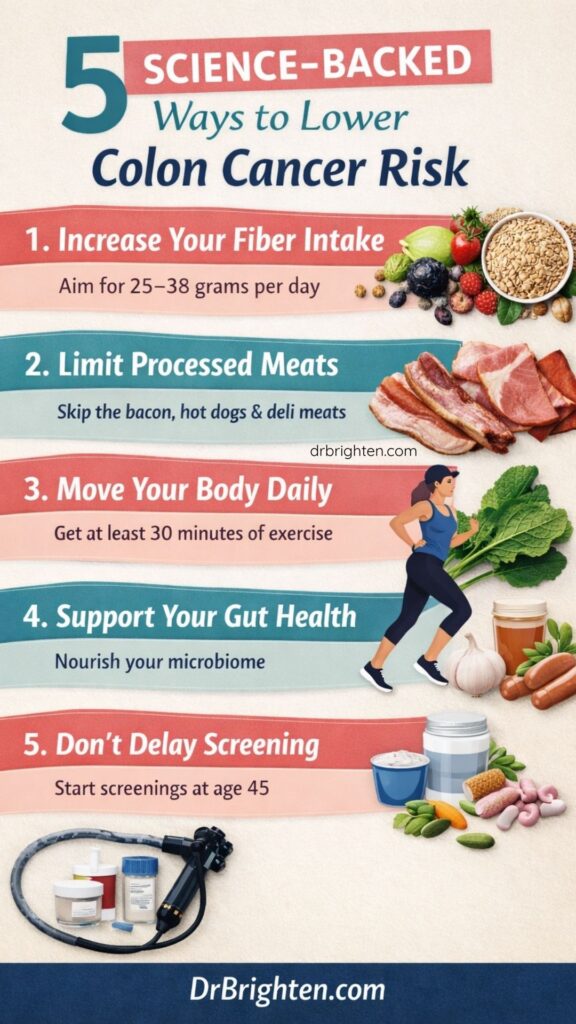
- Begin screening at age 45
- Screen earlier if you have family history or symptoms
Prevention doesn’t stop at screening.
Lifestyle interventions that reduce risk include:
- Increasing dietary fiber intake
- Reducing processed meat consumption
- Maintaining a healthy body weight
- Engaging in regular physical activity
- Supporting gut health through whole-food nutrition
- Limiting alcohol intake
The conversation sparked by James Van Der Beek colon cancer is not just about one individual. It’s about a shift in awareness. It’s about recognizing that colon cancer is not rare in younger adults. And it’s about taking action before symptoms escalate.
This Episode Is Brought to You By
Dr. Brighten Essentials Women’s Probiotic is formulated to support healthy digestion, vaginal microbiome balance, and everyday immune function—simple, daily care for women. A balanced microbiome is foundational for feeling your best—from digestion to confidence. Quality you can trust: third-party tested; manufactured in a cGMP facility
Exclusive for podcast listeners: use the code POD15 for 15% off your order
Sunlighten Saunas
Want a gentle, science-forward way to sweat, recover, and unwind? At Sunlighten, infrared saunas deliver soothing heat that supports relaxation, muscle recovery, and deep, comfortable sweating—without the stifling temps of traditional saunas. With low-EMF tech and options for near, mid, and far infrared, you get a calm, restorative session tailored to your goals.
Exclusive for podcast listeners: use the code DRBRIGHTEN to save up to $1,400 on your sauna
Fygg — a dentist-developed oral care brand on a mission to “Feed Your Good Guys.” Fygg makes science-backed, microbiome-friendly oral care products — like fluoride-free toothpaste and remineralizing varnish — that support a balanced oral microbiome without harsh chemicals, foam, or unnecessary ingredients. Developed by dentists and grounded in research, Fygg helps strengthen enamel, maintain oral health, and promote a healthier mouth for the whole family.
Use code DRBRIGHTEN for 15% off of their products (both one-time and subscription)
Links Mentioned in This Episode
- Fiber rich recipe guide and meal plan
- James Van Der Beek colon cancer news coverage
- Current colon cancer screening guidelines
- WHO processed meats and colorectal cancer risk
- 20 Best Prebiotics for Gut Health and Hormonal Balance
- The Best Probiotic for Women’s Health, and How to Choose
- How Long Does It Take Probiotics to Work?
Related Episodes:
- Dietary Fiber Benefits: Gut Health, Hormones, Blood Sugar, and What a High-Fiber Diet Really Does for Women | Gabrielle Palmeri
- SIBO vs IBS vs Leaky Gut: Tests, Treatments, and How to Heal Fast | Dr. Carolina Gonzalez
- Gut Health Probiotics: What Every Woman Needs to Know to Balance Hormones Naturally
- Is It Just Gas? The Shocking Truth About Gut Pain, SIBO, and What Your Poop Is Telling You | Doc Paco de la Vega
Frequently Asked Questions
Early symptoms can include subtle changes in bowel habits, blood in the stool, fatigue from anemia, and mild abdominal discomfort. Some people have no symptoms at all, which is why colon cancer screening is essential.
Current guidelines recommend starting colon cancer screening at age 45 for average-risk individuals. Those with family history or higher risk factors may need earlier screening.
Yes. Rates of early-onset colorectal cancer have been rising in adults under 50 over the past two decades.
Colon cancer is multifactorial. Contributing factors include genetics, chronic inflammation, processed meat consumption, low fiber intake, microbiome disruption, obesity, and lifestyle factors.
Colonoscopy remains the gold standard because it allows for detection and removal of precancerous polyps. Stool-based tests are useful screening tools but require follow-up colonoscopy if positive.
Estrogen appears to play a protective role in colon tissue. Hormonal changes in perimenopause and menopause may influence gut health and cancer risk, though research is ongoing.
Colon cancer is not a topic anyone wants to think about. But ignoring it doesn’t protect you. Informed prevention does.
Transcript
Dr. Brighten: [00:00:00] Colorectal cancers
are on the rise
Solo Reaction 2 - Front: in younger and younger and healthier, healthier people.
Dr. Brighten: That's
one of the reasons
Solo Reaction 2 - Front: I wanna talk about
Dr. Brighten: colorectal cancer or colon cancer is rising in younger adults, and we're not talking about like 60 year olds. Okay? We are talking about people in their thirties, some in their forties, and currently screening isn't happening for most people until 45. Recently we lost James VanDerBeek and he was only 48 years old, and this was after his battle with colorectal cancer. And if you grew up in the nineties, this definitely hits differently and my heart goes out to his family, his children especially. This is just so hard, but I appreciate him raising awareness around this. Now, I wanna be clear, this episode is not about fear. I want to empower you on the top five things that you can do to help you prevent colon cancer. Because colon cancer is one of the most preventable cancers we know [00:01:00] of. And yet most people are walking around with zero plan or zero idea outside of just eat fiber about what they can do about it.
Solo Reaction 2 - Front: So
Dr. Brighten: in today's episode, we are going to talk about why younger adults are being diagnosed more often, what actually reduces the risk of colon cancer in, you know, weeding out some of the hype, how fiber really works, how you can hit your fiber goals. We're gonna talk about screening, so Cologuard versus colonoscopy, and help you wade through the confusion around this, because certainly in the wake of James Vanderbeek's passing, there has been a lot of confusion and a lot of chatter online. Now first, welcome back to the Dr. Brighton Show. I'm your host, Dr. Jolene Brighton. I'm board certified in Naturopathic endocrinology, and I'm a nutrition scientist. And if you could take two minutes to hit that subscribe button, leave me a review, I would be so grateful. It is your support that helps this information get [00:02:00] out to the people who need it most.
Now, I don't wanna hold you up, so let's get into it. Firstly, why is colon cancer rising in young adults? This is something that is freaking all of us out. You know, James VanDerBeek, he passed away right before I had a birthday, and I'm like, major pause in my life. So here's what the data show. So the rates of colorectal cancer adults under age 50 has been increasing for the past couple of decades. Now, let's be honest, we don't have a single smoking gun. We don't know exactly why this is happening. Like we can't just name one thing. It's not one chemical and it's not one food despite what all of the influencers are telling you. The reality is, is that it is more than likely multifactorial, and so much of it comes down to your nutrition, your lifestyle, how you live your life every single day. So we are seeing increased ultra processed food intake as ultra [00:03:00] processed foods go up. We know nutrient density and fiber goes down so low fiber diets, super ultra processed food like.
Overwhelmed in our diets coupled with sedentary behavior. I'm not accusing anyone by the way, but this is the picture that we're starting to see that is leading to so many health problems in our society, including the increase in colon cancer, so sedentary lifestyle, low fiber, ultra processed food, more sugar, and we get central adiposity, so we get visceral adiposity fat packing around our organs.
Fat packing around our organs leads to metabolic dysfunction. Metabolic dysfunction, by the way, is not just like, oh, you have some insulin resistance and like blood sugar problems. It's highly inflammatory as well. And because the little ecosystem that is our microbiome is not in a vacuum container, all of these shifts can cause microbiome shifts, like what you eat is going to influence what they're able [00:04:00] to eat and how much they can thrive. Now, I think on top of that, there are environmental exposures going on as well.
There are environmental toxins that we are getting exposed to and that we are just barely scraping the surface to understand.
And
all of that together chalks up to a cumulative inflammatory burden. And I wanna pause here because this is not something where like 35 year olds suddenly have like an old colon.
Something about the modern metabolic environment is changing our risk. To be earlier, and that means that we don't wait until 65 to get care. Okay? If you're listening to this now, if we have any kind of changes going on.
We wanna
make sure that we get care. Now, before we get into the five ways to prevent colon cancer, I want you to know I do fiber rich meal plan and recipes drbrighten.com slash plan.
That's D-R-B-R-I-G-H-T [00:05:00] n.com/plan. So if you need some direction, a place to get started, you can grab that.
And
I do just wanna note, you know, James VanDerBeek had come out and said that he had bowel changes and he chalked it up to diet and he changed his diet and it didn't improve and that's when he finally went and got care. So, we're gonna talk about some red flags today, but I just want you to know that living in your own body is really, really important data.
So with that said, let's get into like. The first thing, which is screening. I'm gonna go into screening deeper later in this episode, but. A colonoscopy doesn't just detect cancer, it removes polyps before they become cancer. And that can be prevention. Now I know some people are like really anti colonoscopies. I still don't understand why you can let me know in the comments while you are.
Um, you know, the one argument that I. C made over and over again is that, well, other countries don't do colonoscopies as [00:06:00] frequently as the us And I'm like, well, sometimes when you look at those other countries is because of resources and how many people are trained. And also socialized medicine has to keep the cost down as much as possible.
And so, you know, it is something that I'm like, I, I get where that comes from. And certainly, you know, there's people that would rather do, uh, less invasive testing, however, that less invasive testing is not a hundred percent accurate. So I will spend some more time talking about that later in the episode. But the number two thing that you could be doing is fiber and know it's not just take a supplement. Okay. So fiber. Is one of the most consistently protective dietary factors against colorectal cancer. And here's why I wanna break this down simply for you to understand.
So when you eat fiber, especially fermentable fiber, your gut bacteria are going to feed on it. When they eat that fiber, they then produce short chain fatty acids like butyrate. If you've heard in [00:07:00] the A DHD episodes, we talk about butyrate before, it's such a great short chain fatty acid that helps A DHD brains, but. Why does it help A DHD brains? Because butyrate reduces inflammation, and so it's also helping the health of your gut as well.
And so eating more fiber feeds these bacteria. They produce butyrate. Butyrate helps lower inflammation. Lowering inflammation improves colon cell health. Butyrate also helps with regulating cell growth and keeping those cells optimized.
So fiber
helps your colon cells behave better and beyond that, it's also going to increase your stool bulk, so the bulk of your stool, and that can help with reducing transit time, helping you have more regular bowel movements. Which means less time for potential carcinogens, cancer causing agents to sit there near the cells. Fiber on top of that's gonna help you with improving insulin [00:08:00] sensitivity. So I already said at the top of this, like the metabolic issues that we have can be leading to inflammation and maybe leading to this increased risk for colon cancer.
So anything that's helping with improved insulin sensitivity, that's a plus.
And
in the US the average intake of fibers like 15 grams or less a day, and the recommended amount is a minimum of 25 grams for women, 38 grams if you're a man. So we need to be looking at how we can increase our fiber intake, because the reality is, is that most people are not even close. But while I want you to eat more fiber, if you are only eating like 10 grams a day and you jump to 35 grams a day, you will bloat. You will hate me, you will be mad. And that doesn't mean fiber is bad. It means your microbiome needs to adjust, your gut needs to ingest. But the best sources of fiber, and you can let me know in the comments, are you eating these? How many do you get? I want you to score yourself. So [00:09:00] beans, lentils, chia seeds, flax seeds. We want to eat those Ground berries, like especially raspberries, a great source of fiber. Are you keeping track? How many are you at right now?
Solo Reaction 2 - Side: Cruciferous
Dr. Brighten: vegetables. So we're talking about broccoli, kale, um, getting some brussel sprouts in cauliflower. Oats. I know there's a lot of oats haters out there because they're like, they're rich in glyphosate, opt for organic. But oats are still a really good source of fiber. And remember, we're rotating these things out.
We're getting variety in our diet. Whole grains. Another good source. If you tolerate whole grains, like we're talking brown rice, whole wheat. So let me know how many of these you are hitting and notice. I didn't say fiber gummies. No, I'm not saying that like fiber supplements are [00:10:00] bad far from it, but we want to be starting with real food as we make the fiber shift, not just supplements.
We don't rely on just supplements. Do you need supplements Sometimes? Absolutely. But I want you to be looking at your diet and how you can increase. Fiber from Whole Foods. Now, number three, what you can be doing to prevent colon cancer is looking at your body composition, your insulin.
So visceral fat increases inflammatory cytokines, chemical messengers that increases insulin resistance. High insulin, insulin like growth factor one signaling can promote cellular proliferation. Lots of growing that matters in the colon. So when we talk about maintain a healthy weight, that's not diet culture as much as people say that, like it's about inflammatory signaling and control.
So maintaining a healthy weight is a great way to prevent cancer, as is number four, which is regular physical activity. Regular physical activity helps [00:11:00] reduce the risk of many cancers, colorectal cancer being one of those, and the mechanism is that it improves insulin sensitivity like we talked about multiple times now, which also is going to improve your inflammation. We'll see improvement in how your gut actually functions. We know with long-term diabetes, we have damage to nerves, and your gut can be one of those areas where motility starts to suffer because we've had nerve damage happen. Now when we have. Regular exercise. We are also seeing shifts in immune surveillance, so checking out those cancer cells may be happening more often.
Solo Reaction 2 - Front: Now
Dr. Brighten: when it comes to exercise and cancer prevention, we're not talking about running a marathon or doing an Ironman. We're talking about consistency every single day. Trying to get some movement in wherever your body is at. You need it there and get some movement. It doesn't have to look like everybody, what everybody on the internet says. . Now [00:12:00] before we talk about the last one, I wanna remind you just to go around to the end. We're gonna talk about colonoscopy versus Cologuard,
number five, first I wanna say I, I need to say something that might make you uncomfortable, might make you mad, might make you eye roll at me. Um, but you need to limit your processed meats. So that includes the nitrate free deli, Turkey meat deli meats are classified as a group one carcinogen by the World Health Organization's Cancer research team. And that's the same level of evidence category as tobacco. Ugh. So I, I don't wanna say like, I wanted to say like this is not because the risk is equal, it's because the evidence linking process meet to colorectal cancer is strong. And here's the number that's gonna maybe really upset you. And that is that eating just 50 grams per day, which is about like three slices of deli meat, increases colorectal cancer risk by about 18%.
So if you're eating a sandwich every [00:13:00] day, that's chronic exposure. And I want you to listen to me very carefully because if you're like, I have to turn her off right now. Look. This is not about never eating bacon again. No, I love me some bacon. It's also not about never eating deli meat because sometimes that is the best thing that you can reach for is because you are hungry and you're on the go and like, I get it.
This is about not making processed meat, your default protein, every meal every day, because many people will think it's Turkey, it's lean, it's healthy, but processing, so smoking and curing, and nitrates and nitrites create compounds that damage colon cells over time. And when you combine that with a low fiber or low movement, high stress, metabolic dysfunction kind of lifestyle, that's a modern risk profile. So hear me, I'm not about to be like never eat these convenience meats like I eat them. [00:14:00] I definitely have patients who eat them, people that are just like, this is what I have access to right now.
But what we don't wanna do is make it the only thing we're eating day in and day out. So with that said, let's talk about screening. So Cologuard versus colonoscopy.
So
firstly, let's get practical for the average risk adults. Screening is gonna start at age 45. It's gonna be earlier if you have a first degree relative with colon cancer.
Solo Reaction 2 - Front: If
Dr. Brighten: you have a history of inflammatory bowel disease, so that's going to include ulcerative colitis or Crohn's, you may need to get screened.
Even earlier . So you definitely wanna talk to your provider about your current state, and this is where like having a great gastroenterologist is amazing. 'cause I can give you the lifestyle ways that you can try to dodge colon cancer, but we've gotta be working with a gastroenterologist as well.
Now if you have a high hereditary risk, you would also [00:15:00] need to be screened before age 45. So I wanna now compare options with that in mind. Now, if you get a colonoscopy at age 45 and everything is normal, then your doctor's likely not gonna recommend that you get another one for another 10 years. You're gonna go 45 to 55.
And what a colonoscopy does, it's different than Cologuard that we're gonna talk about. It's different than doing a stool test, is it's gonna visualize the entire colon and if.
Solo Reaction 2 - Front: There
Dr. Brighten: polyps that are like, those are suspicious. We're gonna just see those taken out there, and they're gonna send them off to pathology.
So they're gonna remove the polyps on the spot. And for some people that actually removes pre-cancerous or even maybe the beginning of cancerous lesions, and then they get the treatment that they need. The downside is, is that it does require prep. Nobody likes it. Nobody likes having to prep their colon, and it does require sedation.
And anytime [00:16:00] that we are sedated, there is always a risk of complications and that that's part of the risk of why people will say like, oh my God, but you could die from this. The risk of complications are very small with a colonoscopy.. So to put it in perspective, what most people are concerned about is bowel perforation. That happens at about 0.1% of colonoscopies. To put that in perspective, IUD perforations of your uterus is about 0.1 to 0.2%. And so this is where I kind of, kind of scratch my head because people will be like, I don't wanna get a colonoscopy because there's the risk of perforation.
Um, but nobody bats an eye about the IUD and you might be listening to this being like, no, I wouldn't get an IUD. Either, I mean, fair, I had an ID I'll never do that again either, but the risk of perforation is very low. There is like the, you know, the possibility you could have a reaction to the sedation that maybe there's some bleeding that occurs afterwards, but a good gastroenterologist.
[00:17:00] So I'll just tell you right now. If you're considering a colonoscopy, meet with a gastroenterologist. If he doesn't go through, like, here's the risks and here's the risks for you, and like, here's the benefits and doesn't go through all of that, and it's just like, just get it done. You'll be fine. Okay? Go.
Go see someone else because you deserve informed consent and you deserve to have your mind put at ease and you can bring a list of questions and ask them.
Solo Reaction 2 - Front: But
Dr. Brighten: as of right now, a colonoscopy is considered the gold standard because it is prevention and detection in one.
Solo Reaction 2 - Side: Now,
Dr. Brighten: Now, in recent years, the stool, DNA testing, Cologuard has come out and that's done like one every three years. What is great about this is it's at home. So if I have someone who's like, I'm 40. I don't have like the checklist of, uh, you know, risk factors, but I'm just concerned we can just do this test and, and see at home.
Like, do you have, uh, you know, any reason to go get a colonoscopy sooner? This is gonna look for not just blood. But also abnormal DNA markers. And I think that's important 'cause a lot of people [00:18:00] are like, oh, it's just like a fecal occult, which is a way of testing hidden blood in your stool. But it goes beyond that.
It's gonna look at DNA markers as well. If it's positive, you must get a colonoscopy. So if you are someone who's like, I never want a colonoscopy. Understand that positive means you're getting a colonoscopy. Um, and that's not because we hate you, we wanna torture you, okay? It is because we care about you and we want you to survive and live a really long life like James VanDerBeek should have been able to, and it breaks my heart and I don't want any of that for you. Now the co guard is a good option for the average risk adult who's otherwise gonna not get a colonoscopy and avoid it. But it's not an equivalent to an colonoscopy in its prevention power. So the best test though, I mean, let's be honest, like as doctors were like, get a colonoscopy. The best test is the one you're actually gonna complete and you're gonna follow up with appropriately.
And so sometimes that might be the Cologuard that you are doing first. [00:19:00] But there's some things you need to know about the Cologuard. So firstly, when it comes to colon cancer detection, it's anywhere from like 92 to 94% accurate. That's really good. Those really high numbers.
So
that's why some people like to take that option over starting with a colonoscopy, but when it comes to pre-cancerous polyps, it's less than 50% accurate, whereas a colonoscopy is over 95% accurate. Okay, so keep that in mind is that the colonoscopy is gonna catch the pre-cancerous stuff. The Cologuard isn't gonna be as effective with that. The Cologuard can also have false positives and false negatives, so keep that in mind.
Now
this part matters a lot for the US unfortunately.
Solo Reaction 2 - Front: if
Dr. Brighten: you get a Cologuard and it's positive and then you need to go for a colonoscopy that's no longer a screening exam that may be covered by your insurance, at that point it becomes diagnostic, and then you might have more out of pocket. Copays [00:20:00] or expenses that you have to think about, and unfortunately you have to think about that in the United States, is that there's a real possibility that things get found in that Cologuard and then that changes how your insurance gonna actually cover things.
Now if you are someone who is high risk or you have the red flag symptoms we're gonna talk about here, but one of them is bleeding blood in your stool, then.
Solo Reaction 2 - Front: then
Dr. Brighten: Cologuard's not right for you. It's time for a colonoscopy. And that's the real talk there. Now, the red flag symptoms that you absolutely want to go see your provider for, if there's blood in the stool, if your stool is red, if blood is dripping into the toilet, if, uh, it's tar, like that might be bleeding higher up, but we wanna go see a doctor.
Solo Reaction 2 - Front: If
Dr. Brighten: you're having changes in your bowel movements. If you're constipated and it's not getting better, if you're having diarrhea and it's persistent, if you are having gas, bloating, constantly having [00:21:00] abdominal pain, it's probably time to meet with the gastroenterologist, make sure something more isn't going on.
Then I just need to shift my diet. And then if you have iron deficiency anemia and they don't know why, like you don't have heavy periods, but you're deficient and you eat meat, but you, you're iron deficient. Okay, good time to see the gastroenterologist because that means we may have a bleed somewhere.
We're having absorption issues. We need to make sure that your gut is healthy. Now if you're having unexplained fatigue, unexplained weight loss, and you're like tired, you're losing weight, um, or you know, back on the bowel movements, you got like pencil thin stools, um, things are just not seeming right in your body. Those are red flags. Anytime you're like, this is not normal. Don't get gaslit into believing it's normal.
You live in your body. You're the only one that knows what's normal for you, and if it's not normal for you, it's worth investigating. So I hope this episode was helpful [00:22:00] for you. Again, I am very sad at the passing of James Vander beak. I'm very sad, like anybody passing, you know, so young, and it really, you know, inspired this episode.
His advocacy inspired this episode that he was so open and advocated about this that I was like, you know. We should do an episode on this, talking about ways that you can prevent colon cancer in your life every day. I appreciate you being here. I appreciate your reviews. I appreciate your support, and I will see you next time.