
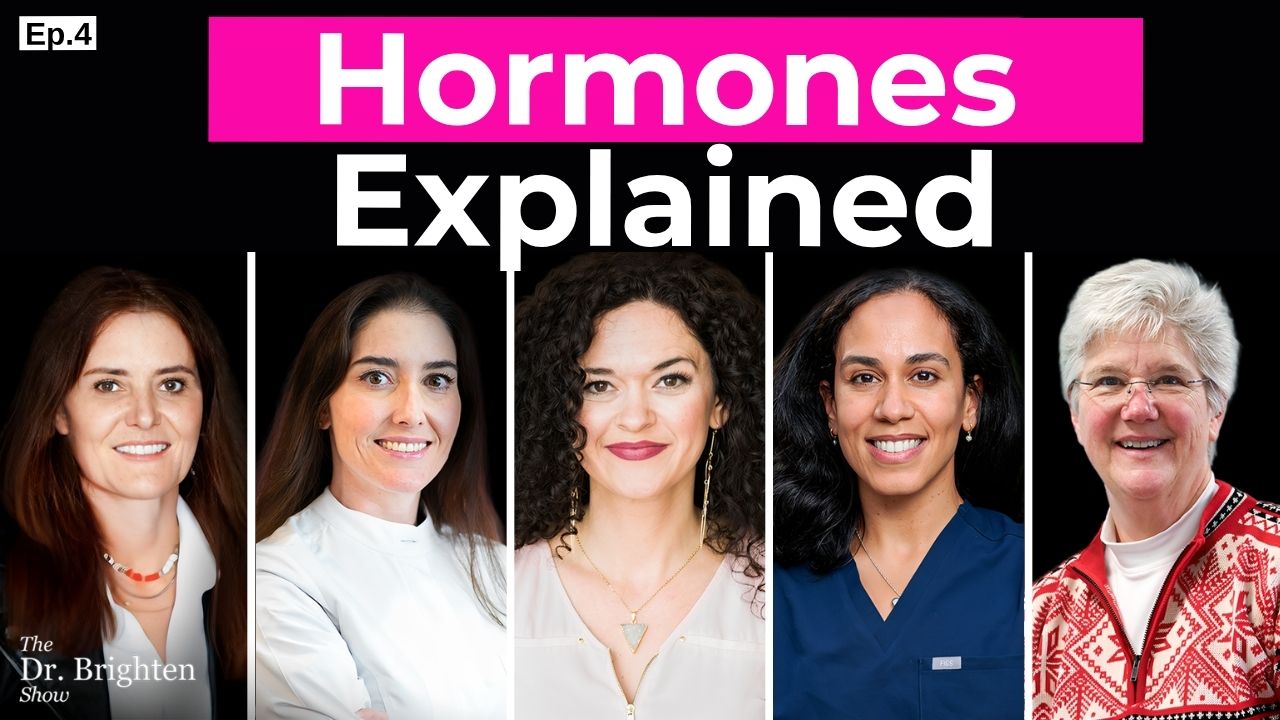


If you’ve ever been told to “just go on birth control” for endometriosis, this episode is going to change the way you understand endometriosis and hormones.
Hormonal therapy is often the first-line treatment for endometriosis, but not all hormones work the same way and for many women, birth control helps symptoms without ever addressing the underlying disease. In this powerful final panel episode of our endometriosis expert series, leading excision surgeons and hormone specialists unpack the truth about the best birth control for endometriosis, progesterone resistance, HRT, perimenopause flares, and whether endometriosis is truly a hormone imbalance.
You’ll learn why some women feel better on hormonal suppression, why others feel dramatically worse, and what every woman deserves to know before being told to wait for menopause, try Lupron, or start HRT.
Is Birth Control Best for Endometriosis: What You’ll Learn in This Episode
If you’ve been only offered the pill and want to understand more, this episode goes far beyond generic answers and gives you the nuance most women are never offered in the exam room.
In this conversation, you’ll learn:
- Why the birth control pill is still the first treatment many women are offered
- The difference between combined pills, progestin-only pills, hormonal IUDs, and GnRH medications
- Why not all hormonal treatments are the same
- The truth about chemical menopause medications like Lupron
- Why experts believe GnRH drugs should only be used short-term
- What progesterone resistance in endometriosis actually means
- How aromatase activity may increase estrogen stimulation inside lesions
- Why bioidentical progesterone and progestins are not interchangeable
- Whether HRT can worsen endometriosis symptoms in menopause
- Why some women flare in perimenopause when estrogen spikes unpredictably
- The surprising statistic that 1 in 10 women live with endometriosis
- Why up to 50% of unexplained infertility may involve endometriosis
- How endometriosis affects the brain, bones, cardiovascular system, sleep, and mood
- Why the disease must be treated as a systemic inflammatory condition
- What role nutrition, inflammation, and cortisol may play in symptom severity
- Why waiting for menopause is not a treatment strategy
If you’ve ever asked: “Is endometriosis caused by hormones” or “Can birth control make endometriosis worse” this episode gives you the nuanced answer.
Hormones and Endometriosis: Is Endometriosis a Hormone Imbalance?
One of the most important themes in this episode is that endometriosis is not simply a hormone imbalance, even though hormones strongly influence symptoms.
The panel explains that endometriosis is an estrogen-responsive, systemic inflammatory disease.
That distinction matters.
Hormones may fuel lesion activity, pain flares, bleeding patterns, and inflammation, but the disease itself is not reduced to “bad hormones.”
As discussed in the episode, many lesions demonstrate progesterone resistance, meaning progesterone cannot adequately signal the tissue the way it normally should.
In practical terms, this means:
- lesions may be less responsive to hormonal therapy
- symptoms may persist despite progesterone use
- birth control may suppress bleeding but not fully suppress disease activity
This aligns with broader literature showing that progestin-only therapies are commonly used as first-line treatment, but response varies significantly among patients.
The episode also dives into the concept that endometriosis lesions may have:
- upregulated estrogen receptors
- downregulated progesterone receptors
- local estrogen production through aromatase activity
This is exactly why some women feel frustrated when told:
“the pill should fix this.”
For many, it helps symptomatically.
For others, it only partially suppresses pain.
What Is the Best Birth Control for Endometriosis?
This episode does not present a one-size-fits-all answer and that’s precisely why it’s so valuable.
The experts discuss several options commonly used:
Combined Birth Control Pills
Often prescribed first, but the experts note that it often offers little relief compared to the hefty amount of side effects. Many of the experts feel it is a good choice when you also want to avoid pregnancy, but is not the best treatment option, as it does not actually treat the disease.
These may help by:
- suppressing ovulation
- reducing bleeding
- decreasing cyclic pain
However, the discussion raises an important question: if lesions are estrogen sensitive, what happens when a medication contains estrogen?
And in addition, if endometriosis lesions can make their own estrogen, how can the pill really address those? It can’t.
This is where individual response matters.
Progestin-Only Pills
Frequently used when estrogen-containing methods are not ideal.
Some research suggests progestin-only therapy may be a better first-line option for many women with endometriosis.
Hormonal IUDs
Especially discussed in the context of:
- adenomyosis
- local uterine symptom control
- reducing heavy bleeding
The panel emphasizes that an IUD can be a symptom management tool, but it is not a cure.
GnRH Agonists and Antagonists
These medications suppress estrogen dramatically and induce a temporary menopausal state.
The panel is very clear that these are not long-term solutions and raises concerns about:
- bone density
- cardiovascular implications
- brain health
- mood changes
This is highly consistent with current clinical guidance that GnRH therapies should generally be used short-term and often as second-line interventions.
Can HRT Make Endometriosis Worse?
The answer from the episode is: it depends on whether residual disease remains and whether progesterone is included.
The experts explain that estrogen-only HRT may reactivate residual endometriosis tissue, especially if excision has not been performed.
This is why the conversation strongly supports the use of:
- combined HRT
- estrogen + progesterone
- especially in patients with known endometriosis history
This mirrors current clinical recommendations that women with endometriosis who use HRT are typically advised to include progesterone to reduce stimulation of residual lesions.
Can HRT Help With Endometriosis?
Yes, and this is where the nuance matters. The episode strongly pushes back against the myth that women with endometriosis should simply avoid hormones forever.
In fact, the panel explains that estrogen is deeply protective for:
- brain health
- bone density
- cardiovascular health
- sleep
- mood
- vaginal and urinary tissue health
This is especially relevant in perimenopause and menopause.
The conversation highlights that many women experience worsening flares in perimenopause due to dramatic estrogen fluctuations, making progesterone support especially important.
Support for women with endometriosis requires better education, better access to care, and tools that help women advocate for themselves with confidence.
This Episode Is Brought to You By
Dr. Brighten Essentials
Want science-backed supplements formulated by a doctor who actually understands women’s health? 🌿 At Dr. Brighten Essentials, every product is crafted to support your hormones, boost your energy, and help you feel your best—inside and out. From targeted nutrients for glowing skin to essentials that fuel your daily vitality, you’ll get the highest-quality ingredients in forms your body can truly use.
Exclusive for podcast listeners: Use code POD15 at checkout for 15% off your order.
EndoGlobal Group
At EndoGlobal Group, a network of world-class endometriosis specialists comes together to provide comprehensive, multidisciplinary care for patients with complex endometriosis—offering advanced diagnostic mapping, complete excision surgery, and holistic support.
Click here to learn more and schedule a free consultation.
Links Mentioned in This Episode
- Beyond the Pill — Dr. Jolene Brighten
- NAC from Dr. Brighten Essentials
- Endometriosis Rest Course
- Endo Flare Guide
- High-intensity focused ultrasound (HIFU) for adenomyosis
Endometriosis Series and Related Episodes:
- Episode 1: Endometriosis Symptoms vs Normal Period Pain with Dr. Patrick Yeung
- Episode 2: What Is Endometriosis? 4 Surgeons Explain the Symptoms, Misdiagnosis, and Whole-Body Impact
- Episode 3: Endometriosis Relief of Pain: Experts Explain Laparoscopy, Chronic Pelvic Pain, and Why So Many Women Are Still Suffering
- Episode 4: Endometriosis Surgery: What Most Doctors Won’t Tell You
- Natural Ways to Manage Endometriosis Beyond Surgery
- The Hidden Connection Between Estrogen and Histamine: Why Your Hormones Cause Inflammation
- 3 Period Problems Women Should Never Ignore (Heavy Bleeding, PMS, and Period Pain)
Meet Our Experts
Dr. Jolene Brighten, Board-Certified Naturopathic Endocrinologist, Endometriosis and Adenomyosis Patient Advocate, Host of The Dr. Brighten Show
Grab your free Endometriosis Flare Prevention Guide
Dr. Anna Sierra, Endometriosis Surgeon with Neuropeviology Training
Doyenne Institute and Endo Global
Based in Mexico City
Work with Dr. Sierra
Dr. Cindy Moser, Endometriosis Excision Surgeon
Pacific Endometriosis and Pelvic Surgery
Based in Gig Harbor, Washington
Work with Dr. Moser
Dr. Shanti Mohling, Endometriosis Excision Surgeon
Northwest Endometriosis and Pelvic Surgery
Based in Portland, Oregon
Work with Dr. Mohling
Dr. Victoria Vargas, Endometriosis Excision Surgeon
Founder, Washington Endometriosis and Complex Surgery
Based in Washington DC
Work with Dr. Vargas
Frequently Asked Questions About Birth Control and Endometriosis
The best option depends on your symptoms, reproductive goals, lesion type, and tolerance for side effects. Common options include progestin-only pills, hormonal IUDs, and combined oral contraceptives.
Not exactly. It is better understood as an estrogen-responsive inflammatory disease rather than a simple hormone imbalance.
Not always, but it may mean that lesions respond less effectively because receptor signaling is altered.
It can if residual lesions remain and estrogen is given without progesterone. Combined HRT is often preferred.
No. Hormonal therapies may help manage symptoms, but they do not cure the disease.
Citations:
Lee, H. J., Lee, B., Choi, H., Kim, T., Kim, Y., & Kim, Y. B. (2023). Impact of Hormone Replacement Therapy on Risk of Ovarian Cancer in Postmenopausal Women with De Novo Endometriosis or a History of Endometriosis. Cancers, 15(6), 1708. https://doi.org/10.3390/cancers15061708
Lee, H. J., Lee, B., Choi, H., Lee, M., Lee, K., Lee, T. K., Hwang, S. O., & Kim, Y. B. (2024). Hormone Replacement Therapy and Risks of Various Cancers in Postmenopausal Women with De Novo or a History of Endometriosis. Cancers, 16(4), 809. https://doi.org/10.3390/cancers16040809
Rossouw JE, et al. (2002). Risks and benefits of estrogen plus progestin in healthy postmenopausal women: principal results from the Women’s Health Initiative randomized controlled trial.JAMA. 288(3):321–333.
Manson, J. E., et al., (2013). Menopausal hormone therapy and health outcomes during the intervention and extended poststopping phases of the Women's Health Initiative randomized trials. JAMA, 310(13), 1353–1368. https://doi.org/10.1001/jama.2013.278040
Chlebowski, R. T., et al., (2015). Continuous Combined Estrogen Plus Progestin and Endometrial Cancer: The Women's Health Initiative Randomized Trial. Journal of the National Cancer Institute, 108(3), djv350. https://doi.org/10.1093/jnci/djv350
Fournier, A., Berrino, F., & Clavel-Chapelon, F. (2008). Unequal risks for breast cancer associated with different hormone replacement therapies: results from the E3N cohort study. Breast cancer research and treatment, 107(1), 103–111. https://doi.org/10.1007/s10549-007-9523-x
Tang, H. C., Lin, T. C., Wu, M. H., & Tsai, S. J. (2024). Progesterone resistance in endometriosis: A pathophysiological perspective and potential treatment alternatives. Reproductive medicine and biology, 23(1), e12588. https://doi.org/10.1002/rmb2.12588
Weisberg, E., & Fraser, I. S. (2015). Contraception and endometriosis: challenges, efficacy, and therapeutic importance. Open access journal of contraception, 6, 105–115. https://doi.org/10.2147/OAJC.S56400
Saleh, F. L., & Taylor, H. S. (2023). Clinical applications of gonadotropin-releasing hormone analogues: a broad impact on reproductive medicine. F&S reports, 4(2 Suppl), 83–87. https://doi.org/10.1016/j.xfre.2023.01.008
Kim E. Y. (2015). Long-term effects of gonadotropin-releasing hormone analogs in girls with central precocious puberty. Korean journal of pediatrics, 58(1), 1–7. https://doi.org/10.3345/kjp.2015.58.1.1
Naheed, B., Kuiper, J. H., O'Mahony, F., & O'Brien, P. M. (2025). Gonadotropin-releasing hormone (GnRH) analogues for premenstrual syndrome (PMS). The Cochrane database of systematic reviews, 6(6), CD011330. https://doi.org/10.1002/14651858.CD011330.pub2
Chantalat, E., Valera, M. C., Vaysse, C., Noirrit, E., Rusidze, M., Weyl, A., Vergriete, K., Buscail, E., Lluel, P., Fontaine, C., Arnal, J. F., & Lenfant, F. (2020). Estrogen Receptors and Endometriosis. International journal of molecular sciences, 21(8), 2815. https://doi.org/10.3390/ijms21082815
Greygoose, E., Metharom, P., Kula, H., Seckin, T. K., Seckin, T. A., Ayhan, A., & Yu, Y. (2025). The Estrogen–Immune Interface in Endometriosis. Cells, 14(1), 58. https://doi.org/10.3390/cells14010058
Heath, A., Farr Zuend, C., Goodman, W. A., Koyuturk, M., & Brubaker, D. (2025). Rethinking the estrogen receptor beta dominance hypothesis in endometriosis: Insights from single cell RNA sequencing meta-analysis https://doi.org/10.1101/2025.09.15.676330
Mori T, Ito F, Koshiba A, et al. Local estrogen formation and its regulation in endometriosis. Reprod Med Biol. 2019;18:305–311. https://doi.org/10.1002/rmb2.12285
Transcript
Dr. Brighten: [00:00:00] Endometriosis patients are always reduced to their endometriosis, and that's all that doctors see and all that doctors treat.
Dr. Shanti Mohling: Taking estrogen only is risky for someone who has endometriosis. Most of my patients have terrible side effects, and so that may not be the best choice for them.
Dr. Victoria Vargas: One thing about progesterone resistance is that going back to the actual regions, they actually have an imbalance in the receptors themselves.
There are more estrogen receptors than progesterone receptors.
Dr. Cindy Mosbrucker: It is incorrect to think that menopause will stop your pain, especially in the 40 year olds. Oh, just wait for menopause and you'll be fine. Some women, menopause doesn't happen until 55. That's 15 years that people are expecting them to sit in pain.
Dr. Ana Sierra: The patient advocates for themselves. Sometimes they know more about their own disease than the doctor that they are going to their offices. If the patient knows more about something that you, it's a wake up call for some doctors.
Dr. Brighten: Welcome back to our final episode. We are gonna talk hormones and [00:01:00] endometriosis, but to kick this off, I need to know from everyone at the table, what is the biggest myth in endometriosis that is hurting women?
Anna, we're gonna start with you.
Dr. Ana Sierra: Um, you need a sexual partner. I've seen a lot of patients that during their teen years or late teen years, were told that if whenever they get married or have a sexual partner, we'll remove their pain as long as they begin their sexual life. So I think that can hurt women.
Dr. Shanti Mohling: Absolutely.
Dr. Victoria Vargas: The retrograde menstruation theory, if you believe that retrograde menstruation is the cause of it, I feel like it diminishes the role of surgery in endometriosis.
Dr. Shanti Mohling: Getting pregnant is gonna cure your pain and your endometriosis. And we know over and over again from studies, from personal anecdotes, from research that pregnancy, absolutely hands down does not cure endometriosis.
Dr. Cindy Mosbrucker: Just wait for menopause. People are, uh, expecting them [00:02:00] to sit in pain and wait when there's absolutely no data. And it is incorrect to think that menopause will stop your pain, stop your symptoms from endo.
Dr. Brighten: Mm-hmm. Well, for everybody tuning in, I'm Dr. Jolene Brighton. I'm the host of the Dr. Brighton Show.
We are doing a series on endometriosis, and while I'm a board certified naturopathic endocrinologist, I'm also an endometriosis patient and I have adenomyosis and have struggled with secondary infertility. And I am joined by an amazing team of endometriosis experts who are bringing you the truth in this series of what you need to know about endometriosis.
And I'd love to have you introduce yourselves.
Dr. Shanti Mohling: Hi there. I'm Shanti Mulling and I live and work in Portland, Oregon and in the Pacific Northwest. My, my niche is really exclusively doing surgery and care for women with pelvic pain and endometriosis.
Dr. Cindy Mosbrucker: Hi, I am Dr. Cindy Moss Bruer from Gig Harbor, [00:03:00] Washington.
Uh, I have a practice dedicated to endometriosis. I've been doing this for 20 years since training with Dr. David Redwine back in the uh, 2006.
Dr. Ana Sierra: Hi, I am Dr. Annas. I am anion surgeon with neurobiology training, and I specifically do see and treat patients with chronic pelvic pain every day.
Dr. Victoria Vargas: My name is Victoria Vargas.
I'm based in Washington DC. I'm part of a practice called Washington Endometriosis and Complex Surgery, and I work with women with endometriosis doing surgery and also, um, long-term care through my, the nurse practitioner I work with in my practice.
Dr. Brighten: Amazing. So we are gonna talk about hormones. In the last episode, we talked about surgery.
We touched a little bit on hormones, and I think that's an important conversation everyone should go back and listen to. But Shanti, I wanted to ask you, what hormone options are available to manage endometriosis?
Dr. Shanti Mohling: Oh, great question. So the hormone options that most patients are [00:04:00] given when they first seek care for pelvic pain, number one, will be a birth control pill.
So patients are offered that and. Uh, alongside of that, patients are offered progestin only pills. They're offered an intrauterine device that releases progestin into the uterus. They then, next line, often they're offered hormone suppressors. These are called GNRH analogs or gonadotropin releasing hormone analogs, which ultimately create a temporary state that's similar to menopause.
But in, in the United States, we have Nora Hyron, uh, primarily. So these are the, the standard. Care options In my practice, I really focus on bioidentical hormone therapy, uh, and, and also will sometimes use the standard pharmaceutical hormones, but bioidentical hormone therapy such as a progesterone. So this is, this is biochemically like the progesterone that our bodies make, and [00:05:00] sometimes it can be used very safely and, and can be helpful for patients to somewhat minimize their pain if they aren't quite ready for surgery or if they wanna use it after surgery.
Some patients use it just in the period of time, after they ovulate, before their period. Some patients wanna use it every day throughout a cycle, and some patients who are menopausal, which we can get into later, may be taking it daily.
Dr. Brighten: They see so often gynecologists take to social media and they preach about how wonderful menstrual suppression is, and they say You wouldn't find a gynecologist who's choosing to have a period.
And so many women look at that and say, well then how can you be an expert about what is normal when you won't? Even, you know, subject yourself to the experience and your perspective of what is normal is to use any medication to suppress the menstrual cycle and just not have one.
Dr. Victoria Vargas: What's normal is for us to be breastfeeding and pregnant most of our lives.
There's a lot of people that think that all the menstrual periods that we [00:06:00] have now nowadays are worsening. Things like we're being exposed to more hormones are natural hormones, which are normal, but we're not supposed to be being exposed to 'em as much like, so breast cancer rates go up and even just how much endometriosis is diagnosed because it's not suppressed for as many years of our lives.
Dr. Brighten: When you're pregnant, it's estriol weak estrogen, but very lovely estrogen that we bathe in. And so it is a different hormone profile, but to take the birth control pill and say, well, that's the same as being pregnant is false because that's progestin not progesterone. And that that estradiol or the ethanol estradiol, that's.
Different than the Estriol that you would be exposed to. And so it's not really fair to say that like, oh, we, you know, we should be pregnant, therefore just be on birth control and act like the hormones are the same. They're not. We know there is a mild increased risk of breast cancer with taking the pill, for example.
On the other side, there's a [00:07:00] decrease in ovarian cancer, which we are very bad at catching. So, you know, there's pros and cons to these medications and I think that. This is important for everyone to listen to, uh, this interview with you guys because I think this group of women is very good at the nuance.
Dr. Shanti Mohling: I am not a fan of birth control pills, and I don't routinely put my patients on them. And, and so one of the reasons why this is controversial is in the fifties, this was like a pro-feminist cool thing. Like women finally have control. We finally can take something that prevents us from getting pregnant.
At the same time, combination birth control pills are four to five times physiologic, estrogen. We have these patients, we think, oh, they might have endometriosis. They're having pain with their periods. Well, we're gonna suppress their periods. Well, yeah, it's gonna make them not have periods and that. Not having a period might help a little bit, but what is four to five times physiologic, estrogen doing to preexisting endometriosis?
We do have studies that show that patients are more likely [00:08:00] to have endometriosis if they have been on a pill,
Dr. Brighten: as you say, like this is controversial. Hi Shanti. I'm the author of Beyond the Pill, who actually wrote a book in 2019 that made a lot of gynecologists hate me because I said, instead of putting them on the pill, you should work them up.
No. Oh, I
Dr. Shanti Mohling: didn't know this.
Dr. Brighten: Yeah, and this was a very controversial thing because I said, instead of prescribing the pill, why don't we ask why? Why are we diagnosing PCOS after three specialists? Why are we diagnosing endometriosis 10 years later? Like because we don't pause and ask why? Because ACOG has told you that you can be lazy, you can be mediocre in women's medicine and just write that pill prescription and do nothing more in center on your way.
And that's where I think ACOG has been very problematic in endometriosis care.
Dr. Shanti Mohling: What happens when we are residents and we're learning about OB GYN, we get lunch after lunch paid for by pharmaceutical reps who teach us about their birth control pill. We are taught by industry. Right?
Dr. Brighten: Mm-hmm. [00:09:00] Let me ask you, Vicki, why do some doctors jump to essentially chemical castration immediately rather than offering alternatives?
When it comes to endometriosis?
Dr. Victoria Vargas: I think oftentimes doctors, they jump to GNRH analogs when patients have failed combined oral contraceptive pills and progestins. And I think it kind of dovetails back to what I was saying before about like some of the myths regarding surgery. You know, I think that they just really don't believe that surgery is helpful for these patients.
They don't see any other option, but these GnRH analogs, I don't think it comes with malicious intent. I think there's a strong influence from the pharma industry and um, in our current guidelines, and I think the role of surgery is often misunderstood among general OBGYNs.
Dr. Brighten: GN Rh analogs, these have long-term consequences.
I wanna talk about how long should these be used and what's the risk if you pass [00:10:00] that?
Dr. Victoria Vargas: So they're FDA approved for about six months. Um, to be honest, I mean I think that the safety data is controversial. Some studies have shown that, you know, your peak estradiol levels never kind of recover after you've been exposed to Lupron.
I think, you know, using this in, in young girls when they're laying down bone or even developing like their, their sexual organs, you know, that need exposure to estrogen and to, and, um, testosterone and, and progesterone to develop. Um, and, and we know the role of estrogen in things like. The heart, the bones, the brain.
I, you know, I think there's probably a lot of things we don't fully understand about the sequela of GnRH analogs. Um, but, you know, we are intended to have some level of hormonal exposure, um, for just normal function of our bodies. So,
Dr. Brighten: does anyone know at the table, if they've ever done studies looking at bone health, brain health, cardiovascular health, when these GnRH analogs are [00:11:00] used?
Dr. Shanti Mohling: I don't think we would have long term enough data to quite reveal that. Mm-hmm. And also, not sure if anyone's specifically looked at it for sure. Not published it that I know of.
Dr. Cindy Mosbrucker: Well, I think that, and some of that may be what was suppressed.
Dr. Brighten: Mm-hmm. And so for people listening, we talked in a previous episode about the suppression of the research surrounding these.
But I asked this question because it really, it, it goes along with the theme that's come up in every single episode, which is. Endometriosis patients are always reduced to their endometriosis, and that's all that doctors see and all that Doctors treat and often without any regard, unless there is a wish to have a baby.
So I wanna ask them, is there any point where hormonal suppression should come before surgery?
Dr. Ana Sierra: I actually don't like to use GNRH. I don't like the way that I, I've met patients that tell me I feel like I am myself, but I'm not myself. The way that I act with my [00:12:00] kids, the way I act with my husband is not the same.
I want to throw myself out of buildings. I, this is not working for me. My brain is different. Like, I don't know if I would want to be the one that. Place them in that situation. I actually don't like,
Dr. Victoria Vargas: this is basically not a long-term solution for any patient. So I think that's the first point. But number two is let's say a patient was having a hysterectomy for like an enormous uterus and they also have endometriosis, right?
So if you have a big uterus from fibroids with exists with, along with endometriosis, often, um, sometimes using GNRH agonists or antagonists leading into surgery can decrease blood loss and make the surgery safer.
Dr. Brighten: Mm-hmm.
Dr. Victoria Vargas: So I think in that particular situation, I think it's something that should be considered, but it may make endometriosis harder to see, and I wouldn't necessarily use it for the endometriosis itself.
Mm-hmm. Leading into surgery,
Dr. Brighten: how do we decide if hormones like birth control. [00:13:00] Or progestin only, or even using progesterone are being supportive or are being harmful.
Dr. Shanti Mohling: It's really a conversation with the patient.
Dr. Brighten: Mm-hmm.
Dr. Shanti Mohling: Most of my patients have terrible side effects, and so balancing out the side effects in this conversation with them, that may not be the best choice for them.
So it depends on what their need is, where they are in their reproductive life, and whether they want to have to try a progestin only and see if they don't have side effects so that they won't have a period yet they don't wanna lose their uterus. It's a multifactorial decision process that I make with each individual patient.
Mm-hmm. I never say, okay, after surgery you have to be on this. Birth control pill or you can't be my patient. And I hear from my patients that that's what they are told.
Dr. Brighten: Mm-hmm.
Dr. Shanti Mohling: I do also like for patients to consider a marina IUD to be placed at the time of [00:14:00] surgery, especially if they have signs, early signs of adenomyosis.
And so we wanna just suppress locally, the glands inside the uterus after excision surgery, uh, while they go through college or do what they need to do. They're, they, they wanna keep their uterus. They're not sure what they want in the future, and they don't wanna be having periods. So that would be a great option.
And I don't choose Jan Rh analogs almost ever. And then some patients really don't want a synthetic hormone. They really want a bioidentical hormone. And so if they're young and they only need progesterone, then we're going to tailor that dose to to their need. And if they're menopausal or perimenopausal, sometimes I'll do hormone testing.
I can do either serum testing or blood spot testing through a special lab that's actually near Portland. You probably know ZRT lab.
Dr. Brighten: I know ZRT. Yeah.
Dr. Shanti Mohling: And um, and so then I'll tailor bioidentical hormone therapy to where they are in that portion of their [00:15:00] reproductive cycle.
Dr. Brighten: Mm-hmm. We have used the term progestin and progesterone very deliberately, not interchangeably.
Can you define the difference for people listening? Because often their provider will say, yes, I'm putting you on progesterone, but as it turns out, it's progestin.
Dr. Shanti Mohling: Yes, exactly. So progesterone is biochemically, iso molecularly the same as what we make. It looks the same to your body. Progestins originally, like for example, Provera were developed by altering the progesterone molecule to make it more bioavailable to take orally.
And, uh, progestins tend to be a little more potent in, uh, activating the progesterone receptors in the body. And so they can be a little stronger and a little bit, sometimes more effective in suppressing disease or controlling bleeding or pain.
Dr. Brighten: Mm-hmm. And let's talk about it in the context [00:16:00] of progesterone resistance that we can see in endometriosis lesions.
Dr. Shanti Mohling: So progesterone resistance means that our own natural progesterone may not be enough to really suppress, um, the endometriosis lesions. I think that we know that patients with endometriosis have, uh, a kind of an imbalance in a sense that they have more estrogens than progesterone throughout the cycle.
And so that imbalance perhaps is stimulating more, uh, the endometriosis lesion.
Dr. Brighten: Mm-hmm. And is this why sometimes doctors will elect for progestins over progesterone when a woman's not getting relief with the bioidentical? When.
Dr. Shanti Mohling: I honestly think it has more to do with pressure from pharma that has, because they can patent their molecule for their company, they are able to then support studies to, to look at outcomes with [00:17:00] their, their patented product.
Mm-hmm. Whereas you can't patent a bioidentical hormone and therefore you can't own it and make money off of it, so you don't pay for a big study for it.
Dr. Brighten: So would you say it's fair, and this can go to anyone at the table, that progestins are choice because of the pharmaceutical funding that's gone into it?
Because I think it's an
Dr. Shanti Mohling: unconscious choice.
Dr. Brighten: Mm-hmm.
Dr. Cindy Mosbrucker: Also, I, I do think in some patients though, there's better cycle control with progestins than there is with natural progesterone. I've, I've seen patients who are on even, you know, 2 3, 2 3, 400. Milligrams of progesterone and they're bleeding erratically, and so I think that is easier to control with specifically North syndrome, which is what I usually use.
Dr. Victoria Vargas: Mm-hmm.
Dr. Ana Sierra: I think it's better to have biodentical hormones, because progestins do have a higher rate of making patients more [00:18:00] anxious.
Dr. Victoria Vargas: I think one thing about progesterone resistance is that going back to the actual lesions, like they actually have an imbalance in the receptors themselves. Mm-hmm. Like there are more estrogen receptors than progesterone receptors.
And the, the progesterone receptors on the, on the endometriosis lesions are suppressed. So like the progesterone can't actually suppress the, these lesions as well
Dr. Brighten: because the progesterone can't dock on the lesion.
Dr. Victoria Vargas: Yeah.
To
Dr. Brighten: the receptor.
Dr. Victoria Vargas: And in addition, there's, so there's an upregulation of estrogen receptors, there's aromatase production, so there's the circulating testosterone is being converted to estrogen, and so they're even more sensitized to estrogen.
I think like progesterone resistance is relatively common, but it's like a huge challenge in the endometriosis.
Dr. Brighten: Do they know why the progesterone receptors are downregulated on these tissues?
Dr. Victoria Vargas: I think it's like endometriosis has survival instincts
Dr. Brighten: because sometimes, you know, we will see things. So like in the case of [00:19:00] PMDD that has, um, it's not about the levels of progesterone, but it's actually about the allopregnanolone and the GABA receptors that are in there.
We see that neuroinflammation, heightened neuroinflammation mm-hmm. Causes more dysfunction of the receptors. And so I would wonder if there's something to that, why, you know, we brought up n-acetylcysteine in a previous episode. Leading into glutathione, a huge free radical scavenger. And if that modulating the inflammation and the reactive oxygen species can actually change the tissue to be more receptive to progesterone.
It's a question that I need a scientist to answer.
Dr. Victoria Vargas: Yeah. But like aromatase inhibitors, other medications like this is when I think people start to talk about using orissa, like the lower dose of it, and, um. Because these patients don't really respond as well. Mm-hmm. To the typical or higher doses like you do an IUD plus an oral progestin for these patients.
Like you start to think, um, off the beaten path of like typical regimens. Mm-hmm. Um, for these patients because [00:20:00] they don't really respond to the typical regimens.
Dr. Brighten: And for people listening within this conversation, we're talking about body identical bioidentical progesterone. We're talking oral or vaginal, but we're not talking about wild yam cream.
I would say that is a huge scam in the endometriosis community is the wild yam cream. And they will not offer you endometrial lining protection if you are also taking estrogen or you have high levels of estrogen and you have co-occurring PCOS with endometriosis because. Endo refuses to like it is the most insecure disease.
It has to bring so many others with it.
Dr. Ana Sierra: When you use estrogen in the vagina of endometriosis patients, especially in the late thirties sponge, sometimes it can help with the vaginal pain and the dryness. Mm-hmm. And they are like, no, I'm premenopausal. I don't need this. Or they'll bring up cancer or they'll fire up my endometriosis if I apply a little bit of estrogen.
It is not counter-indicated. And it does [00:21:00] help with a lot of the vaginal symptoms and all the urinary symptoms also.
Dr. Brighten: Yeah. What we know from the research, vaginal estrogen is not gonna go systemic in a meaningful way that's going to affect your serum levels. So. With progesterone resistance. I wanna ask you, Vicki, 'cause you mentioned the receptors being downregulated is the same true for adenomyosis?
Dr. Victoria Vargas: I think it's true for adenomyosis. I'm definitely not the expert in this regard. Mm-hmm. But this is where I feel like, you know, like, okay, like progesterone resistance, easy fine do surgery, you excise the lesions of endometriosis. But if this patient wants fertility, then I think, and they have that same sort of, um, lesion type in their adenomyosis, then it is challenging.
And like I said, I think that's where you have to like get creative with their hormone.
Dr. Brighten: Mm-hmm.
Dr. Victoria Vargas: Regimen if they're not ready to conceive and they're very symptomatic from their adeno.
Dr. Brighten: And do we have studies on placing a, uh, progestin-only IUD in the uterus and [00:22:00] that being affected with adenomyosis or is that something we're trying?
So progestin, IUD What about doing vaginal progesterone suppositories?
Dr. Shanti Mohling: I don't think we have data with adenomyosis.
Dr. Brighten: Mm-hmm.
Dr. Ana Sierra: The thing about Marina, marina, IUD is that you get the progestin inside of the uterus where it's needed. So that's the thing, uh, that won't be the same with. Vaginal proje, uh, progesterone, the suppositories.
Dr. Shanti Mohling: Mm-hmm. And this, this also gets back to what Cindy was saying in that sometimes you're gonna choose a synthetic progestin because they are rather powerful. And also when it's embedded in this thing that you can put in your uterus, it's incredibly powerful for the lining of the uterus to help with bleeding.
Occasionally doesn't work and to help with adenomyosis. Mm-hmm. It's really one of our best
Dr. Ana Sierra: tools, but this is not a cure. That is something that is important. And if any patient is listening to this, the IUE does not cure adenomyosis. It's just like a plug or something that you can help to manage the symptoms.
But [00:23:00] whenever it's removed, I mean the adenomyosis is going to still be there. And there are a lot of patients that does not tolerate having an IUDI. I have patients that tell me that I feel something stuck into my uterus, please take this out of me.
Dr. Cindy Mosbrucker: Although I find that the tolerance of the IUD is much improved when it's placed in the OR and they're asleep.
Dr. Brighten: Mm-hmm.
Dr. Cindy Mosbrucker: And, and so it's less traumatic, number one. And number two, we know for sure it's in the right place.
Dr. Ana Sierra: No, we use sedation for all of our patients.
Dr. Brighten: Yeah. So in Mexico, they actually believe, well you guys did in women's pain. Mexico's like, oh, endometrial biopsy without sedation. Like nobody does that.
And the US is like, hold my bear. Here I am. Even as we talk about progestin IUDs, there is research showing significant mood altering effects associated with these. And so if that's true for you and you have endometriosis and you're like, maybe I'll try the copper IODI would just caution you, the copper IOD can make pain a lot worse.
It can make bleeding a lot [00:24:00] worse. What we're talking about here is progestins that are gonna, these are hormones that are gonna be delivered. They're gonna thin the uterine lining. The periods should get easier, not harder. And that copper IOD is very opposite for those with endo.
Dr. Victoria Vargas: And I know that this is like an episode about hormonal therapies, but I do think there are some non-hormonal therapies we mentioned in previous episodes.
Girl, that's
Dr. Brighten: my next question.
Dr. Victoria Vargas: Like that high intensity frequ frequency ultrasound, which has had some promising results in like some smaller studies and radio frequency ablation. I mean, I don't know. Uh, radiofrequency ablation is easier to do in the US but it has, I feel like, less data to support its use for adenomyosis.
But I think those are things that like we should be advocating a little bit more for here. Um, I would love the opportunity to be able to offer, for example, like hi fu for an adenoma because even though adeno myomectomy surgery is feasible and I enjoy doing those surgeries, there's a lot of sequela to doing an adeno myomectomy or increased risk of uterine rupture for those [00:25:00] patients.
Dr. Brighten: And, and can you explain that procedure for people? 'cause I, I am sure people are like,
Dr. Victoria Vargas: what is that? So adeno myoma is like a focal lesion of adenomyosis. Mm-hmm. But there's still also diffuse adenomyosis in the rest of the uterus. But there's usually one area of the uterus that has like a larger lesion and you can remove these adeno myomas.
Um, it's sort of like removing a fibroid. But since you're reconstructing the uterus with some amount of tension and like one principle of surgery is you wanna close incisions without tension and you're bringing together adeno myotic tissue, which is as healthy as like normal myometrium, there's a higher risk that when you get conceived that you could have a separation of that incision.
And that's called a uterine rupture. So you can't labor after you've had this type of, um, procedure. So it's a kind of a considered a higher morbidity, which means higher risk surgery. And so it would be great to be able to offer things like. High intensity frequency ultrasound, f as as an alternative because you can still, if you need to [00:26:00] go back and do the surgery if they fail, I mean, no one wants two surgeries, but it's like a less invasive option to offer a patient
Dr. Ana Sierra: even less invasive for, I'm sorry, uh, nutrition, I mean nutrition and physical therapy.
Yeah. Oh, sorry.
Dr. Cindy Mosbrucker: I was just gonna say another thing. For somebody that has a marina and they are experiencing mood, uh, alterations, they could always swap out the marina for a Skyla, which was designed for teenagers that has substantially less progesterone. Mm-hmm. Now I don't typically use the Skyla unless I have to.
Um, but it would be a less hormonal, it would be a better option for somebody with adenomyosis than a copper IUD. It would still give them contraception and maybe it wouldn't suppress the adenomyosis so much, but at least it wouldn't make it so much. It wouldn't make it. Worse. Like the copper wouldn't.
Mm-hmm.
Dr. Victoria Vargas: Yeah. And the haifu wouldn't be birth control, that would [00:27:00] just be treating the adenomyosis symptoms. Yeah.
Dr. Brighten: And do any of you use low-dose and naltrexone?
Dr. Shanti Mohling: Absolutely. I.
Dr. Brighten: Say more.
Dr. Shanti Mohling: Well, so I, I think it's a great option for patients who've had excision surgery and then still have some residual pain, and maybe they've been deconditioned from years and years of being in pain, and so they have central sensitization, they have, uh, increased inflammation.
We, we know that LDN, which is low dose naltrexone, naltrexone is also very effective if someone has Hashimoto's in terms of decreasing total body inflammation and, and improving in, in that area. But it also is helpful for patients with ongoing pain after surgery.
Dr. Victoria Vargas: Mm-hmm.
Dr. Cindy Mosbrucker: Do you know the mechanism by which it is anti-inflammatory?
Dr. Brighten: It works on, uh, opioid receptors within the brain,
Dr. Victoria Vargas: and it's so much so, like speaking about central sensitization, our opioid exposed patients tend to have like a, [00:28:00] almost like a sensitization after being exposed to opioids. It is such a better option. Then
Dr. Cindy Mosbrucker: because their receptors get upregulated. Yes. When they're on all the drugs.
And then it takes a while to get back
Dr. Victoria Vargas: down to, yeah. If ever. If ever, if ever.
Dr. Shanti Mohling: But good for them to know if they are on LDN before surgery, that they come off of it a couple weeks ahead of time, so that yes, they will still be able to respond to opioids in the post-surgical period.
Dr. Brighten: Mm-hmm. It's also important to know that this is something that has to be started low and slow.
And if you have crazy nightmares, that is something that is a known side effect. And so that's why it's typically started at uh, one milligram and then a slow increase over two week period of time before getting to the therapeutic dose, which is typically three milligrams. But some people feel good at like one and a half, two milligrams.
But that is one of the most common things that I will hear from patients is like, I had these wild dreams that kept me awake and it's like, okay, you may be [00:29:00] sensitive or. They've seen someone else who's put them straight on three milligrams as a dose, which is a great therapeutic dose, but it can be way too much for the brain.
Way too quick. Um, you mentioned nutrition, Anna, what specifically about nutrition can be helpful? You know, not just from the endometriosis perspective, but from the hormonal perspective as well.
Dr. Ana Sierra: I am not a nutritionist and I usually refer my patients to a nutritionist because I work in a multidisciplinary center.
But, uh, on the basic level. We need to test the patients about their, like, specialty or special things that make them more inflammated. Mm-hmm. Like there are special type of foods that make their inflammatory system go wild. And if you add this inflammation to the inflammation that then endometriosis causes, it's like feeding the fire, right?
Dr. Brighten: Mm-hmm.
Dr. Ana Sierra: So some patients are sensitive to gluten, some patients are sensitive to lag, uh, like dairy. Uh, some patients are sensitive to, uh, chocolate. Some [00:30:00] patients are sensitive to, don't say that. Even like tomatoes. Uh, they do like crazy diets. Whenever they're like experimenting in, which are the foods that make them blo, I'll really recommend them to don't do that and to seek a nutritionist mm-hmm.
In order for 'em to get a proper diet and not do anything like it's too restrictive for a long period of time. Yeah. We always advise our patients that it's like an 80 20 rule, that we do not expect them to travel with a Tupperware to every, like, family meeting or everything. Uh, a very large part of society is eating with the people that you love.
Dr. Brighten: Mm-hmm.
Dr. Ana Sierra: So if you don't share this is you're losing a part of your social self, so you should be able to have. That strong, basic, or strong basis of 80%. So you have the other 20% that you can go outside and have whatever it is that you enjoy with your husband if you want to go one night out or enjoy with your friends or something.[00:31:00]
No, but it is really, we can see a before and after when patients do have a proper nutrition help.
Dr. Brighten: Mm-hmm. I think those are all, all these elimination diets are best done with a nutrition expert so that you can truly get the data and see what is and isn't working for you. When it comes to these diets, I think it's important for people to understand their therapeutic.
Therapeutic has a window of when we're using it and it should not be lifelong. Outside of that, I would say the anti-inflammatory diet, which is essentially like a Mediterranean diet, is always winning the research. So high polyphenols, high fruits and vegetables, getting lots of fiber, cold water, fish, so you're getting all of your Omega-3 fatty acids in nuts, seeds, you know, these whole foods should be the 80% of eating and I'm a hundred percent with you when it's like, and then when you go out, stop stressing about food because it's the stressing around food that can sometimes make the reaction to food so much [00:32:00] worse.
I do wanna continue the conversation about hormones, and you mentioned menopause. Now there are a lot of providers who will say, if you have a history of endometriosis, you are not allowed to have hormones when you enter menopause. What are your thoughts on that, Shante?
Dr. Shanti Mohling: Well, if you haven't history of endometriosis and you have not had it excised or treated.
You are likely to have an exacerbation of your symptoms if you start estrogen. And so I really believe that if you have endometriosis and you're entering menopause and you're still having symptoms in pain, you still might wanna consider excision surgery. And once you've had really adequate excision surgery, receiving estrogen plus progesterone, even in the absence of a uterus, I believe is wise counsel.
And so, so this for our listeners is controversial. Most gynecologists across really the world [00:33:00] believe that if you have had your uterus removed, that you do not need to have a progestin or progesterone with your estrogen during menopause. And. I think that because of, while it's a small risk, the 1% risk of malignant less than 1% risk of malignant transfer, transformation of endometriosis does exist.
And so taking estrogen only is risky for someone who has endometriosis. Say someone has had endometriosis, I actually published a case report on a endometrial endometrial cancer developing in a diverticulum of the colon in a patient who was using estradiol pellets post manna post, uh, hysterectomy. And not using any progesterone or progestin.
And so I think she was more at risk of developing this endometriosis induced, it was right next to end a bed of endometriosis. It really [00:34:00] demonstrates that if you're feeding, uh, these endometriosis lesions with estrogen and not counterbalancing it with opposing progesterone, you probably are increasing your risk.
Dr. Brighten: The problem that I, um, this is what I take, the hill I will die on, I should say, with the recommendation. That if you don't have a uterus, then you don't need progesterone. Is that it again, reduces women to just a uterus. Exactly. And it forgets the fact that we are also breasts, we are also brain, we are also bone.
You know, as you were saying that like oh you know, this is controversial. I was like laughs and allopregnanolone like laughs and getting good quality of sleep and staying asleep and not raging out and not losing your cool all the time. And so it's again like a really big problem to always be looking at women as if they're a uterus.
Right. And then maybe a breast anywhere. Bikini lies is what medicine basically reduces women to. And you know, to your point about cancer development, it's also interesting 'cause there [00:35:00] was a study and we definitely need more that if you have, um, endometriomas and you are given estrogen only, you have a much higher risk of ovarian cancer.
Then in, and then when they found, if you're given estrogen and progesterone, there is no risk. There is no risk compared to if we give you just estrogen. And so I think even if a uterus has been removed, you can never know that all the endometriosis is gone. So what is the harm in giving progesterone?
There's not, in giving progestins, yes, there appears to be an increased risk of breast cancer. There is that increased risk, but with progesterone itself, that risk doesn't, doesn't appear to exist, but. To your point, again, pharma is not invested in studying progesterone. No one really is 'cause there's no profit to be made on it.
Dr. Shanti Mohling: There's an old French study that was like 80,000 women and it looked at, um, menopausal treatment using bioidentical estrogen and comparing it [00:36:00] with um, three different progestins and progesterone and each of the three progestins, which included Provera, um, and I believe noone and one other slightly increased the relative risk of breast cancer.
Whereas the relative risk of breast cancer with estradiol and bioidentical progesterone was one, which means it did not either increase or decrease the risk of breast cancer when taking estradiol, which is a bioidentical estrogen with progesterone, which is a bioidentical progesterone.
Dr. Cindy Mosbrucker: I think a lot of these problems.
Uh, stem from the worst study in the history of the world, which is the Women's Health Initiative looking at, forgive my French horse, piss urine. Yeah. I
Dr. Brighten: mean, that's not French. That's just facts.
Dr. Cindy Mosbrucker: Premarin, and in case you didn't know this, the name comes from pregnant mares urine, and then Provera, which is the worst synthetic [00:37:00] progestin that has ever been made, in my opinion.
And given these hormones to women who were 65, they were 10 to 15 years past menopause, they were completely asymptomatic. They were primarily trying to look at the cardiovascular risk. But what they found was that the Prempro group had eight cases per 10,000 women per year, increased risk of, of breast cancer.
But what they didn't realize is that the control group had they, they didn't. Exclude women who had been on estrogen only in the past. And the control group actually had a lower rate of breast cancer. And so part of these issues is how the study was designed. The second phase of the study came out and showed that women without a uterus who were just given [00:38:00] estrogen, actually had a lower risk of breast cancer.
Mm-hmm. And that estrogen did everything that we always thought that it did, which is protect the brain, protect the heart, protect the, the bones,
Dr. Shanti Mohling: and protect the colon.
Dr. Cindy Mosbrucker: Yeah.
Dr. Shanti Mohling: And
Dr. Cindy Mosbrucker: the microbiome. And you're right, Shanti, the, the. Uh, the risk of breast cancer, even with Nora syndrome, is much less than with Provera, but with progesterone it's even better.
Dr. Brighten: Mm-hmm. And you know, what I think is really important for women to understand is, you know, we, I brought this up in a previous episode, is that women with endometriosis are a much higher risk for cardiovascular disease and having a cardiovascular event, which we know estrogen is protective against. And so it's very easy when you have a disease that's driven by estrogen to decide that estrogen is the devil and the worst thing ever.
And really it's about balance and it's about nuance. And I think a [00:39:00] lot of physicians have been out there echoing that like, the problem is we just need to get rid of estrogen without regarding the entire body. What I'm hearing from you, Shante, is that. Going into menopause, wanting to have HRT, you would recommend having excision surgery first, so there's not the risk of those tissues being activated once in menopause or even, this is the tricky thing too.
I'll bring up in perimenopause that we often see the estrogen is going high, skyrockets dropping, high dropping, and women's endometriosis is flaring, and doctors are like, it's just perimenopause. Even the. You know, people that are out there talking about menopause and trying to put it on the map and get things to change are not taking like lot of or stock of what endometriosis patients are saying about their experience.
And this is where using progesterone definitely comes in of like, you have to have something opposing that. And the, you know, to Cindy's [00:40:00] point, the just wait until menopause can actually do a lot of harm because there's so much unopposed estrogen that can happen month over month before those ovaries are finally like, alright, we're, you know, FSH you keep talking, we're done.
We're not gonna, we're not gonna respond to that.
Dr. Shanti Mohling: Absolutely. I've seen estradiol levels go up into the thousands peaking at mm-hmm. At, uh, mid cycle in perimenopausal women. Yeah. At first I like was worried and then I realized what was happening.
Dr. Brighten: Yeah. In the context of this conversation though, I wanna say to Anna, you had said about endometriosis being this inflammatory, systemic, chronic condition.
Why does that perspective, that definition of endo matter in the context of talking about hormones?
Dr. Ana Sierra: I think it's about getting the whole picture in. Mm-hmm. Maybe about that and not seeing patients as, uh, uterus and ovaries. I think that's the whole point of, uh, defining endometriosis as a systemic disease is something that affects [00:41:00] every part of their body.
Mm-hmm. And that can be found in. Any organ of their body. So I think that's important. But I think also because, well, as you were saying, estrogen and hormones affect every part of their body too.
Dr. Brighten: Mm-hmm.
Dr. Ana Sierra: So removing the hormones can affect a lot of other things. And not all, every patient gets like this advice that if you are on blueprint, you may lose bone density, you may increase your heart, uh, disease, or your chances of getting heart disease.
These are the things that we have to talk with our patients beforehand. And the informed consentment is really, really important.
Dr. Victoria Vargas: I think targeting the hormones alone doesn't actually target the endometriosis and the implications it has on your body.
Dr. Ana Sierra: Mm-hmm.
Dr. Victoria Vargas: So you have to treat the actual endometriosis.
And you know, of course you can also manage the hormones as a separate issue, but the endometriosis has to be treated
Dr. Shanti Mohling: if you remove a young person's ovaries. They [00:42:00] immediately go into surgical menopause, right? Mm-hmm. So their, their natural JNRH and FSH skyrockets, right? And what happens is this also is gonna drive the adrenals, and then you get this elevation in cortisol.
Cortisol in terms of the world of hormones, cortisol is king, okay? So if you've got elevated cortisol, you've got a state of chronic stress, you're, you're affecting your immune system, you're affecting the, all the rest of your hormones system, you're affecting your sleep. You are fully, totally driving inflammation, and you can't, you can't get away from it.
So this is why a lot of the things we talked about earlier, uh, like, like Vicki was talking about doing these things for the vagus nerve. Calming your vagus nerve, doing anti-inflammatory diet. All of these things are trying to modulate what's happening with our adrenals, right? So we're in constant stress.
We're elevated cortisol, we take out the ovaries, we're in elevated cortisol, we go through [00:43:00] menopause. We're in elevated cortisol and we are like stress biscuits, we, right? So we've gotta find ways to lower that in. One of the ways is diet, one of the ways is hormone therapy.
Dr. Brighten: Mm-hmm. Yeah. And I think, you know, it's really important to understand that any chronic inflammatory.
Disease requires a response from the adrenal glands. And so for however long your body has been struggling with endo, and this is why we see things get worse, right? When women are stressed, when they enter into a decade of life, where they're caretaking between children and parents, and there's all of these factors coming on, is that your adrenal glands have already been producing that cortisol to suppress that inflammation, to try to control that is the cause of endometriosis.
A gut bacteria?
Dr. Ana Sierra: No, actually there are gnosis. SEPA is, uh, helpful and it has been discovered that in patients that have this SEPA predominant in their bacteria on the gut, they have less risk of having, uh, bowel lesions. So sometimes it's called like protective and sometimes we [00:44:00] prescribe them to our patients in order for them to not move forward.
And you have to think about the connection between the anus and the vagina. They share the same microbiome. Mm-hmm. So if you have something or any pathology that is going to make you more constipated and not removing the poop and having bad bacteria there, you're probably going to have more symptoms in your vagina.
So
Dr. Brighten: yeah, the gut is the primary storehouse for the lactobacillus and without, I mean, it's the thing that you can see the changes in perimenopause, especially as estrogen declines. We see decrease in diversity of flora, and it's a matter of time until we start to see the vaginal symptoms can arise from that as well.
Does anyone think at the table that the solution to curing endometriosis is going to be treating the gut in terms of where we're at currently?
Dr. Victoria Vargas: I mean, I think managing inflammation. Of the gut mm-hmm. Um, can help with symptoms and the nerves
Dr. Ana Sierra: of the gut.
Dr. Victoria Vargas: Yes.
Dr. Ana Sierra: Sorry, they talk about that also
Dr. Victoria Vargas: nerve. [00:45:00]
Dr. Ana Sierra: Yes.
Dr. Victoria Vargas: But I, but, and I think the diet is, we talked about the anti-inflammatory diet and we, we also, there's also the reverse, which is the inflammation from the endometriosis, you know, leads to gut inflammation.
I think the microbiome probably plays a role that we don't fully understand. Um, and it's probably really important in helping our PA patients mitigate their endometriosis, um, symptomatology and even potentially the severity of it. But is it the cause of en, is it like an abnormal gut microbiome that cause of endometriosis?
As far as we know now, that is not a common belief among experts.
Dr. Cindy Mosbrucker: There was a really fascinating study that was published a couple of years ago where they took, uh. Auto transplant endometrium and gave it to rats. And then like a month later they sacrificed the rats and they looked at their colon in their small bowel.
And what they found was that the glial cells of the colon became reactive. And what the glial [00:46:00] cells are, they are the cells that kind of insulate the neurons of the enteric nervous system. And by being reactive, what that meant is that the nucleus was irritated and that they were inflammatory. And that the inflammatory cells surrounding the nerves is part of the reason why women with endo have such significant GI symptoms.
Dr. Brighten: Mm-hmm. Yeah, it makes sense. And I do think, you know, to your, all, all of your point is that we. Know that managing gut health can help with modulating inflammation, can help with endo Belly in itself can help with the removal of estrogen. So we're not getting re conjugation circulating estrogens increasing.
There's a lot I think we can do with gut health, but I'm on the same page as all of you. I mean, if it was a cure, I'd be the first on it, but I don't think this is the key. And I often think when you have people [00:47:00] who have a chronic condition that affects their dietary habits, when we see alterations in gut microbiota, we have to ask the question, was that their first, maybe it came from their mothers, you know, that's completely possible.
Or was it something that developed due to dietary restrictions? You know, we often see this in the um, neurodivergent community. Where autistic people have very different gut microbiomes, but we also know they have very different eating patterns. And so it's a very chicken or egg situation. I just don't think we're at a point where we can hang our hat on this and say, just give an antibiotic and that's gonna make endometriosis go away.
Certainly I would love to be proven wrong 'cause that would be like super easy and super sweet, but I just don't think we're gonna be there. Um, I wanna go into a little bit more about, um, EDS pots, uh, MCAS 'cause we've talked about this a little bit in each episode, but this was a listener question that they said.[00:48:00]
Knowing the body of evidence with endo and the comorbidity list of Ehlers Dan, low syndrome pots, uh, dysautonomia, MCAS, how are you changing surgical protocols to be safer for patients in this population? I
Dr. Victoria Vargas: think there really needs to be a medical counterpart to the surgical treatment of endometriosis because these are very complex comorbidities that we understand simply because we see our patients.
That have, we see the pattern that our patients have these, but it's not something that we are trained. At least I'm not, I wasn't trained in, in my residency or fellowship. It's just something that I've learned through experience with my patients. And so I think, you know, we talked a little bit about the pre prehabilitation before surgery.
I definitely think POTS needs to be optimized. You probably need a special, you know, we usually do have a little protocol, like a bolus before surgery, a bolus after salt tabs after. Mm-hmm. Um, [00:49:00] we, you know, we have the EDS, we make sure that they don't have c spine laxity that could lead to like, um, problems during intubation.
Um, we positioning
Dr. Cindy Mosbrucker: is a lot more careful.
Dr. Victoria Vargas: Yes. Um, and we, there's definitely things we take into consideration, but we are not experts and we need partners, um, to help fully optimize these patients and to help them get the full benefit out of their, out of their surgery because. The truth is like surgery is much harder on their bodies.
Mm-hmm. And, um, and they will have a longer recovery. And I, we set these expectations, but like, we just don't have enough information to take like the best possible care of these patients. A medical counterpart that could like help us
Dr. Brighten: mm-hmm.
Dr. Victoria Vargas: Would be, I can, I could just, can't even express just how beneficial it would be.
Dr. Brighten: If you're that provider, please drop us a comment on YouTube and let us know who you are.
Dr. Shanti Mohling: Also, a lot of our EDS patients have a much pro [00:50:00] protracted course of pain management after surgery. And so a lot of times they will need a second prescription for opiate. Medications after surgery. Sometimes even a third, sometimes I'll add, uh, what's called a benzodiazepine, something like Valium that helps to, as a muscle relaxant for some of these patients.
They, they, they come to the table having faced a lot more difficulty in the past, and yes, comorbidity in terms of their, their pain, they have pain from other sources as well as
Dr. Cindy Mosbrucker: end well. It's fairly well documented that EDS patients feel more pain for any given stimulus. It's almost like they're born with a intrinsic central sensitization already.
Dr. Ana Sierra: And they have more risk of having pain because of their vascular, like the, the way that they move. Mm-hmm. And the way that they're in, like vascular nervous package. Mm-hmm. I don't know if that's the word in English, but can, it can move even more and it can cause nerve compressions, so, well,
Dr. Cindy Mosbrucker: I think that's why [00:51:00] EDS patients have pots because their, their blood vessels is specifically, the veins just dilate and they don't contract the way they should and so they don't have normal venous return.
Dr. Brighten: Mm-hmm. Very possible. Plus the nervous system dysregulation that comes along with all of that. Mm-hmm. Healing long-term requires a team
Dr. Cindy Mosbrucker: healing, requires a team.
Dr. Brighten: Mm-hmm.
Dr. Cindy Mosbrucker: And specifically for patients with central sensitization, I think that there's a huge role for. Um, psychology, clinical psychologists, pain psychologists, and cognitive behavioral therapy to try to help them reduce the amount of anxiety they have.
Because we know anxiety increases pain because when pain is processed, the signals come up to the thalamus. The thalamus kind of reaches out to the other sensory cortexes and says, Hey, is everything all right? And if we're not seeing anything dangerous, we're not hearing anything dangerous, [00:52:00] then it's like, yeah, everything's fine.
Shut it down. And so then the thalamus tells the spinal cord, get outta here. We don't want to hear it. And if it's not okay, if we, if we realize that we just burned our finger on the hot stove, if we realize that a rattlesnake bit us, then our brains ratchet that signal up and our pain is heightened because we need to pay attention to it.
Because something really bad might happen if we don't pay attention to it. So people with anxiety. When their thalamus reaches out, Hey, is everything all right? No, it's not. I'm worried something's wrong and I think that we don't do a good enough job at trying to help our patients kinda ratchet that down and they have to in order to get their pain under control.
Dr. Brighten: Mm-hmm. I wanna ask each of you, what's a practice, A daily practice you would challenge patients to do, you know, big or small, that can make a big difference in their health [00:53:00] long term? Shante, I'm gonna start with you.
Dr. Shanti Mohling: I really encourage patients to journal and to really understand where they are in their lives relative to struggling with pain and overcoming it.
I'm a big believer in that impact that that can have on your own personal wellbeing. And so just every single day trying to write three pages, and you might start with a very small notebook so that your three pages are, are little pages. But I, I think that, that it helps you to begin to deeply understand your pain, deeply understand what are the triggers, what, what happened yesterday that made my pain worse.
Today
Dr. Victoria Vargas: I am personally a very anxious person. I do meditation. I don't spend hours of me time meditating a day. I'll do a 10 minute meditation. I feel like meditation quiets my mind. It helps me understand what I'm feeling. It's like journaling for Shanti. And then one other thing that I do is exercise. I think if I didn't, couldn't exercise, I don't know where I would be.
'cause [00:54:00] I think I would fall apart.
Dr. Brighten: I think exercise would be honest answer too.
Dr. Victoria Vargas: Yeah.
Dr. Ana Sierra: Again, with um, uh, validation of our patients, sometimes they're called lazy because they don't do things. Oh, I think I will tell them to listen to their bodies and not try to out exercise themselves or think about them as lazy.
I don't know if you've heard about this, about the spoons. I heard this and it was like, it made so much sense to me because when a, uh, when a chronic pelvic pain patient or a chronic disease or a patient that has chronic diseases wakes up, they have a limited amount of energy and they have to decide in which activities they're going to spend this energy or spoons.
And if folding the clothes is gonna take five spoons and taking a bath, it's gonna take three spoons. If you, it is like, I don't know, another patient explained it to me is like playing street fighter. And then just try to, your life starts to diminish. And sometimes if there's no more energy and you still want to do things or [00:55:00] society forces to, or your brain is telling you that you're not lazy and you can do more.
Then that can even backfire you and turn you into, uh, a flare up. So I would advise our patients to be patient with their body and to really understanding which point are they are, they are. And if all they did was. Stay in home and take care of themself, that is a very good day also.
Dr. Brighten: Mm-hmm. You know, endometriosis care, I think we've established is pretty broken and it's because of systemic failures, not because patients aren't advocating or, you know, trying to, you know, find the right provider or just not doing enough.
So women didn't cause this problem. We're giving a lot of solutions for what women can do for themselves, but they're still living with the consequences of this systemic issue. So wanna go into some of the big issues about what needs to change in endometriosis care. So let's start there. What specifically needs to change in medical [00:56:00] education?
So future clinicians don't repeat the same mistakes that are being done currently
Dr. Ana Sierra: training, and they have to understand the disease and they have to know how to excise it in appropriate way.
Dr. Cindy Mosbrucker: They need the appropriate mentors to teach them these things. Yes, as well. And, um, I think in addition to teaching medical students and, and residents, I think we need to focus on, I mean, we have to focus on better training for gynecologists.
I think we also need to focus on better training for GI docs, radiologists, general surgeons, and every other specialty that interacts with Endo patients on a regular basis. And then I think we have to prioritize fellowship training and reproducing ourselves. My goal in life at this point in time is, is to create a, a center that will live on [00:57:00] after I retire.
And so I have, um, my colleague Tristan Newville, she's 90% trained, and then, uh, Jen Yagi is my current fellow, and she's on her way to, um. And two being excellent. The two of them together are phenomenal. I would encourage every surgeon who is good at endometriosis, good at excision to want to pass that on to the next generation, either in person or even with virtual mentoring like I did with Vicki a long time ago.
Dr. Brighten: Do you think it's fair to say that any clinician who treats women should know endometriosis enough to make a referral?
Dr. Cindy Mosbrucker: Oh, absolutely. Enough.
Dr. Shanti Mohling: Well, I would go further and say that all pediatricians ought to know as well.
Dr. Brighten: Mm-hmm.
Dr. Shanti Mohling: And I wanna make a shout out to Shannon Cohn, [00:58:00] who directed below the belt and she has gone all over the world showing this video and or this film, and gone into medical schools and gone into, uh, political venues to.
Show people the devastating effects of endometriosis and, and I think that the more we continue this education, your work with social media, my work with social media, each of us in, in our worlds reaching out along with other providers who do this, to educate that this disease exists. It can be excised, it can be treated, and there can be multimodal approach to feeling better.
Dr. Victoria Vargas: I feel like. One of the ways to improve care for endometriosis is to pay for it, because I think the thing is that the best surgeons in, in the US are not in network and therefore are not in academic institutions. And actually I think a lot of our academic counterparts sort of look [00:59:00] down on us at a network surgeons who truthfully are just trying to find balance in our lives mm-hmm.
And do a good job for our patients. Um, but it's really hard to do that because we're not really like the, our institutions aren't reimbursed well for the care we're giving, so we're not supported. And so we have, we're treating the hardest, most complex patients with the least possible support. We're not like the neurosurgeons or the heart surgeons or the cancer surgeons, like we are the bottom of the bottom of the totem pole.
And it's impossible to do a good job under those conditions for these patients. I think reimbursement. I think we need some governing body to create a standard of care. Like someone needs to step up and say, you know, okay, we don't have enough research, but here's our opinion. Escher has done that in Europe.
Like we need someone to do that in the United States.
Dr. Brighten: Why do you think ACOG hasn't done that? 'cause they have opportunity.
Dr. Victoria Vargas: They reaffirmed their 2012 practice [01:00:00] bulletin. A SRM did something along the same lines for theirs. A SRM is the reproductive. I think there's just conflicts of interest there. And so we need a separate body that whose sole focus is endometriosis because, and like of course we need the gynecologic surgeons to be leaders in that society that I'm discussing that doesn't exist, but should, but we need everyone because the thing is that we just need support from all the specialties that are gonna care for these patients.
Right. The pediatricians, the adolescent, and um. Pediatric gynecologists. We need the colorectal surgeons or general surgeons that are helping us with our bowel disease. We need the urologists, we need, we need the pelvic four physical therapists. I mean, we just need all our partners to be part of this and, and to be, I think that's the only way to, to get like comprehensive enough guidelines for how complex this disease is and how it can be identified by people other than the gynecologist.
I mean, how much pressure can you possibly [01:01:00] put on OB GYNs? Like, I don't wanna malign our OB GYN partners. I feel sort of like conflicted. I mean, on the one hand I'm frustrated by some of the behavior. But on the other hand, I feel like they have the hardest freaking job in the world.
Dr. Brighten: I think they're expected to do way too much.
Dr. Victoria Vargas: Yes. And it's
Dr. Brighten: too much for one profession.
Dr. Cindy Mosbrucker: The residencies need to be, the specialties need to be separated. Obstetrics needs to be its own thing. Yes. GYN surgery needs to be its own thing. We need to have one unified internship and then branch out from there and create surgeons who are really good at doing surgery and you know, leave OB in office gynecology and as tubal ation
Dr. Ana Sierra: like we're the only specialty that the medical and the surgical part is still
Dr. Cindy Mosbrucker: separate.
The same. Yeah. It's together. We
Dr. Victoria Vargas: need to destigmatize reproductive medicine. We need to
Dr. Cindy Mosbrucker: for women, because reproductive medicine for men is not stigmatized.
Dr. Victoria Vargas: It needs to be de-stigmatized. Like no medical professional should be embarrassed about talking about periods. Otherwise you just shouldn't [01:02:00] be a. A medical professional, like periods should not be something that's difficult for anyone taking care of patients, of which half of our them are women.
You have to talk about a physiologic process. Like it's, you have to be capable of that. You know, I think there's just so many doctors who don't, who don't know very, the very basics of health that you should learn in high school. Not even in medical school, but in high school, you know? Um, and you know, I, I wanna shout out to my partner, Melissa McHale.
She's of a younger generation. Like I, I think we should be supporting the younger generation. We should be uplifting them, uplifting the young people who can do the research and all the things that are harder as we get older under the conditions that we're working in now.
Dr. Brighten: So for the clinicians who are listening to this right now, what can they do to start to implement some of this positive change?
Like, these are all great ideas. What is the way forward? Because I know there's clinicians right now who just heard everything you said, and they're like, let's go. What's the [01:03:00] direction?
Dr. Ana Sierra: Know when to refer a patient. That would be the first thing. I mean, if I don't know how to handle this, let's get you to somebody that is going to be able to handle it.
Because I have this problem with a lot of patients that gets them like a 10 year after the doctor has tried like hormonal her hormonal and never did a surgery or a proper surgery. Mm-hmm. So I think, yeah,
Dr. Brighten: but other than referring, we also need standard of care to be revised. We need acog, A SRM. To be de influenced by capitalistic powers that be, we need a body that governs all of this.
We need better education. Who do we lobby?
Dr. Victoria Vargas: We need research. We need to fund research. Research regarding reproductive health for women and just women's health. Because I think, not just reproductive health, but like we know all sorts of things present differently in women and that women are underrepresented in research.
So we need to fund studies that are [01:04:00] focused on women's health. I know at the moment that's more difficult, um, in the climate of the United States, but I do think this is truly an issue that has impaired the quality of the care that women get
Dr. Brighten: and not just the quality of care. I mean, it is impacting everyone.
Who's in a woman's life with endometriosis. And I think that's important for people to understand as well, is that we've talked a lot about the endometriosis patients experience, but there are also the children of endometriosis, women, the mothers, fathers, brothers, sisters, like coworkers. Like there is this entire community that's also being impacted by this disease, even in ways that they can't see.
And as you know, Shanti did her appeal to capitalism. Like if these women can't show up to work, they're not contributing to the workforce overall. And I think that that's an important thing. We have to expand. Out from, because honestly, I don't think [01:05:00] a, I don't think ACOG cares. I don't think any of these bodies care.
I don't think NIH cares. I don't think anyone cares. Like you guys care, like I care, like endometriosis, patients care and the people in their lives about their health and their wellbeing. But certainly people are gonna start caring when they recognize that one in 10 women have endometriosis. 50% of infertility that is unexplained is actually endometriosis.
So there goes the population when we start to understand that as significant. Portion of days are missed at school and missed at work. Like this is starting to have ramifications on our society. And I hate to be like, we have to appeal to all these other things because no one cares about us. But like as an endometriosis patient, I dare a cog to prove me wrong.
I dare 'em, prove me wrong, that you actually care about endometriosis patients, because that would be absolutely wonderful. So let me ask the question. How can patients participate in change without being [01:06:00] expected to sacrifice their health, their energy, their sanity? So patients want to help. They get burnt out just the same way.
I mean, I watch endometriosis advocates pop up on social media. They go hard, they're gone for a while and it's because they start to burn out in doing this work. So I'm just curious, what are some simple ways that doesn't overwhelm them, that they can create change?
Dr. Ana Sierra: What is making the change? For example, here in Mexico is the patient asking for the things?
It's like the patient advocates for themselves and they are, sometimes they know more about their own disease than the doctors that they are going to their offices. So if the patient knows more about something than you, that's does something into your brain like, this cannot be done. This I have to change.
So I think it's a wake up call for some doctors. When a patient comes and presents you a clinical case that you do not understand, it's like. What is this? No. And I [01:07:00] think a very informed patient can help change doctors.
Dr. Victoria Vargas: Yeah. I think that's true. I think patients are driving a lot of the change in the United States, to be honest.
But I also think they're so vulnerable and it's, they're often, I think it's hard not to have ego when someone is telling you that isn't a ty, a typical expert, um, that they have more knowledge than you do in your supposed area of expertise. So I think, um, I think we as medical, the. Doctors need to do more.
And not just the doctors, but everyone else, like the PTs, we need to do more. And patients, I mean, patients can advocate for themselves, but I'm not really sure that's, that's completely fair.
Dr. Brighten: What I'd also say as a patient, if you're listening to this, when you see doctors that are sitting here who go against the grain, who are fighting against the medical establishment to get you better care, like leave them a positive [01:08:00] comment on social media.
If you've seen them as a patient, leave them a positive comment on like Google Maps, right? Like, go and support them and lift them up. Because I think it's so easy to channel your anger and hate at people who are doing a bad job, right? And who are totally failing you. Or maybe even perpetuating myths. And look, I'm not gonna tell you, like don't go check people and put them in their place or, you know, make sure that like information is correct on the internet, but we need to spend more energy.
Building up people who are supporting the community. So when you see someone else with endometriosis share their story, leave a positive comment, it left a, it was a lot of courage for them to do that. When you see clinicians who are trying to change things, they're getting so much hate and heat from colleagues and insurance companies and everyone else, your positive comment can help them keep going so that they don't hit burnout.
And it sounds like. Such a simple thing, but it is [01:09:00] so powerful, and I will say at the same time, it's one of the best things you can do for your health, and I think it's really important that we recognize that this ally ship, it only gets sustained, right? We are a bunch of little entities, little boats floating out here, and we only.
Stay afloat by tethering together and supporting one another. So I would definitely encourage patients to do that. I would like to close this. This has been such a, I'm so blessed to spend so much time with all of you, but I wanna talk about the hope, like what is your hope? What is the future of endometriosis that we can look forward to?
What do you see endometriosis care looking like in the next five to 10 years?
Dr. Victoria Vargas: I just think there's a lot of hope. I wanna be get real positive right now. I feel like let's go. I love the younger generation of surgeons. Like I said, my partner and actually even my other partner, Dr. Vin, who's the colorectal surgeon who's so passionate about endometriosis and [01:10:00] like talks about it at conferences.
I feel like people are just. Getting into this disease in a way that never, I never saw before in my train in my life. Like I just think that people are becoming really excited scientists. I have so many scientists reach out, um, with potential projects. And I feel like, um, the interest in this disease is greater than ever and we have to ride that wave, um, now and we have to like harness the energy of the advocates that are putting in the effort.
Um, and. Like they're lifting us up, um, and empowering us. So I think I'm gonna just lay this out. This is something I've talked to Cindy about, and my partner Melissa Hel and I, we wanna start. And Dr. OBAs, our, our colorectal colleague, wanna start the North American Endometriosis Consortium, um, for endometriosis surgeons to join together to develop research projects, um, grants [01:11:00] for patients to have surgery, um, advocacy and all sorts of things, um, to help, you know, improve the care of endometriosis.
In North America so Anna can join. Yay.
Dr. Ana Sierra: I was going to say like how much north is North America? Because Yeah. I'm in America, so,
Dr. Victoria Vargas: yeah, so I mean, and she can like lead the work on neuropathology. Oh. I mean, we have all these incredible, young, excited people who wanna platform to help our patients and I really think this is, this is something we have, we have to create that governing body that just isn't there.
I think that's what we have to do.
Dr. Ana Sierra: Podcasts like this and having you here, it's like something that makes me like hopeful for the future because nearing my entire life, what I dream of having. Female in the Metis surgeons here in Mexico. It like I was telling you about this before because when I was training to be a surgeon or we have, uh, two kinds of, well they used to call me, uh, my name [01:12:00] is Anna Gabriela, so my male version of my name will be Gabrielle.
So I was called Gabrielle because no females could enter the surgical, you could be a surgeon. So I was Gabrielle like for one year in my training and there were two type of bathrooms. You have bathrooms for doctors and bathroom for nurses. And now I see the, the hope because you go to hospital here and you have bathrooms for doctors and for Dr.
So I tell my fellows like, you don't know what this means, but this means so much for me. So I think the change is underway, but um, it's going to take. Podcasts like this and female surgeons getting together, and a lot of information to our patients and a lot of advocacy. But I think we'll get there.
Dr. Shanti Mohling: I, I wanna share a story about Anna because this is part of what gives me hope is that I, I see surgeons younger than myself who are so passionate, so excited, so talented, [01:13:00] so skilled about surgery.
And so this is, this is to illustrate how passionate Anna Ciara is that when she had a newborn, twice for the first six months of that newborn's baby's life, she went to the OR with the baby on her back during surgery and would nurse the baby at breaks between surgeries. This is how dedicated. She is to her, her surgical skill helping patients with neuro, pelvic, pelvic logic, pain, and endometriosis.
And I, I've known, I've known Vicki now for more than a dozen years and, and watching her devotion and, and having, you know, this incredible expert in my neighborhood in the Pacific Northwest and realizing when I see even my own patients and how they recover and flourish and send me pictures of their babies, I realize, okay, we are doing [01:14:00] something that is helping and we just need to keep doing it and keep spreading the word and keep teaching.
And one of the platforms I teach on is I, I, um, go and proctor other doctors who are trying to learn excision techniques on the robot and, you know, we, we just need to keep giving in all the ways that we can and also keep our own health intact so that we can keep having the energy to do this. So, yeah.
Dr. Cindy Mosbrucker: Well, I agree with what all of you guys have said about the future surgeons that are coming up now, uh, training to be endo experts. I mean, they're awesome. They're just wonderful human beings. But I wanna change gears a little bit and say that I think that there is some basic science research being done that is hopeful, and that hopefully maybe in 10 years we will have some treatments available for endometriosis, similar to some of the newer immune therapies for malignancies, that they're very [01:15:00] targeted and that they are based on receptors and, and certain.
Uh, chemicals on the cell wall of endometriosis so that we can target the endo itself rather than having to use hormones which are kind of like, you know, carpet bombing. And instead we can take a little sniper and just take out the lesions themselves. And, um, I think they're doing a lot of really good work up at MIT and other places around the world, and hopefully one of them will, will work.
Dr. Brighten: Mm-hmm.
Dr. Cindy Mosbrucker: Because, I mean, we know surgery is good, but it's not perfect. And there's, I mean, in my practice there's probably, you know, 3% ish, maybe five. Who continue to have significant pain that feels just like they're endo pain, even though they don't have endo. And we can take 'em back to the OR and say, you [01:16:00] know, we look, there is no endo.
We've done biopsies 10 different places. They are not positive for endo. You did not, your endo is not causing your pain, but it's your nervous system. It's your pelvic floor, it's your bladder, it's other things. And so if we, if we did have a different way to manage it, it would be, um, it would be wonderful.
Dr. Brighten: Mm-hmm. This has been an exceptional series. Thank you all so much for taking the time, not just here, but in your day-to-day life to change endometriosis care for the better. For everyone listening, one of the biggest things you can do for us is share this. Everywhere possible so that we can get accurate information out to the clinicians who need it and to the women who need it most.
So thank you all for being here with me today.
Dr. Ana Sierra: Thank you so much, John. Thank you for this opportunity. I think this is going to help a lot of patients.