



Let’s talk about the divorce rate in America without the blame games, the “men are trash” hot takes, or the tired advice that sounds good on a mug but falls apart the minute a kid pukes at 2 a.m.
Here’s the reality: divorce is common, but it’s not random. Patterns show up again and again—especially in midlife. And if you’re hearing more conversations about menopause and divorce, that’s not because hormones “ruin women.” It’s because midlife can amplify everything that was already fragile: emotional disconnection, uneven mental load, and intimacy that feels more like pressure than connection.
This article is based on my conversation with therapist Leann Borneman on The Dr. Brighten Show, and it’s for two kinds of people:
- The woman who’s thinking, “I love him, but I feel alone in this marriage.”
- The man who’s thinking, “I didn’t know it was that bad…how do I fix this?”
Let’s start with the data—then we’ll talk about what actually moves the needle.
What is the divorce rate in America right now?
If you’ve ever seen someone throw out “50% of marriages end in divorce” like it’s a universal law of physics—pause. It’s more complicated than that.
The CDC’s provisional data (from reporting states) puts the divorce rate at 2.4 divorces per 1,000 population with 672,502 divorces reported (45 states + D.C.) in the most recent provisional year.
That number has generally been trending down over time, and the Census Bureau has also reported declines in divorce rates over the 2012–2022 period (measured per 1,000 women age 15+ who divorced in the last year).
So why does it feel like divorce is everywhere?
Because “overall divorce rate” hides the part that matters most for this conversation:
Divorce is increasingly a midlife and later-life story
Divorce after age 50—often called gray divorce—is a real, documented trend. The research shows the gray divorce rate doubled from 1990 to 2010, and by 2019, 36% of divorces involved adults 50+.
(And yes, the “36%” stat is big. It means divorce is no longer primarily a “young people can’t commit” narrative.)
Midlife is where long-standing patterns finally come due.
If you’ve ever thought, “I love him, but I feel alone in this marriage,” this episode will put language to what you’ve been carrying. Listen to the full episode now and hear what most therapists won’t say out loud.
Divorce Rate in America: What You’ll Learn in This Episode (And Why It Matters Now)
If you’ve been watching the headlines about the divorce rate in America and wondering what’s really driving it—especially in midlife—this episode goes deeper than surface-level statistics.
We’re not just talking numbers. We’re talking patterns, nervous systems, intimacy, mental load, menopause, and the subtle dynamics that quietly push couples apart.
Here’s what you’ll walk away understanding:
- Why the divorce rate in America doesn’t tell the whole story—and why midlife divorce trends matter more than the overall percentage.
- Why women initiate most divorces—and what that reveals about emotional disconnection in marriage.
- The real reason women leave (hint: it’s usually not infidelity).
- How menopause and divorce conversations intersect—and why hormonal shifts amplify existing cracks instead of creating new ones.
- What emotional disconnection actually looks like before anyone says the word “divorce.”
- Why fighting isn’t the biggest predictor of divorce—avoidance is.
- How mental load erodes intimacy over time, even in couples who “never fight.”
- Why “How can I help?” can backfire—and what to say instead.
- How problem-solving too quickly invalidates emotions (even when it’s well-intentioned).
- The “her touch equals sex” pattern and how it quietly shuts down physical intimacy.
- How to rebuild safe, pressure-free touch that restores connection instead of creating resentment.
- Five daily check-ins that actually lower divorce risk and increase emotional safety.
- The subtle signs your marriage may be drifting toward divorce—even if everything looks “fine.”
- How men can reduce divorce risk starting this week with small, specific shifts.
- Why vulnerability—not performance—is the foundation of long-term intimacy.
If you care about your marriage—or want to understand why so many midlife marriages are unraveling—this episode connects the dots between the divorce rate in America, menopause, mental load, and emotional safety in a way most conversations don’t.
And more importantly, it gives you actionable tools to change the trajectory.
Listen to the full episode now and hear what most therapists won’t say out loud.
This Episode Is Brought to You By
Dr. Brighten Essentials Radiant Mind—a science-backed formula created to support women’s brain health through every stage of life. If you’ve ever felt the brain fog of perimenopause or noticed how ADHD can amplify challenges with focus, memory, mood, or sleep, you’re not alone. Radiant Mind combines clinically studied saffron extract, Bacognize® Bacopa, Cognizin® Citicoline, and zinc to help nourish your brain chemistry and support clarity, calm, and resilience.
Coconu
Want body-safe, hormone-friendly intimacy products you can trust? 🥥 At Coconu, everything is made with organic, plant-based ingredients and free from hormone disruptors, harsh chemicals, and synthetic additives. From luxurious lubricants to intimate essentials, Coconu is designed to support comfort, confidence, and connection — helping you feel your best in your most personal moments.
Exclusive for podcast listeners: Use code DRBRIGHTEN15 at checkout for 15% off your order.
Why do women file for divorce more than men?
This part makes people uncomfortable, but we need to say it clearly: women initiate most divorces.
Michael Rosenfeld’s work (often cited in relationship research) found women initiated about 69% of divorces in heterosexual marriages.
Now here’s what I want you to hear:
That doesn’t mean women “don’t value marriage.” If anything, it often means women have been trying—for a long time—until the cost becomes too high.
The #1 theme I see in this conversation: emotional disconnection
Not “he forgot our anniversary.” Not “we don’t travel enough.” Not even “the sex isn’t frequent.”
It’s the slow, chronic experience of:
- feeling unseen
- feeling like the household runs because she runs it
- feeling emotionally alone while being technically partnered
Women will tolerate a lot. But invisibility over years? That breaks people.
And no—this is not just “women being dramatic.” Emotional connection is a biological safety signal. When you don’t feel emotionally safe, your nervous system shifts out of connection mode and into survival mode.
That matters for intimacy, communication, and yes, staying married.
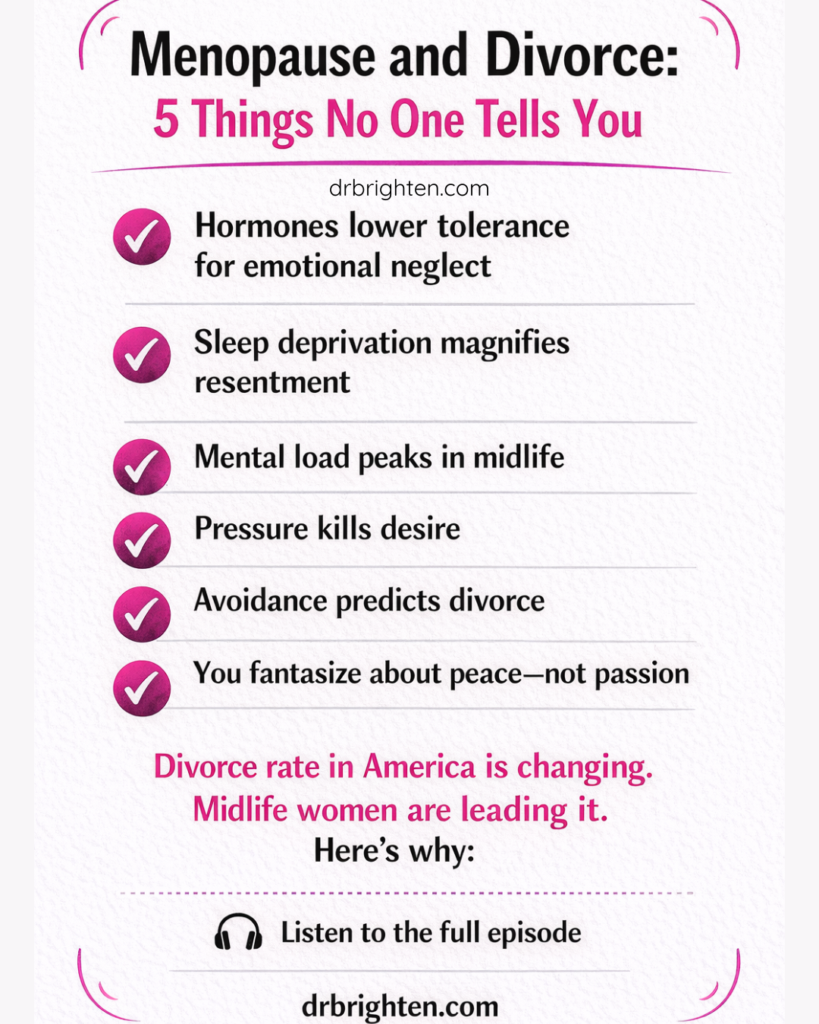
Menopause and divorce: is there actually a connection?
This is where nuance matters.
There isn’t one tidy study that says: “menopause causes divorce.” And if anyone is selling that narrative, I’d be skeptical.
But there is a very real pattern: the timing of midlife relationship strain overlaps with perimenopause for many women—because perimenopause is a neurological and physiological transition that can lower your tolerance for BS you used to “push through.”
Perimenopause commonly brings shifts in:
- sleep quality
- mood regulation
- anxiety sensitivity
- body temperature and comfort
- libido and arousal response
- stress physiology (hello, cortisol spikes)
And here’s the key: hormonal change doesn’t create a bad relationship out of nowhere.
It magnifies what was already there.
If you’ve been overfunctioning for a decade—doing the mental load, smoothing over conflict, swallowing resentment—midlife can remove your ability (or willingness) to keep performing.
Leann said something in our conversation that matters: many couples are “performing” marriage instead of living it authentically. And midlife can be the moment where the performance collapses.
If you’re a husband who thinks things are “fine”… but something feels off—don’t wait until she’s already emotionally gone. Press play and learn the exact shifts that reduce divorce risk starting this week.
The hidden marriage killer: emotional disconnection
People love to blame divorce on communication. “Just talk more.” “Use ‘I’ statements.”
But if you don’t feel emotionally safe, communication becomes another performance.
Emotional disconnection looks like:
- You live together but don’t share a life
- You avoid conflict because “fighting is bad”
- You’re polite roommates
- Touch feels loaded—like it always means sex, or always means rejection
- One person carries the emotional labor, the other calls that “overthinking”
And here’s a spicy truth that’s backed by clinical reality:
Fighting isn’t what ruins marriages. Avoidance does.
If you’re still arguing, you’re still emotionally invested.
The couples I worry about are the ones who don’t fight because they’ve gone numb. They’ve stopped reaching. They’ve stopped hoping.
Conflict can be growth—if it’s handled with respect. Avoidance is decay.
The mental load problem that quietly drives women out
If you want a relationship to fall apart slowly, here’s a reliable formula:
- Give one partner most of the mental load
- Add kids, work, aging parents, health stress
- Keep telling her “just ask for help”
- Watch her stop asking
- Act shocked when she leaves
Mental load is not just “doing chores.” It’s the cognitive labor of:
- knowing the schedule
- noticing what’s running out
- anticipating what the kids need
- planning appointments
- remembering birthdays
- tracking school stuff
- managing social calendars
- carrying the emotional temperature of the house
And here’s why “How can I help?” can backfire:
Because now she has to:
- scan everything in her brain
- decide what can be delegated
- explain it
- manage the follow-through
- and still hold responsibility if it goes wrong
That question can feel like one more task.
A better approach is initiative with awareness:
- Learn the school portals
- Know the routine
- Restock what’s always used
- Own a domain (not “help,” but responsibility)
A relationship is not a group project where one person is the manager and the other is the intern.
Menopause doesn’t destroy marriages—unspoken resentment does. Listen to the full episode to understand what’s really happening beneath the surface—and how to fix it before it’s too late.
The “her touch equals sex” pattern that destroys intimacy
This is the part of the episode that made me want to pull men aside like a big sister and say: listen to me.
When a woman initiates touch—hugging, leaning in, cuddling—and it consistently gets interpreted as a sexual green light, she learns something important:
Touch isn’t safe. Touch has consequences.
So she stops touching.
Not because she hates you.
Because her nervous system is protecting her from pressure.
If you want more sex, you have to stop turning affection into obligation.
What men can do immediately
- Bring back non-sexual touch
- 5-second hug
- kiss on the forehead
- hand on her back as you pass
- Make out sometimes without escalating
- Yes, like teenagers
- No, it does not have to “go somewhere”
- Ask instead of assuming
- “Is this a cuddle moment or a more moment?”
I know some people think asking “kills the mood.” You know what kills the mood more?
Pressure. Obligation. Emotional disconnection. Resentment.
Before you make a permanent decision about your marriage, hear this conversation. It might change the trajectory of your next 10 years. Listen to the full episode and get the practical tools that rebuild connection.
How to save your marriage: five check-ins that actually work
No, this is not about adding another “relationship habit” that becomes… her job.
These are tools that work because they reduce uncertainty and increase safety.
1) The 60-second emotional check-in
Once a day, ask:
- “How are you—really?”
- “What stressed you today?”
- “What would feel supportive tonight?”
You don’t need a 45-minute therapy session. You need consistency and sincerity.
2) Validation before fixing
If your partner is upset, your first move is not solutions.
Try:
- “That makes sense.”
- “I can see why that hurt.”
- “I’ve got you.”
Problem-solving too early can feel like: “Your feelings are inconvenient.”
3) The Sunday partnership meeting
10 minutes. That’s it.
- What’s happening this week?
- What are the pressure points?
- What needs to be owned (not “helped”)?
This is where you prevent resentment instead of treating it after it metastasizes.
4) Reduce mental load without asking first
Pick one domain and own it. Examples:
- kids’ school communication
- grocery inventory + restocking
- bedtime routine + planning
- appointment scheduling
- laundry start-to-finish (not “tell me where things go”)
5) A daily “safe touch” ritual
A hug, a hand squeeze, sitting close—without expectation.
You are re-teaching the nervous system: connection is safe.
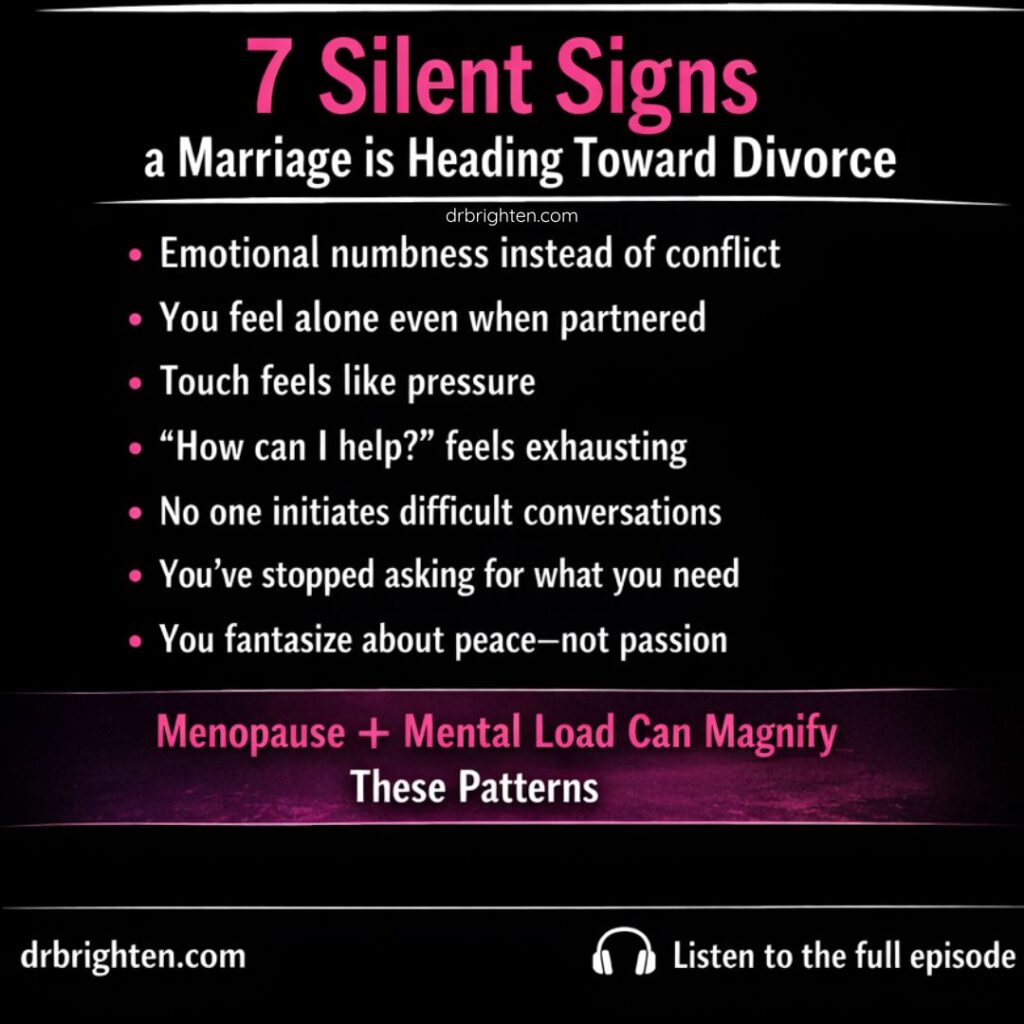
Signs your marriage might be heading toward divorce (even if nobody’s yelling)
This is for the man who thinks, “We’re fine.”
Be honest if you see these:
- She no longer initiates touch
- She seems emotionally flat around you
- She’s “handling everything” but looks exhausted
- She stops bringing up issues (not because they’re resolved—because she’s done)
- Conversations are logistics only
- You feel like roommates
- She’s building an independent life without you in it
If you’re hearing this and feeling defensive—pause. Defensiveness is a sign this matters.
A 7-day challenge for men who don’t want to lose their marriage
If I could give you one assignment for the next week, it’s this:
Every day for 7 days, do one thing that communicates: “I see you, and I’m on your team.”
Not “I bought flowers.”
Not “I tried to have sex.”
Not “I told you I love you.”
One team behavior:
- take something off her plate without asking
- ask how she’s doing and actually listen
- validate instead of fix
- initiate the Sunday check-in
- repair after conflict instead of withdrawing
- offer touch with no agenda
And if you want one sentence to start with tonight:
“I love you. I see how much you carry. What would feel supportive this week—so it’s better for us?”
Give her time to answer. Don’t make it urgent. Make it real.
Most divorces don’t start with betrayal. They start with emotional disconnection. Hit play on the full episode and learn the 5 daily changes that could save your marriage.
Final thoughts: divorce isn’t inevitable, but denial is expensive
The divorce rate in America isn’t just a statistic—it’s a signal. A lot of people are living in relationships where the emotional operating system slowly breaks down.
And when menopause enters the picture, it’s not that women “become impossible.” It’s that women often lose the capacity to keep carrying what never should have been theirs alone.
If you take nothing else from this:
- Emotional connection is not optional.
- Mental load is not invisible—unless you choose not to see it.
- Touch should create safety, not pressure.
- Conflict can be healthy; avoidance is what kills relationships.
- Most people don’t need a new partner—they need a new pattern.
If you’re in this right now, I’m rooting for you—but I’m also going to tell you the truth:
Love without effort doesn’t survive midlife.
Teamwork does.
Links Mentioned in This Episode
- Leann Borneman’s website resources: Partner Intimacy Menu and ADHD-informed Bedroom Check-in
- Leann Bourneman’s Tik Tok: @bournemanpsycotherapy
- Leann Bourneman;s Instagram: @bournemanpsycotherapy
- Leann Bourneman’s Website: bournemancoaching.com
Sources (for the stats cited)
- CDC Marriage & Divorce FastStats (provisional 2023 data; reporting states): divorce rate 2.4 per 1,000, 672,502 divorces
- U.S. Census Bureau overview on marriage/divorce trends (2012–2022 declines in women’s divorce rates)
- Women initiate ~69% of divorces (Rosenfeld analysis, discussed in major outlets and ASA coverage)
- Gray divorce doubling 1990–2010; 36% of divorces by 2019 among adults 50+
Transcript
Dr. Brighten: What is the one thing that men are consistently doing that's unknowingly sabotaging their relationships?
Leann Borneman: From my clinical observation from. Of all the women that I've worked with, it's the her touch equals sex. Ah, it, it is the woman wanting to initiate a hug, a grab from behind, and then all of a sudden it's like, oh, okay, are we ready to go?
Like, yeah. And then a woman generally isn't, they're just looking for affection and for some couples and dynamics, this can work wonderfully, you know, depending on where you're at in terms of your sex drive. But for a lot of women. They feel a lot of pressure. Mm-hmm. Around touch and touch then equating to sex.
And I don't think men do this, uh, inherently to be a perv or a annoyance.
Dr. Brighten: Yeah.
Leann Borneman: But it [00:07:00] is something that I see quite often that is causing a rift in the relationship and it over the time buildup of just like, I don't wanna touch you anymore. Mm-hmm. And then the disconnect starts. That
Dr. Brighten: makes. No, definitely.
And you know, in my opinion, I think one of the biggest obstacles men face in being in relationships with women is that they've taken advice from other men. And so when you, I didn't expect this to be your first answer, but when you say this, I'm like, oh. This is something that you would see some male coach going viral online, being like men, if she gives you a hug, that's your open invitation.
So what does this do to relationship over time? Because this episode isn't about dragging men. For everyone listening, we really want to help men be successful in relationship with women. So if you are a woman and listening to this and you have a partner who is male, pass this episode along 'cause we're gonna give a lot of tips today.
Leann Borneman: So for a lot of women when they're [00:08:00] initiating touch and it is being reciprocated as let's go.
Dr. Brighten: Mm-hmm.
Leann Borneman: That again, pressure. And for a lot of women, they're maybe not ready. Think about like the parents, the moms, the dynamics in the house, like going into the bedroom takes a lot of energy and mental.
Attention. Mm-hmm. And if you're just hugging your partner and then all of a sudden it's like, oh, let's go. It's like, no. Well guess what's gonna end up happening? She's gonna learn to avoid. That touch isn't safe because that touch means sex. And unfortunately, a lot of people, and this comes just packed from our upbringings, we're not taught how to be in relationship.
Really not, we kinda will suck at communication. No one really gives us this book on how to do it. So instead of saying to your partner like, Hey, I've noticed when I touch you, you just want sex and it's making me uncomfortable. People just start to avoid. Mm-hmm. They stop touching and then that disconnect starts happening.
So. When a person is getting advice from other people, like, oh, she wants you. Maybe, yes, she wants you, [00:09:00] but maybe she just wants emotion. Maybe she just wants nurture in that moment. She doesn't want sex in that.
Dr. Brighten: I can imagine a man listening right now is like, how do I tell the difference? How do I tell if like her touch means it's go time or her touch means it's just cuddle time?
Right?
Leann Borneman: And I think this is where like you're gonna hear me repeating myself all the time. You don't have to guess. This is where you have to stop, be being a mind reader.
Dr. Brighten: Hmm.
Leann Borneman: And just ask. Say, Hey, does that touch mean you wanna do something? Or does that touch mean you just wanna hug? I know that takes like the sexy and the romance out of it when you have to straight up ask somebody what they want, but I can't tell you how many couples I've worked with.
But the second they start initiating communication and getting out of your own head, it creates a space of safety where now you're touching more and that's the whole point. Mm-hmm. You want more touch that equals connection rather than interactions that are causing you to feel disconnected.
Dr. Brighten: Well, I'm glad that you answered that because that was going to be my question is like, how do people communicate it?
I often we'll hear [00:10:00] things that like. Communication makes it feel less sexy. And I feel, and I'd love to get your perspective on it, that's because of how it's been portrayed in the ME media is like, this is how it should be. So we think this is the way that it operates. But what I'm hearing from you is that reality is very different than what we've been shown on TV should be our relationship.
Leann Borneman: Yeah. And again, like when we think about this idea of like, how can a person know my partner wants X, Y, and Z? Not a mind read. Yes. It is not a romantic gesture to be like, Hey, do you wanna do X, Y, and Z? Mm-hmm. Is this me? I get it. I do. I understand it. But you know, the bigger issue is, is that if your relationship.
Is creating space where she doesn't feel safe. And when I say safe, I don't mean that you're verbally or uh, physically abusive. It's just like comfort, right?
Dr. Brighten: Mm-hmm.
Leann Borneman: If she doesn't feel safe to say, I'm looking to just have a hug because I need to just feel connection, the question then becomes how can you create [00:11:00] connective experiences and interactions that are gonna create safety where you guys can just be open with them?
It's the most empowering thing. You don't have to be a mind reader. The amount of stress in relationships that I see constantly. Where one person specifically more so than man, because again, we're talking about the upbringing messages we've received. You know, a man is a problem solver. He should know everything.
He's the warrior. No, you do not in this realm. And when you can release yourself from that and lean into curiosity and collaboration and conversation, it is so awesome to see one of my clients do it 'cause it's so free. Empowering.
Dr. Brighten: Yeah, I We're gonna get into more like tangible action things for people today, but I want to ask you, if a man thinks his marriage is fine, what are the subtle signs that should make him stop and pay attention?
Leann Borneman: That's actually a really awesome
Dr. Brighten: question. So
Leann Borneman: the first thing that comes to my mind is I think of initiation. And why I go to [00:12:00] initiation is because what I've seen clinically is that there are a lot of women that aren't the initiator. Now, that doesn't mean that there's something wrong in your relationship, but it is a great place to pause because if you're the one that's always initiating and your partner is reciprocating, okay, why ask yourself like, is it because she just isn't a initiator again?
That's fine. Mm-hmm. But is there a thing there where now maybe she's showing up because she feels she has to. You're not realizing it. That's a really great place just to pause, ask. Another thing I like to think about is who is taking on all of the mental load in your home, right? Who's doing the scheduling?
Who's, if you have kids, like doctor's appointments, after school activities, friendships, tutors, you name it, are you going to work? Is she also working? But then also taking on all of this. That's another great place to pause and ask, is she doing okay? Does she need me to check in and be like. Can I do anything?
Can I take anything off your [00:13:00] plate? Because we get so used to being on this go, go, go. Like robotic lifestyle, right? We don't think like, Hey, is she okay? And a lot of the times the woman, because of the scripts of she's the nurturer, she's the caregiver, she's the superhero, right? She may not say anything and so you might think, yeah, everything is fine until it's not.
I think those are two really great places to observe and pause and see if you can check in with your partner.
Dr. Brighten: Okay, I wanna play two truths and a lie. And so we're gonna ask, I'm gonna make three statements. We're gonna ask the audience, go into YouTube, leave a comment, let me know which one you think is the lie.
We'll give you some time to do that and we'll come back to those. So firstly, most divorces are filed by women. Second, couples who fight regularly are more likely to divorce. And the third statement is. The number one reason women leave marriage isn't infidelity. So I'm gonna give you some time to answer everyone who's listening, run over to YouTube, leave us a comment.
What do you think is [00:14:00] the lie? And I wanna ask you, while they're doing that, what's your spiciest opinion about why marriages fail that most therapists won't say out loud?
Leann Borneman: I don't know. I, when I say I don't know, I don't know if other therapists may say this out loud, but this is what I observe. I don't think it's the communication issue as the number one.
It is people trying to perform in their relationships instead of being authentic in their relationships that are failing the relationships because of the scripts. The narratives, the expectations, when you think of what it's like to be a man, what it means to be a woman, what it means to be mom, what it means to be in a relationship, a marriage, and you're going into these things with this idea of how you should be, and you stop being who you want to be.
And then, yes, communication ends up being part of that, but that right there, that is what's killing a lot of relationships, is showing up and not. Being your authentic self or not feeling confident [00:15:00] to be your authentic self and throwing the scripts out the window and making your own script,
Dr. Brighten: I think. That is a hot take because I think the script among therapists is to say communication is to always say communication.
And so I think that's a lot for people to really think on is like, how am I not myself when I show up in a relationship? And I think you're right. Like um, you know, we know that initially when couples get together, there often is in that honeymoon phase of everybody being their best. Right, showing their best, showing up their best, and that starts to erode over time.
But it's interesting to hear that from you that like there can still be this playing the part that we think we're expected to play that's sustained in a relationship.
Leann Borneman: Yeah, and I think I would take it even one step further. A lot of the times people, when you ask them what does it mean to be a, a. Self.
It's a hard question for people to answer because when you think about how you grow up in society, how many times are you really given the opportunity to be your authentic self? [00:16:00] Right? Like how much. Pressure and judgment is placed on you and many interactions that you're having. So when I ask my clients, who are you?
They don't necessarily know.
Dr. Brighten: Mm-hmm.
Leann Borneman: And that right there is like a holy crap moment for so many people. 'cause it's for the first time that they have to ask themselves, is this who I want to be? Or is this what society has told me I should be? Is this what my family has? Told me I should be, is this what my values and belief system has told me I should be?
And are they mine for real?
Dr. Brighten: Mm-hmm.
Leann Borneman: It, it's a huge, like reflective, but also grieving process. And when I see and work with couples, finding your authentic selves is like one of the first. Places you have to go before you can then communicate what's the point of communication if you don't know what you want to communicate.
Dr. Brighten: Mm-hmm.
Leann Borneman: You have to be communicating authentically.
Dr. Brighten: Yeah. Well, let's reveal which one of these is a lie. So true or false, most divorces are filed by women.
Leann Borneman: I would say true.
Dr. Brighten: Okay. True or false. [00:17:00] Couples who fight regularly are more likely to get divorced.
Leann Borneman: False.
Dr. Brighten: All right. And then, so we know this one's true.
The number one reason women leave marriages isn't infidelity.
Leann Borneman: True.
Dr. Brighten: Alright, so tell us why couples who fight regularly are not more likely to get divorced. Why is that a lie?
Leann Borneman: Because when we think of fighting, fighting is a wonderful thing and I know that's gonna be a hot take. And, and, and when we think of fighting, I'm not.
Saying Lashing out at your partner is healthy. But what we're saying is, is that when you are fighting, that means that you have some level of emotional investment. Think about it. If you're going about your day to day and you're not fighting. Why?
Dr. Brighten: Mm-hmm.
Leann Borneman: Are you numb? Have you given up already? When you're fighting?
There is some level of an emotional investment, and this is where we can lean in and get curious. Why? What's the disconnect? Where are you guys struggling to understand one another? Fighting and conflict. Conflict in general is actually healthy. We need conflict. If we don't have conflict, we're stagnant.
That means we can't grow. And so it's how do we handle conflict [00:18:00] that determines healthy versus unhealthy? So with the couples that I work with, the couples that are coming in fueled, angry, frustrated, oh, I love them 'cause they got a lot of fire under them, and that means that there's so much in them and so much care, so much passion, and we just have to unpack the layers.
Mm-hmm. And figure out what does that frustration really mean and how do we find the right ways to communicate it?
Dr. Brighten: Okay. I imagine there is a man listening to this right now who probably has learned that fighting isn't healthy and maybe is walking away or shutting down when conflict arises, what tips would you give them?
Leann Borneman: I would say that you have been taught. The, the right thing in the sense that conflict when it's heated and it's, it's angry and it's hostile, it isn't safe, it isn't good. Mm-hmm. And you know, not for nothing. You don't really want to invest and give into those types of dynamics. That's where you probably should be going and speaking to a qualified professional to help navigate, but.
If it's just frustration, understand that you and your partner are allowed to feel [00:19:00] emotions and anger and frustration. That's actually you guys having something very much in common. Lean into it. Ask yourself, why are we so frustrated? I always like to tell my clients this all the time. It's never really about the dishes.
There's something under there, and we have to get curious, like, what does the dishes mean?
Dr. Brighten: Mm-hmm.
Leann Borneman: Right? And so if a man is saying, conflict is bad, I'm going to avoid, I gotta tell you something. Avoiding is worse than the conflict. Avoiding for her is gonna probably mean you don't care about me. You don't care about us.
And again, is that a healthy dynamic or unhealthy? I'm not gonna say yes or no to that. What I'm gonna say is that when we don't invest and we don't show up, we're being disconnected. So I would invite you to try to find ways that feel comfortable for you to at least show up in some capacity. Whether that's, I hear that you're angry, what's going on?
Just show up. Mm-hmm. Don't avoid, because again, avoidance just kind of creates a space of, oh, I guess you don't care.
Dr. Brighten: So let me ask you, why do you think most women file for [00:20:00] divorce? You sit with couples all day, every day. Why is it women are the ones who initiate divorce?
Leann Borneman: For me, in the work that I do and the patterns that I see, it is the chronic emotional.
Disconnection. Mm-hmm. Uh, invisibility. Um, I've seen so many, I've worked with so many amazing women and couples and, you know, they can handle betrayal, they can handle stress, they can handle the scheduling and all of that. But when they s. Start over time, not being seen emotionally and feeling invisible.
That's the break for them. Mm-hmm. They also are not wanting to have another child. They have children, they wanna partner. And a lot of women, especially when we look at the data, people who have higher levels of degrees, they, they, they don't have the mental space anymore to deal with it. They wanna partner.
They don't want a child or someone to take care of. And so we see that when [00:21:00] a woman isn't being met emotionally. Well, at some point there's a breaking point.
Dr. Brighten: Mm-hmm. And I think that really weaves into the other truth we had, which is that it's not infidelity that's driving so many women to file for divorce.
And I think that's always the assumption because in a lot of ways society has said that's the acceptable reason to get a divorce. Um, but I'm just curious, do you have any more to add to that of like, it's. Not necessarily infidelity driving this. And it was what, you know, as you just said this actually I think about how infidelity you think is the ultimate betrayal, but what you just shared is like being feeling abandoned and in that way feeling.
That being maybe more of a betrayal for women.
Leann Borneman: Yeah, it's the not being seen, not being heard, not being validated. Again, going back to the scripts, and again, I have yet to really meet a man that's an asshole. Like I have wonderful clients, I've met wonderful people. We have all been fed very similar [00:22:00] scripts, and we follow suit to them without pause.
And so unfortunately the role of caretaker, all of the. Holidays and all of the birthday parties and all the school events, they do generally fall on the woman. And when you get to the place of, I'm only one person mentally, physically, perimenopausal, like there's so many layers there and your partner isn't showing up and you're not having a conversation, abandonment is real.
Dr. Brighten: Mm-hmm.
Leann Borneman: It feels like you are alone. It's, it's very hard to feel seen in a relationship if you don't feel heard.
Dr. Brighten: Mm-hmm.
Leann Borneman: And, and validated in your experiences. And that yes, that's rejection, that's abandonment, and that's what I see every day when people are walking in the door, especially with like desire discrepancies and other things like that.
Desire discrepancies, get them through the door. But what the real problem is, is generally not being seen.
Dr. Brighten: Yeah. You know, I appreciate you saying that you haven't really met a man who is [00:23:00] an asshole, because I think that's always the default of like, men are purposely hurting us, uh, willfully using us, neglecting us.
I mean, there is, um, I think a propensity towards. Exploiting the labor of women in relationships, but I don't think that comes out of a place of like, oh, I'm going to do this thing to you as much as that, I look at, I mean, I even look at my own relationship dynamic and I look at like, what was the boomer generation like?
And it's like, well, of course you never had anyone model to you what it look like to actually task share. Actually look like to, you know, even, even fathers talking to their sons about their feelings, like that may not have been a thing that's happening. And so I really appreciate the empathy and the compassion of viewing this through the lens of like, there have been these scripts that men have been handed at this role they think they're supposed to, uh, fulfill.
And it's not working for them. It's not serving them. It's definitely not serving their partner.
Leann Borneman: Yeah. And I think what you're also talking about, and listen, are there good and bad people in the world? Of course.
Dr. Brighten: Mm-hmm.
Leann Borneman: But again. [00:24:00] Going back to that like idea of authentic self as well. You can't be your authentic self as long as you're holding onto the script that has been handed to you from the very early stages of your life.
And there is a script of what it looks like to be, man. There is a script of what it looks like to be woman, and we are all victim of that. And so, yeah, again, like if you're listening to this, like I would be. Willing to bet that you aren't an asshole, you are just, you've been given the script. That's not going to allow you to be authentic and meet the same language and communication styles and support systems that's needed for human beings to just survive and thrive together.
Dr. Brighten: Mm-hmm. I wanna get into some practical tools, uh, because I think this is a really good point from men who are listening to be like, okay, what can I do to start to cultivate these things? So I wanna ask you. If you could come up with five daily check-ins, every husband should practice, what would that look like in a relationship?
Leann Borneman: I think this is a great question and it's actually goes back to what I do with my clients. So I actually create [00:25:00] like these cute little PDFs for my clients to do weekly check-ins with one another, daily check-ins, depending on like where your level of disconnect is. And that's gonna vary as well. But if you're going.
Uh, through your day and you're just like bump and grind, where you're not really taking pause. It's just a great time either in the morning if you have the space or before like the end of your day to sit down and just say, how are you? What was going on today for you? Was there anything that happened today that caused you stress?
Is there anything I can do to help? Like really check in, ask real level questions about how the person is navigating in their day, what's coming up for them, what do they need, and really leaning into also like how does that make you feel? I know that's like the typical therapy. This, like, how does that make you feel?
Dr. Brighten: He say that like all the time to my son and he finally, he's 12 now, and he is like, you always ask me that. Like, why do you ask me whenever I tell you something? Like, and how does that make you feel? And I'm like, because I don't know how you're feeling and I don't know how to respond to you, and I need that information.
And he's [00:26:00] like, well, you need to mix up your language, ask it differently. I'm like, okay. Like, yeah, uh, like, are you angry or happy? And he's like, what? That's even later, mom. I'm like. I dunno, but like that's always the thing that like I also default to as well. 'cause I'm like, I can't know how you're feeling.
Like I know how I might be feeling if I was in that situation, but that's not my experience.
Leann Borneman: Yeah. And that's a great point that you're making. We don't know, get out of your own head. You're not a mind reader.
Dr. Brighten: Mm-hmm.
Leann Borneman: But you're also doing something so important there. You're pausing and allowing them to have the stage they're being heard.
You're giving them the pause and the space to be heard. And when you think about your day to day and how busy you can get, if just by default your day is so hectic and you're not giving each other space to be heard by default, you then feel you're not being heard.
Dr. Brighten: Mm-hmm.
Leann Borneman: And that in itself can rob you from the connection.
So just. Stopping and saying, how are you doing? How does that make you feel? It, it might also, and I'm gonna forewarn anyone trying this, if you've never [00:27:00] done this before, your partner may be like, what the hell? What is going on right now? They may not even know what they're feeling and thinking because it might be the first time somebody is giving them the moment to just pause and be asked, what do they feel?
Mm-hmm. What do they need? What are they thinking?
Dr. Brighten: Yeah. So, okay. What I'm hearing is we gotta do check-ins. We gotta do check-ins about how your day is, and checking in about how you're feeling about all of that. And I imagine somebody listening right now is gonna say, I've got three kids. We get to bedtime routine and that's like, you know, hours zero and you know, all hell breaks loose.
And by the time that's done, we're completely exhausted. All we can do is just like, watch Netflix. I know you have. You have your own multiple children living under a roof. So what are your tips? Because you're not just a therapist, you're also a woman living this experience as well.
Leann Borneman: Yeah, and I, I think you speak volume to the realities of a crazy household with children.
I'm a mom of three. Uh, my day is packed and by [00:28:00] the end of the day, you just spoke volume to what me and my husband do. It's okay. Everyone's asleep. We check out Netflix on, we're good to go now. The problem is, is that some days you might need that. Mm-hmm. You might not have the mental capacity to be checked in, and the idea of stopping and pausing and checking in with like one another is wonderful, but sometimes you may not have the mental space for it.
And that's okay. And I can't stress that. I think anything we do, it should not actually be about consistency. Consistency then puts a lot of pressure that we're supposed to follow this daily thing. Well, what if you don't have the mental space for it? What if something comes up and now all of a sudden you have this expectation and now it's not met?
And now it's like, oh, well they didn't check in with me.
Dr. Brighten: Mm-hmm.
Leann Borneman: Persistency. Showing up when you can, that's important. And at the end of your day, giving yourself the five, 10 minutes, you can set an alarm if you need to to give yourself the decompression time. Me and my husband, sometimes I know this might sound really weird, I'll text him my thoughts.
'cause I literally don't have the energy to say things [00:29:00] out loud. I will be in the bathroom. I mean, I know this is gonna sound TMI, but most people we poop at least once a day. You got five, 10 minutes of time to check in with your partner, even if it's in a text message thread. These are things that you can implement.
There's no right way. It's just doing it. That's the point. Checking in, finding what works for you, your system. And I think one of the things that's important to also note is that everyone's situation is different. And this is why like when I'm working with clients, this idea of a check-in is very tailored to them.
I call it the a la carte service.
Dr. Brighten: Mm-hmm.
Leann Borneman: I find out what their needs are, where their struggles are in terms of the communication and needs. Um. And then I kind of create the checkpoints for them. For some people it's really good to have like a Sunday check-in if you can. Like, you know how they do meal prep Sundays?
Dr. Brighten: Mm-hmm.
Leann Borneman: I tell 'em the partner Sunday check-ins where you ask like really real realistically, like what are the demands of your week? Where are you gonna be? How crazy is it gonna get? What do you need? How does this look like? Do you need me to go shopping for [00:30:00] you? And then also implement your nightly check-ins if you have them just to say, Hey, how are you doing?
Hey, I'm here. Holding a hand. Sometimes you don't even have to talk. Sometimes just grabbing your partner's hand. Clamping it together, letting them know that you're there. That's all.
Dr. Brighten: Mm-hmm. You say Sunday check-ins, and I think listening right now, women are going to be like, okay, that's another thing on my to-do list.
Like I know there are women, 'cause I'm this woman who's automatically like, okay, like this needs to be implemented, therefore I have to take this on and implement it. How can we not make that? One more mental load, one more thing for women to do and empower men to be the ones who initiate that Sunday check-in.
Leann Borneman: Yeah. I think one of the biggest things is putting in your environment. Get it outta your head. You don't have to add more to your mental load. Mm-hmm. Put it in your environment. Talk about these things together as a unit before you implement them. Create it as a team. I think that. The other big thing here is that it shouldn't be one person's responsibility.
The whole [00:31:00] point of adding connection and closeness in your relationship is showing up as a team.
Dr. Brighten: Mm-hmm.
Leann Borneman: And so even with the idea of checking in with one another, putting it on your fridge, a post-it note even, because if you pass the fridge all the time, it's insight in mind. You can remember, take pause, sometimes checking in only takes 30 seconds.
Mm-hmm. That way, if let's say the wife doesn't have the capacity to do it. If the husband passes the refrigerator, he sees it, oh, hey, how are you doing today? What's going on? Right? Again, it's about teamwork and not making it a mental thing for you. Put it in your environment because you don't need an extra thing on your plate.
You just don't.
Dr. Brighten: Yeah. So let me ask you, because you brought up earlier about how men are really following a script of problem solving. They've been told they have to solve problems. How can men listen so that their wives or partners feel heard, rather than going into that like solution oriented problem solving mode?
Leann Borneman: Yeah. So like let's say your wife is. Uh, stressed or crying. You know, I think one of the [00:32:00] greatest things is asking her, like, what's going on? Right? Lean in first once she explains it. Wow. Like, I get it, but can you let me know? Like, what does that mean for you? Like, how are you feeling at the end of the day?
I'm sure after the crying and the stress is over, problem solving, it has a place, right? We wanna make sure we're not in that state. But in that moment, I gotta tell you, nine times outta 10, a woman does not care on what she should do, how she should do it. She just wants you to see her. She wants you to be part of it.
She wants you to know you're willing to be vulnerable and lean in and be part of her ex. Experience again, team. Right? So leaning in and saying like, how is this making you feel right now? Like, what's going on for you? Hugging her, consoling her. Maybe sometimes she doesn't wanna hug sensory issues, but make sure you, you know, know what her needs are.
But taking that pause, acknowledging, validating. That's important. Problem solving when someone's upset is an invalidation.
Dr. Brighten: Hmm.
Leann Borneman: And again, [00:33:00] uh, I think the most caring people are the ones that mess up the most because it's a very helpless feeling to see your partner upset and just sit there. You want to fix it, you want to engage in that way of making sure that they don't feel that way, and that's a beautiful thing, but psychologically speaking, that's invalidation.
They just want you to see them and hear them in that moment and be vulnerable with them.
Dr. Brighten: Mm-hmm. We've talked about touch points that can happen with helping communication. Fostering the relationship. I wonder if there are also touch points, rituals, things that partners can be doing to help keep intimacy alive in their relationship as well.
Leann Borneman: Yeah, so I think one of the things that couples forget is that touch is really important outside of just the bedroom. So a lot of the times we get very used to waiting to touch our partner, to kiss our partner as a precursor to sex. And so then we're leaving out intimacy in [00:34:00] just our day to day.
Dr. Brighten: Mm-hmm.
Leann Borneman: Um, if you're listening right now, when was the last time you just made out with your wife? Right before you went food shopping? Mm-hmm. Just to make out with her. We don't usually do that. It's a precursor to something else. Giving touch and intimacy and learning sensuality outside of the bedroom, just in our day to day is one of the most rewarding close bonding experiences you can produce in your relationship and.
Unfortunately, if your wife is also used to touch meaning sex, it does take some time for her to know that the touch is safe. Mm-hmm. That she can be open to that touch and know that there's no pressure to it, and that it's just about closeness and sensuality. I mean, there's nothing sexier than if a wife is.
Doing something in the kitchen or folding laundry. And her husband just comes up behind her, wraps his arms around her, and gives her a kiss on the cheek or the neck and just holds her for five seconds and then walks away. That's hot, that's sexy, that's sensual. And it's also [00:35:00] just a form of connection.
Dr. Brighten: Mm-hmm. And for men listening. What I'm hearing, and I kinda wanna underscore, is that if, if you wanna score more, and then this is one way is to actually make it where touch is more of the day-to-day rhythm rather than something that comes with pressure. I, um. I think every year for like the last five years, I put out a post before Valentine's Day, and I say, if you are not in the mood Valentine's Day, that is normal because all of these expectations, right?
That flow from that of like, well, you have to buy the chocolate and buy the teddy bear. And then that's like, and I always, my audience knows, I'm always like, who's turned on by a teddy bear? Raise your hand because the things that Hallmark tells you to buy, you're like. Wait, what? Uh, but you know, it's very normal to see that women are like, I'm not in the mood of my anniversary.
I'm not in the mood, um, on Valentine's Day. I'm not in the mood anytime there's this external pressure saying that I have to be in the mood. And I [00:36:00] think that's an important way to frame this for men listening, because it's not just you. There's also how there's these pressures outside, but it's. There are people, and it can happen to men too, that anytime there's this pressure and that it's like I have to perform, I have to have sex.
It's like the, the nervous system's, like then we're not doing that.
Leann Borneman: Mm-hmm. Like
Dr. Brighten: systems shutting down
Leann Borneman: and you're completely accurate on that because. Pressure is the killer. It is the buzzkill to any level of joy. I'll be even a self-disclosed moment right now coming to this trip to come on this podcast.
I had this level of pressure because you think, okay, you're going away for a couple of days. You wanna be intimate with your partner because you're gonna be away. The level of pressure that I started feeling and I had to take a moment and pause and be like to my husband, listen, I gotta be honest like I'm feeling.
So much pressure right now. I want to cuddle with you, but now I'm nervous to cuddle with you because I feel like there's this expectation now that because I'm going away, there's gonna be more to it and I don't know if I have the bandwidth for more. And he's like, babe, it's okay. Let's [00:37:00] just cuddle and.
Having that open line of communication to break the pressure is wonderful because think of it this way, pressure is like you having now a threesome in your relationship.
Dr. Brighten: Ah, I like that. That's a really good way to look at it. And it's not hot guys.
Leann Borneman: It's not hot, not, not that, not that threesome. You want, not at all, because it's going to affect your nervous system and that pressure shuts you down and now you're not in the moment.
You don't feel strong, empowered, confident to engage. So yes, learning touch. Just to be what that is, is a beautiful space to add that level of connection. And yes, touch might make it then more safe for her to feel more inclined and interested to engage in maybe ways that she wasn't able to because too much pressure was there to begin with.
Dr. Brighten: Mm-hmm. We talked about mental load as it can contribute to increasing divorce rates, especially as we see in women in their forties, we see that it's like. I think midlife, it's like 70% of women are initiating divorce. And you spoke a bit to mental load before. Mental load can [00:38:00] also be a reason why a woman is not in the mood.
She's not connecting like she just like our nervous system can't even pick up what you're putting down. So for men listening, there's a lot of incentive here to reduce mental load for their partner, but they may not know how. So how can men reduce that mental load?
Leann Borneman: So this is actually a very tricky question, and why I say tricky is because a lot of the clients that I've worked with, the husband is like, how do I help?
Asking her that question is now another demand.
Dr. Brighten: That's
Leann Borneman: so
Dr. Brighten: true.
Leann Borneman: It's so true.
Dr. Brighten: It's like,
Leann Borneman: and I know how it feels because it's like, maybe you should just know. Maybe why do I have to orchestrate and tell you? So think of it like this. If you have kids. How is she accessing all the schedules? Reach out to the teachers yourself.
Contact the school. Get the contact information. Create your own level of connection to these things. Start being observant in your kitchen. What are the typical snacks your, your children are eating? What are [00:39:00] the common things that are there? Start taking notes on that if you can. Again, can you ask her?
Yes. I just wanted to start with the free cursor that generally asking your wife, Hey, how can I help? While it is a well-intentioned question, it can also come down with some shutdown and overwhelm for a woman because now she has to think, she has to problem solve. She has to figure things out that she's just doing so automatically.
Um, so taking that initiative, start really looking at your home environment. What are the demands being present? Definitely still asking if you can and start creating your own level of routine or putting it in your agenda. Um, my husband for instance, I told him straight up that my mornings are crazy. He goes and leases the house before me.
Um, so I'm home with the kids. I have to get everyone situated. I've got a DHD, I'm in perimenopause. Mornings are crazy. And we've tried the whole get everything ready before bed. So what he does in the morning, believe it or not, he brings all of the clothes [00:40:00] downstairs for me. He puts the waters in their backpacks.
For me, that helps. And that was him looking at what needs to be done and then initiating it. And then one morning he's now telling me the weather reports. 'cause that was one more thing that I would stress about in the morning. What's the weather like? How is this, he would take note to those things. And he started initiating changes in our dynamic to help ease that load for me.
Dr. Brighten: Yeah, I think that's so important to, uh, you know, highlight the asking can sometimes feel like one more thing you have to do, but I wanna tie it back to what you said earlier, is that if you're doing these check-ins, you're asking about what does your week look like? What's stressing you out? How are you feeling about things like.
You are indirectly getting the intel on the mental load without asking that triggering question. Yeah. And if men are confused by that right now, I just want you to understand is that we are constantly walking around with this huge to-do list. And then when you'd say like, oh, well just tell me what I need to do, [00:41:00] then it's you become on the to-do list.
Like you are then on the list of like, okay, now I have to like figure out what I can delegate to you. And it becomes more pressure. And so I think often. When men hear these things, um, there's this narrative of like, women are punishing us. Women are just, you know, withholding from us. There's all these things that play out and they don't understand that they say is a physiological nervous system response and that it isn't even a choice.
And it often isn't conscious. The woman is not even aware of what is happening within her central nervous system or that her cortisol is spiking and her norepinephrine is going up. Like we can go into the whole biochemistry of it, but like, it doesn't actually matter because you can't control that. Like this is just is.
And so we have to find the workaround, which I think you've beautifully outlined in throughout this whole episode actually.
Leann Borneman: And I think also to piggyback off of that, you can also find safe ways of introducing the question as well. Because the idea of sitting down and saying to your wife like, Hey, how can I help?
'cause I noticed you're really stressed again, well-intentioned, but for her. [00:42:00] Depending on where her mental load is, that might now feel like urgency. Mm-hmm. And that urgency might shut her down. So a safe way of doing this could also be like, Hey listen, I've been thinking I'd really like to show up more and help you.
I want you to have space to think about this. But if you're able to give me any insight on what would be helpful to initiate and integrate in our day-to-day, that would be great. Even if you need like a week to get back to me on it, I just wanna let you know that I wanna help. I'm trying to navigate this and figure out ways I can naturally help, but I also don't wanna mess up and I wanna make sure I'm doing the right things to help and support.
Mm-hmm. So take your time. You can do that as well. That is actually really helpful for a lot of people because it allows 'em to know, okay, wait a minute. You want to know, but you're not telling me I need to stop right now and I can get back to you. That's a safe way of navigating that as well.
Dr. Brighten: Mm-hmm. Let me ask you, what are like some of the most common mistakes men make when their partner is upset?
I.
Leann Borneman: Trying to problem solve.
Dr. Brighten: Okay, so back to the problem solving.
Leann Borneman: But again, it is so [00:43:00] well intentioned, like it really is, I mean, not for nothing. Again, you see your partners crying, you feel helpless. You don't want your partner to be upset. That's beautiful. But again, in that moment, your partner wants to feel seen, wants to be validated.
So your helplessness is uncomfortable. That's a you problem. You need to learn to be comfortable with vulnerability and under. Dan, your wife is gonna be upset and part of being upset means you're gonna lean into that. She just wants you to see her. She just wants you to say. I understand. I've got you.
Just to give her that moment. Don't try to problem solve. And if you're a wife listening to this and you do want problem solving, tell him it's okay for you to direct and tell your husband and your partner what you need and want from them. You don't need to be mind readers, but when you see your wife is upset, she's crying, do not problem solve.
Suck down that helplessness and just hug her, show up for her because that right there is what she [00:44:00] needs and wants for the most part.
Dr. Brighten: Mm-hmm. So let me ask you in this, what is one sentence every man should learn to say to make his partner feel truly heard?
Leann Borneman: Get into a therapist mode, how does that make you feel?
Dr. Brighten: Yeah. Okay. Okay. I wondered if that was gonna be more sexy.
Leann Borneman: Make it more
Dr. Brighten: sexy. Okay. How do we sexist sex up the, how does that make you feel?
Leann Borneman: Okay. I'm gonna try my best to go into like a normal person mode and not therapeutic here. Um, if your wife is crying, she's upset, just say like, Hey, wow. Like I can see this.
It's really affecting you. I get it. This sucks. Normalize it. Normalize it, and then say. What do you need from me? What would you like? Do you want me to hug you? How? How is, how is this affecting you? Again, getting into just tapping into what it means for her. That is a beautiful thing. Mm-hmm. You're giving her space to tell you what she needs, what she wants.
You're letting her know, I care. You're important to be heard, seen, [00:45:00] validated, pausing, and just really checking in and. That right there is, I think one of the strongest, uh, switches that I see with my couples all the time when they stop seeing sadness or frustration, even as a moment to like freeze because you don't know what to do and you start leaning into it.
Believe it or not, you become closer because if you're not leaning, you're avoiding. Avoidance is more of a disconnect.
Dr. Brighten: Yeah. Well, let me ask you for our male listeners right now, if you were to challenge them to one thing to commit to for the next seven days to improve their relationship, what would that be?
Leann Borneman: I think this is a very hard question to answer, and I say that because I feel like we all have different needs.
Dr. Brighten: Mm-hmm.
Leann Borneman: And we all come from different relationships and stressors and demands. So I think the best way to answer this is to commit to trying to find a way every [00:46:00] day to check in with your partner to see how you can support them.
Dr. Brighten: Mm-hmm.
Leann Borneman: And that is where the nuance is gonna come in for your relationship, your needs, your stressors. Because again, if you're working. You've got children, you've got stressors. You are just like all of us, we're stressed. We just go, go, go, go, go. Commit to having a pause to check in with one another, and then find that special connection or question that works best for your relationship.
That's gonna be most helpful.
Dr. Brighten: Okay. So let me ask you, and I know this can be a bit of a difficult question, but I would like to give men some hope. So in listening to this episode today, if they implement just some of the things that you are talking about here, what might their relationship evolve to, to being in the next five years?
Leann Borneman: Oh my God, that's gonna be fucking phenomenal.
Dr. Brighten: That's amazing. I,
Leann Borneman: I can't, we
Dr. Brighten: should put this at the front.
Leann Borneman: I, I can't stress the importance of feeling seen in your relationship.
Dr. Brighten: Mm-hmm.
Leann Borneman: You feel safe. [00:47:00] If you feel seen, you feel safe, which means you are going to show up more, you're gonna be connective, you're gonna be vulnerable.
Vulnerability is scary as all hell. I understand it, but vulnerability is like this door to access, to connection, to curiosity, to exploration, to growth, and that right, the hair is chef's.
Dr. Brighten: Now I'm gonna caveat what I'm gonna say next with that. We don't give medical advice to strangers on the internet or in real life.
But I'm curious if you had 60 seconds in an elevator with a husband who is feeling like my relationship might be heading down the road towards divorce, what would you tell him?
Leann Borneman: I would tell him to pause, go home, sit down with your wife when you can have a moment and just say, I see you. I love you. I appreciate you.
How can I show up more for us? And that right there is the key us because again, you are a team at the end of the day. As women, we want help. Yes, but that's [00:48:00] the problem. We shouldn't be the ones that have all this pressure and demand on us. It's an US thing. We got married, we're in a relationship, we are an us, so how can I help us?
Dr. Brighten: So beautifully said. Well, thank you so much for sharing your expertise. I hope this helps men everywhere. Women, if you can share it with them, have a healthy relationship because ultimately that is what they want. Just no one gave them the guidebook. And there's too many men exerting their expertise on women all over the internet telling men, this is what women want.
When women literally will tell you what they want. And I think you really. Covered so much in this episode to help men navigate that.
Leann Borneman: Thank you so much for having me. And I'll say this to finish off that, unless you're settling in your relationship and you started this relationship the wrong way, I am a firm believer that there is no reason your relationship has to end.
I believe that the expectations and the scripts and the fear of being vulnerable are the real barriers to your connection. And if you can find ways to impede those barriers [00:49:00] by taking some of the advice and trying to use it today, you are. Going to see your relationship grow because it deserves it and it doesn't have to not grow.
Dr. Brighten: Oh, so, so encouraging. Thank you so much.
Leann Borneman: Of course. Thank you so much for having me.