f you’ve been wondering whether Ozempic, semaglutide, tirzepatide, or other GLP-1 medications could help with endometriosis symptoms, chronic pelvic pain, adhesions, fatigue, or endo belly, you are not alone. More and more women with endometriosis are reporting that GLP-1 medications may be helping with symptoms that go far beyond weight loss, from lower inflammation and less pain to improved energy and better blood sugar stability.
But what does the science actually say?
In this episode of The Dr. Brighten Show, Dr. Jolene Brighten breaks down the emerging research and real-world clinical observations around GLP-1 receptor agonists and endometriosis, including what is currently known, what remains theoretical, and why this conversation may be one of the most important developments in women’s health right now.
You’ll learn how GLP-1 medications like Ozempic (semaglutide), Wegovy, Mounjaro (tirzepatide), liraglutide, and exenatide may influence inflammatory signaling, fibrosis, metabolic dysfunction, and long-term cardiovascular risk in women living with endometriosis.
GLP-1, Ozempic, and Endometriosis Symptoms: What You’ll Learn in This Episode
In this episode, we explore whether GLP-1 medications may help manage endometriosis symptoms and endometriosis pain through mechanisms that extend far beyond weight loss.
Here’s what you’ll learn:
- Why endometriosis is not just painful periods, but a full-body inflammatory disease
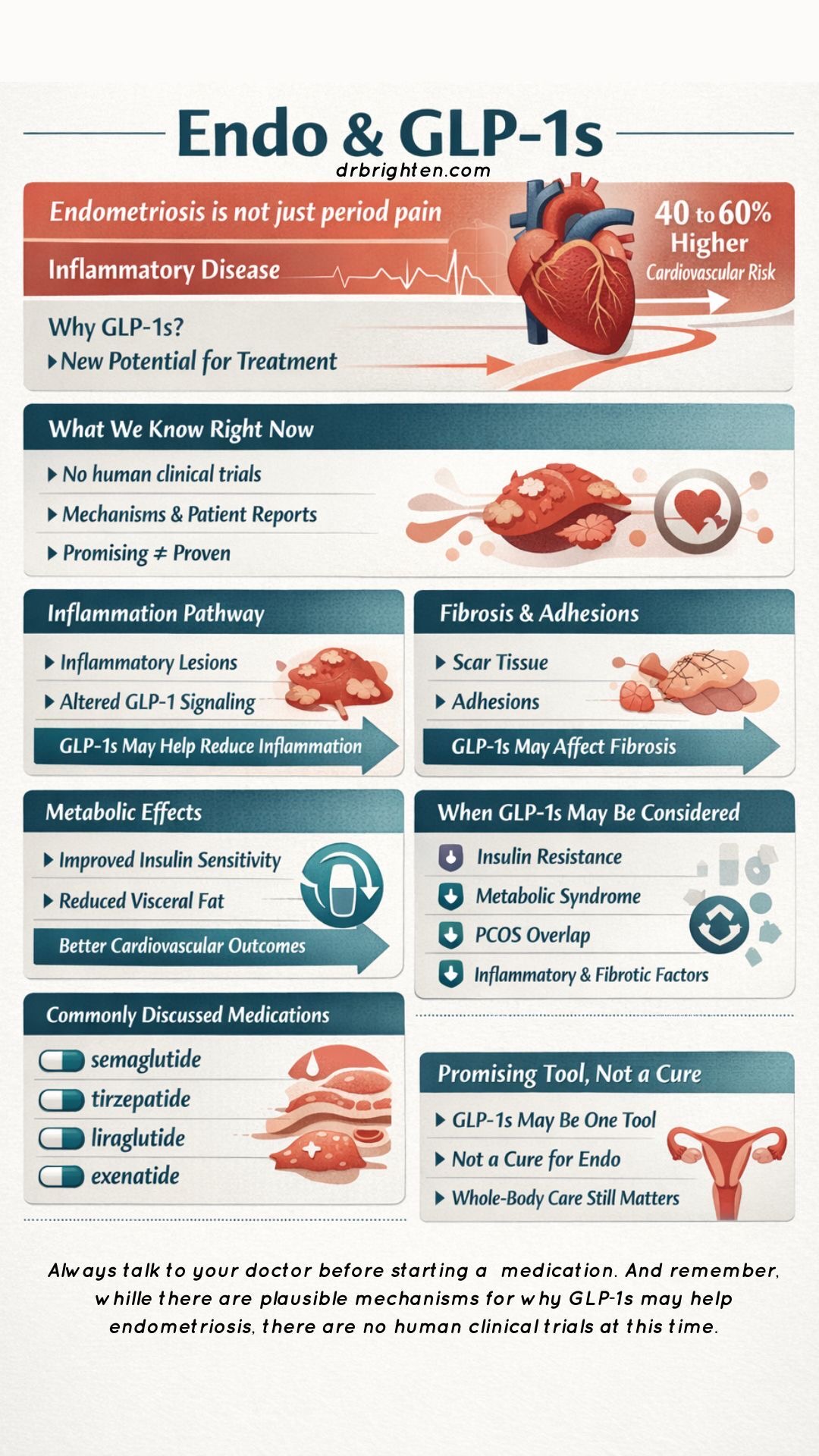
- The shocking statistic that women with endometriosis may have a 40–60% higher risk of cardiovascular disease
- How Ozempic and other GLP-1 medications may help reduce inflammatory signaling
- Why GLP-1 levels may already be altered in women with endometriosis
- The connection between endometriosis pain, cytokines, prostaglandins, mast cells, and immune dysfunction
- How adhesions, fibrosis, and scar tissue may contribute to worsening pelvic pain
- Why some women report less endometriosis pain after starting semaglutide or tirzepatide
- How GLP-1s may support blood sugar stability, insulin sensitivity, and reduced visceral fat
- Why 80% of women with endometriosis report fatigue as a major symptom
- The possible connection between mitochondrial dysfunction, brain fog, and endo fatigue
- Which GLP-1 medications are most commonly discussed: Ozempic, semaglutide, tirzepatide, liraglutide, and exenatide
- Why GLP-1s are not a cure for endometriosis, but may be one tool in a broader strategy
- What to discuss with your doctor if you have endometriosis symptoms plus insulin resistance, PCOS, or metabolic syndrome
- Why endo belly, blood sugar crashes, and inflammation may all be connected
- How nutrition, sleep, omega-3s, NAC, and pelvic floor physical therapy fit into the bigger picture
How Ozempic and GLP-1 Medications May Affect Endometriosis Pain and Symptoms
One of the most important takeaways from this episode is that GLP-1 medications may influence multiple pathways involved in endometriosis symptoms and pain.
Endometriosis is not simply tissue growing outside the uterus.
As discussed in the episode, endometriosis lesions are biologically active inflammatory tissue. They recruit immune cells, produce inflammatory cytokines, create local estrogen signaling, and contribute to scar tissue formation and adhesions.
This means symptoms like:
- chronic pelvic pain
- painful ovulation
- painful bowel movements
- fatigue
- endo belly
- pulling or tugging pain
- worsening symptoms after surgery
may all be driven by more than one mechanism.
GLP-1 and Inflammation in Endometriosis
One of the most compelling reasons GLP-1 medications are being discussed in endometriosis is their effect on systemic inflammation and immune signaling.
GLP-1 receptor agonists may help modulate:
- macrophage activity
- inflammatory cytokines
- oxidative stress
- blood sugar instability
- visceral adiposity
These are all factors that can amplify endometriosis pain and symptoms.
According to the episode, a human study found that women with endometriosis had lower GLP-1 levels in peritoneal fluid, suggesting that GLP-1 signaling may already be altered in the inflammatory environment surrounding lesions.
GLP-1 and Adhesions, Fibrosis, and Scar Tissue
Another major focus of this episode is how GLP-1 medications may influence fibrosis and scar tissue signaling.
This is especially important for women experiencing:
- adhesions after excision surgery
- worsening ovulation pain
- organ tethering
- pulling pelvic pain
- bowel symptoms
- pain with movement
As discussed in the transcript, animal studies suggest that GLP-1 medications may reduce collagen deposition and fibrosis pathways, which could potentially influence adhesion formation.
For many women, this is where endometriosis becomes life-altering.
Endometriosis Fatigue, Brain Fog, and GLP-1s
Fatigue is one of the most overlooked endometriosis symptoms.
In the episode, Dr. Brighten notes that approximately 80% of women with endometriosis experience fatigue as a major symptom.
This may be connected to:
- immune activation
- reactive oxygen species
- mitochondrial dysfunction
- chronic inflammation
- pain-related nervous system stress
GLP-1 medications may help by reducing oxidative stress and improving metabolic function, which may translate into improved energy for some women.
Ozempic vs Tirzepatide vs Other GLP-1 Medications
One of the most frequently asked questions is:
Which GLP-1 is best for endometriosis?
The honest answer shared in this episode is that there is currently no one best GLP-1 specifically for endometriosis, because there are no direct human clinical trials comparing them for this condition.
The most commonly discussed options include:
- Ozempic / semaglutide
- Wegovy / semaglutide
- Mounjaro / tirzepatide
- liraglutide
- exenatide
Tirzepatide may be discussed differently because it acts on both GLP-1 and GIP receptors, making it mechanistically distinct.
However, the right medication depends on:
- symptom goals
- insulin resistance
- metabolic health
- GI tolerance
- fertility plans
- access and cost
- physician experience
Natural Strategies Discussed Alongside GLP-1s
This episode also emphasizes that medications are never the whole story.
Additional strategies discussed include:
- blood sugar stabilization
- anti-inflammatory nutrition
- omega-3 fatty acids
- NAC (N-acetylcysteine)
- polyphenol-rich foods
- sleep optimization
- visceral fat reduction
- pelvic floor physical therapy
- nervous system rehabilitation
- gut healing and microbiome support
This Episode Is Brought to You By
This episode is brought to you by The Endometriosis Reset, my step-by-step program designed to help women address the full-body drivers of endometriosis symptoms, including inflammation, blood sugar instability, endo belly, fatigue, scar tissue support, and nervous system dysregulation.
Inside the program, I walk you through clear protocols for nutrition, supplement timing and dosing, lifestyle support, and the conversations to have with your doctor so you can stop piecing together conflicting advice online.
Learn more at drbrighten.com/endocourse
EndoGlobal Group
At EndoGlobal Group, a network of world-class endometriosis specialists comes together to provide comprehensive, multidisciplinary care for patients with complex endometriosis—offering advanced diagnostic mapping, complete excision surgery, and holistic support.
Click here to learn more and schedule a free consultation.
Links Mentioned in This Episode
- Endometriosis Reset Course: drbrighten.com/endocourse
- Dr. Brighten Essentials N-Acetyl Cysteine (NAC)
- Saffron for Endometriosis: How It Can Help With Pain, Mood, and Inflammation
- Endometriosis and Painful Ovulation: Why Ovulation Hurts, Where It’s Felt, and What Helps
- Best Supplements for Endometriosis (Evidence-Based Guide)
- Does Endometriosis Go Away After Menopause? Here’s the Truth
Related Episodes:
- Natural Ways to Manage Endometriosis Beyond Surgery
- Endometriosis Relief of Pain: Experts Explain Laparoscopy, Chronic Pelvic Pain, and Why So Many Women Are Still Suffering
- The Hidden Connection Between Estrogen and Histamine: Why Your Hormones Cause Inflammation
- Endometriosis Surgery: What Most Doctors Won’t Tell You
- Birth Control for Endometriosis? Hormones, Progesterone Resistance, and What Doctors Aren’t Telling You
- Endometriosis Symptoms vs Normal Period Pain with Dr. Patrick Yeung
- What Is Endometriosis? 4 Surgeons Explain the Symptoms, Misdiagnosis, and Whole-Body Impact
- 3 Period Problems Women Should Never Ignore (Heavy Bleeding, PMS, and Period Pain)
- Can Ozempic and Mounjaro Fix Thyroid Issues? The Anti-Inflammatory Power of GLP-1 Agonists! | McCall McPherson
- GLP-1 Weight Loss in Menopause: How HRT Amplifies Results
Frequently Asked Questions About Ozempic, GLP-1s, and Endometriosis
GLP-1 medications like Ozempic may help manage some drivers of endometriosis pain, including inflammation, blood sugar instability, and metabolic dysfunction, but they are not currently proven treatments for endometriosis lesions.
Some women report improvement in symptoms such as pain, fatigue, inflammation, and endo belly, but clinical trials specifically studying semaglutide for endometriosis are still lacking.
No. As discussed in the episode, GLP-1 medications are not a cure for endometriosis and should be considered one potential tool within a broader strategy.
Because GLP-1s may improve inflammation, gut-related symptoms, and insulin resistance, they may help some women with bloating and endo belly symptoms.
References:
Mu, F., Rich-Edwards, J., Rimm, E. B., Spiegelman, D., & Missmer, S. A. (2016). Endometriosis and Risk of Coronary Heart Disease. Circulation. Cardiovascular quality and outcomes, 9(3), 257–264. https://doi.org/10.1161/CIRCOUTCOMES.115.002224
Cavadias I, Maitrot-Mantelet L, Perol S, et al. Risk of cardiovascular disease and mortality among women with endometriosis: A systematic review and meta-analysis. Acta Obstet Gynecol Scand. 2026; https://pubmed.ncbi.nlm.nih.gov/41310987/
Pabon, M. A., Wang, X., & Rexrode, K. M. (2024). Beyond reproductive health: the cardiovascular risks of endometriosis. European heart journal, 45(44), 4744–4746. https://doi.org/10.1093/eurheartj/ehae674
Szpila, G., Szczotka, J., Suchodolski, A., & Szulik, M. (2025). Endometriosis and Cardiovascular Disease: Exploring Pathophysiological Interconnections and Risk Mechanisms. Diagnostics (Basel, Switzerland), 15(12), 1458. https://doi.org/10.3390/diagnostics15121458
MDPI
Desai, S. N., Reed, C. C., Mendez, Y., Yang, Q., & Guan, X. (2026). The Hidden Link Between Endometriosis and Obesity: A State-of-the-Art Review. Cureus, 18(2), e102896. https://doi.org/10.7759/cureus.102896
Bendotti, G., Montefusco, L., Lunati, M. E., Usuelli, V., Pastore, I., Lazzaroni, E., Assi, E., Seelam, A. J., El Essawy, B., Jang, J., Loretelli, C., D’Addio, F., Berra, C., Ben Nasr, M., Zuccotti, G., & Fiorina, P. (2022). The anti-inflammatory and immunological properties of GLP-1 Receptor Agonists. Pharmacological research, 182, 106320. https://doi.org/10.1016/j.phrs.2022.106320
Yang, F., Luo, X., Li, J., Lei, Y., Zeng, F., Huang, X., Lan, Y., & Liu, R. (2022). Application of glucagon-like peptide-1 receptor antagonists in fibrotic diseases. Biomedicine & pharmacotherapy = Biomedecine & pharmacotherapie, 152, 113236. https://doi.org/10.1016/j.biopha.2022.113236
Liu, C., Zhang, Q., Zhou, H., Jin, L., Liu, C., Yang, M., Zhao, X., Ding, W., Xie, W., & Kong, H. (2024). GLP-1R activation attenuates the progression of pulmonary fibrosis via disrupting NLRP3 inflammasome/PFKFB3-driven glycolysis interaction and histone lactylation. Journal of translational medicine, 22(1), 954. https://doi.org/10.1186/s12967-024-05753-z
Fandiño, J., Toba, L., González-Matías, L. C., Diz-Chaves, Y., & Mallo, F. (2020). GLP-1 receptor agonist ameliorates experimental lung fibrosis. Scientific reports, 10(1), 18091. https://doi.org/10.1038/s41598-020-74912-1
Anastasi, E., Scaramuzzino, S., Viscardi, M. F., Viggiani, V., Piccioni, M. G., Cacciamani, L., Merlino, L., Angeloni, A., Muzii, L., & Porpora, M. G. (2023). Efficacy of N-Acetylcysteine on Endometriosis-Related Pain, Size Reduction of Ovarian Endometriomas, and Fertility Outcomes. International journal of environmental research and public health, 20(6), 4686. https://doi.org/10.3390/ijerph20064686
Karakoç, E., Halaçlı, S.O., Hanelçi, R.H. et al. N-acetylcysteine stimulates organelle malfunction in endometriotic cells via IFN-gamma signaling. Sci Rep 15, 15120 (2025). https://doi.org/10.1038/s41598-025-00195-z
Guo, C., Huang, T., Chen, A., Chen, X., Wang, L., Shen, F., & Gu, X. (2016). Glucagon-like peptide 1 improves insulin resistance in vitro through anti-inflammation of macrophages. Brazilian journal of medical and biological research = Revista brasileira de pesquisas medicas e biologicas, 49(12), e5826. https://doi.org/10.1590/1414-431X20165826
Mehdi, S. F., Pusapati, S., Anwar, M. S., Lohana, D., Kumar, P., Nandula, S. A., Nawaz, F. K., Tracey, K., Yang, H., LeRoith, D., Brownstein, M. J., & Roth, J. (2023). Glucagon-like peptide-1: a multi-faceted anti-inflammatory agent. Frontiers in immunology, 14, 1148209. https://doi.org/10.3389/fimmu.2023.1148209
Shiraishi, D., Fujiwara, Y., Komohara, Y., Mizuta, H., & Takeya, M. (2012). Glucagon-like peptide-1 (GLP-1) induces M2 polarization of human macrophages via STAT3 activation. Biochemical and biophysical research communications, 425(2), 304–308. https://doi.org/10.1016/j.bbrc.2012.07.086
The Hidden Link Between Endometriosis and Obesity: A State-of-the-Art Review https://www.cureus.com/articles/424899-the-hidden-link-between-endometriosis-and-obesity-a-state-of-the-art-review#!
GLP-1R activation attenuates the progression of pulmonary fibrosis via disrupting NLRP3 inflammasome/PFKFB3-driven glycolysis interaction and histone lactylation https://link.springer.com/article/10.1186/s12967-024-05753-z
Journal of Translational Medicine – Pulmonary fibrosis is a serious interstitial lung disease with no viable treatment except for lung transplantation. Glucagon-like peptide-1 receptor (GLP-1R) https://doi.org/10.1186/s12967-024-05753-z
Mahony L, Saunders P, Whitaker L et al. The overlooked symptom in endometriosis: brain fog The Lancet Obstetrics, Gynaecology, & Women’s Health, 2025; https://www.thelancet.com/journals/lanogw/article/PIIS3050-5038(25)00111-6/abstract
Your host is Dr. Jolene Brighten, board-certified naturopathic endocrinologist, FABNE, Menopause Society Certified Practitioner (MSCP), nutrition scientist, and certified sex counselor. As a licensed naturopathic physician, she utilizes her prescriptive authority, holds an active DEA license, and aligns her educational frameworks with leading global guidelines, including ESHRE and The Menopause Society. She is an international speaker who trains other licensed medical providers, including MDs, on the prescription and clinical management of HRT. She serves as a faculty member for the American Academy of Anti-Aging Medicine (A4M), acts as the Lead Researcher for the Brighten Essentials Research Division, and is currently directing ongoing scientific research initiatives to advance clinical care standards for women navigating endometriosis, ADHD, and severe hormone sensitivity.